



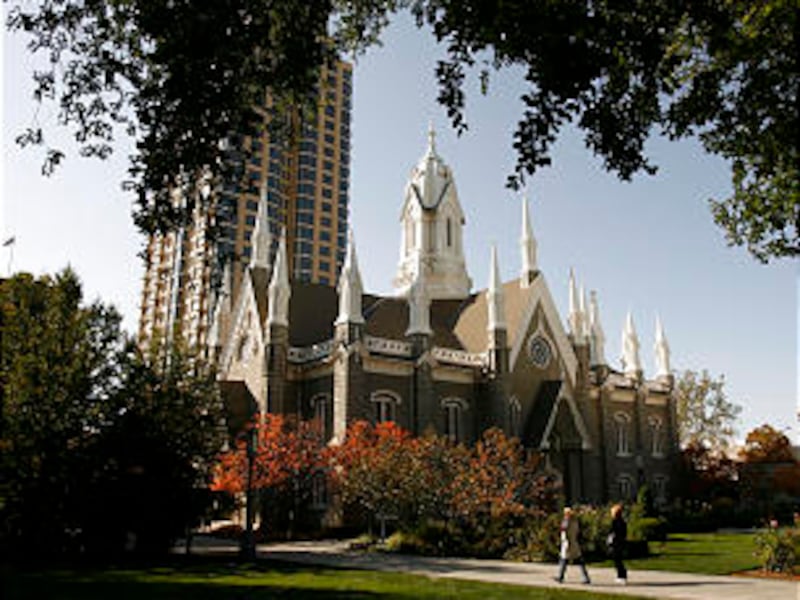
The gardens at Temple Square, the Conference Center and Church headquarters in Salt Lake City are undeniably something special. A visit to the gardens is more than a stimulating visual experience of floral colors, shapes and sizes. It's a feeling. The message of the Church is that Jesus Christ is the Savior, and the gardens invite His Spirit to be present. People come to the gardens to feel that Spirit. The caretakers of the gardens feel a responsibility to care for and beautify the grounds of the Church that bears His name. President Spencer W. Kimball said, "Now we ask you to clean up your homes. … We urge each of you to dress and keep in a beautiful state the property that is in your hands" (Conference Report, Oct. 1974).


Eldon Cannon, group manager of Ground Services for the Church leads a team of full-time gardeners who take care of all the gardens at Temple Square and Church Headquarters. "I believe in the message we are trying to create at the gardens. I believe that the work matters," said Brother Cannon. "The message of the Church is Christ-centered. The gardens surround and point to the temple and the blessings that are available there. The secret of the spirit present here is Jesus Christ. The workers and volunteers who operate here love and believe in what they do."


Origins of the gardens at Temple Square go back to a story told about a Church leader who traveled East to visit the World Exposition in 1893. During his visit he saw some beautiful, grand elm trees. Desiring the same type of trees to exist on Temple Square, he arranged for elm trees to be planted that still exist today along the central walkway through Temple Square. Over the years, the grounds on and around Temple Square began to be beautified and enlarged. At one point there was even a green house attached to the temple.


Today, the gardens are a highlight for visitors and locals who come to the downtown Salt Lake City area. From the visittemplesquare.com website it reads, "World-renowned gardens surround the 35 acres of the headquarters of The Church of Jesus Christ of Latter-day Saints. These gardens include 250 flower beds, more than 165,000 bedding plants, and over 700 varieties of plants from all over the world. The gardens are redesigned every six months and replanted by hundreds of volunteers."


The work and planning that go into the gardens is tremendous. The seven full-time supervising gardeners at the Church each have their own areas to watch over. They get to choose what flowers will be planted in their space. However, the gardeners do not change more than 10 percent of their gardens every year to keep a consistent feel. The Church operates four greenhouses that grow all of the flowers and plants that are needed at the gardens. There is even a trial space at the green houses to try new ideas before actually implementing them.


When it comes to planting season, large wheeled racks of flowers are wheeled in and popped out of their cartons. Using a technique called "tossing," gardeners throw different kinds of flower packs onto the beds in a natural flow to coordinate growing. Flowers never appear in single, neat rows containing the same type. "We use a technique of organizing the gardens called skeleton, tendon, flesh," said Brother Cannon. "This is a process that develops the garden bed like a body. First a core group of flowers are planted that represent the skeleton. Add to that more flowers as tendons on the skeleton, and a final set of flowers are planted to flesh out the remaining space. The process limits attention that may be drawn to single flowers that are struggling or dying."


Another technique that is utilized in the gardens of the Church is called the "piston effect." Like the pistons in a car that alternate up and down, the flowers and plants in the Church gardens grow or are trimmed back to highlight different growth cycles throughout the year. As one flower blooms (pistons up) and falls away (pistons down) another one in the same area is coming up just as its neighbor is coming down so interest is generated at all times.


Jennifer Udy, a full-time gardener at Temple Square, grew up gardening and believes a person should have fun doing it. She started as a part-time employee in the gardens and eventually went full-time while completing a four-year degree in horticulture through Utah State University. "Good plants need good soil. You need to start at the ground up," said Sister Udy. "If you want to have a great garden, you need to start small, have success, grow and develop the garden and slowly increase its size so you don't get discouraged. Gardening is an experiment that you learn from and gain success with. People think gardens just happen. Gardens take time and effort to be successful. With a little time each day, a garden can look great."


According to Chicagogardens.com, rooftop gardens are one of the fastest growing garden trends in U.S. urban centers, and overseas they have been growing explosively for years. Because of the underground multi-level parking structures beneath Church headquarters, the gardens above qualify as rooftop gardens. Another interesting detail about the gardens between the Joseph Smith Memorial Building and the Church Administration Building is that if viewed from above, the garden bed shapes resemble the State of Utah.
"There are a lot of great stories about the history of the gardens," said Brother Cannon. "The honeysuckle trees or 'sweetheart trees' on the east and west ends of the Salt Lake Temple were donated by a couple in Salt Lake that had them growing on their property. The one on the east was destroyed by a tornado in 1999, but has started to grow back. Many couples married in the Salt Lake Temple had pictures taken on a bench that sat underneath the tree on the east. The tree on the west side still has a bench underneath it.


Another great story from the gardens is about a giant evergreen tree located at the entrance to Temple Square on the east side. It is a Cedar of Lebanon (Cedrus lebani). Anciently, wood from this type of tree was used in the making of King Solomon's Temple as mentioned in the Bible. A woman brought back a seedling from her visit to the Holy Land around 1949. It was planted at Temple Square and has been growing ever since. Every other Christmas season, it is dressed completely in red lights.

Without the help of volunteers throughout the year, the gardens would be much harder to maintain. At certain times during the year, volunteers come and help plant or pull out flowers. On Saturday, Oct. 15, a record number of 803 volunteers worked on the gardens. The number represents youth, families, single adults and their leaders from Layton to Provo. Dave Butler, a youth leader from the Layton Utah West Stake, said, "This is our third time serving here, and we're already scheduled for next year. This is a popular service project for our youth."

The gardens also benefit from service missionaries called to serve specifically at the gardens. Sister Wendy Douglas, a service missionary with the gardens, said, "I think its great to be able to say you've helped work on such a beautiful garden. Not a lot of people have that opportunity. If I could describe the gardens in one word I would call them 'celestial.' "
