





PROVO, UTAH
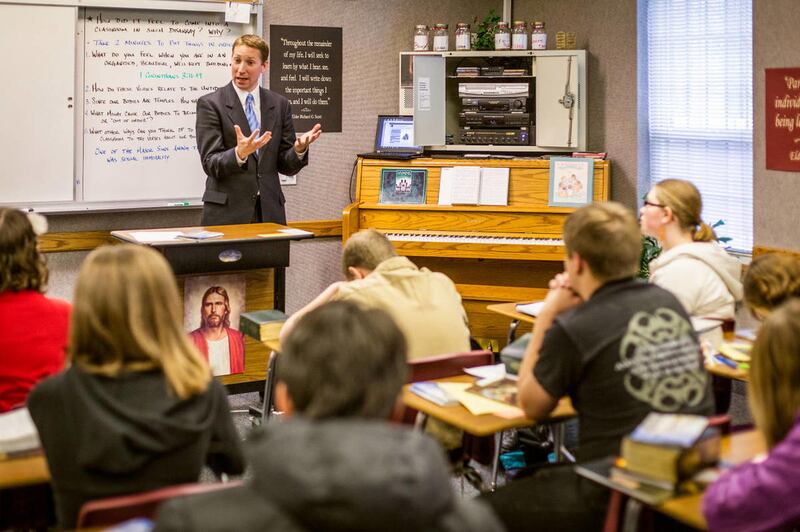
Speaking about the science of improvement and performance within a gospel framework, Scott R. Braithwaite, assistant professor of psychology at BYU, began his session at BYU Campus Education Week by using a story about President David O. McKay.
The context of President McKay’s comments were directed to a group of brethren in the Physical Facilities Department of the Church doing some work outside his Hotel Utah apartment in 1965. President McKay stopped to explain to the men the order of questions the Lord would ask during a person’s end of life personal priesthood interview to account for earthly responsibilities.
The questions dealt with the following:
Accountability report for relationship with wife. Accountability for each child. Accountability for what was done with talents. Give a summary of service callings. Questions regarding honesty in all dealings.
Contributions to community. Continuing his presentation with the parable of the talents in Matthew 25, Brother Braithwaite explained that a talent was a sum of money equal to about twenty years of work. Even though the servants in the parable were given different numbers of talents, a single talent still represented a large sum. Several conclusions were drawn:
God gives us what we need to do His work. All are expected to increase their talents, even though the servants in the parable had not been explicitly told to do so. More was expected from those who were given more. Simply staying the same because of fear was viewed as wickedness. We will be judged how we use our talents.
He shared a quote from President Spencer W. Kimball that said, “God has endowed us with talents and time, with latent abilities and with opportunities to use and develop them in his service. He therefore expects much of us, his privileged children” (The Miracle of Forgiveness [1969], p. 100).
“Think of someone in the world who is the very best at something,” said Brother Braithwaite. “What qualities do they possess?” The audience responded with some ideas: someone must be passionate, persistent, have challenges to overcome, is willing to sacrifice and have a high-degree of self-management.
K. Anders Ericsson, a psychology professor at Florida State, where Brother Braithwaite received his Ph.D., did studies on the deliberate practice of the acquisition of expert performance or, in other words, how people get really good at stuff, said Brother Braithwaite.
“What his research discovered was that innate ability had little to do with what made a person an expert performer,” said Brother Braithwaite. “If you are within a normal range of ability, intelligence doesn’t determine destiny.” To develop world-class expertise at something, the time needed is ten years or 10,000 hours of deliberate practice.
Deliberate practice is defined as something that pushes the limits of people’s abilities by requiring them to do something they cannot do yet. “Many times we spend our time doing things we are already good at,” said Brother Braithwaite. “A lack of deliberate practice will cause a person to level off. … Deliberate practice is so intense you can only do it for one to four hours a day. It also involves seeking critical feedback targeted at improvement from an unbiased mentor.”
A study of students at the Academy of Music in Berlin was set up to determine what separated the best students from the average students. All of the students were extremely talented. “The key was not how many hours were spent in total because they all spent the same amount of time,” said Brother Braithwaite. “The key was how they spent their time. Elite performers spent 3.5 hours practicing alone and the lowest skilled musicians spent 1.5 hours.” The best students also worked in two defined periods at a deep level and took a nap and rested in between periods. The worst students were busy all day, never rested and never got intense, deliberate practice.
He then related this deliberate practice to a person’s constant need for growth in the gospel through repentance. “For I remember the word of God which saith by their works ye shall know them; for if their works be good, then they are good also” (Moroni 7:5).
But too often some members do not engage in the plan of salvation the way they should. They are not diligent in the things the Lord would have them engage. Satan distracts them with the things that keep them busy, and they fall asleep to what is important, said Brother Braithwaite. One of the most important things in life is to determine what matters most, so precious time isn’t wasted on things of little worth.
Brother Braithwaite shared Nephi’s words about Satan’s distractions. “O that ye would awake; awake from a deep sleep, yea, even from the sleep of hell, and shake off the awful chains by which ye are bound, which are the chains which bind the children of men, that they are carried away captive down to the eternal gulf of misery and woe” (2 Nephi 1:13).
To assist the audience members with finding what is most important, Brother Braithwaite talked about the pattern of developing Christlike attributes from the manual Preach My Gospel (p. 126). He asked, “What Christlike attributes do you need to develop more fully?” To develop an attribute he suggested following these guidelines:
Deconstruct the attribute by defining what it looks like. Get a “mentor” and become aware of your blind spots. Develop a specific game plan and work on one thing at a time. Realize that as a person makes progress, models show that things start slow in the beginning and then move to a steep incline of growth where people can begin to see how much progress has been made, said Brother Braithwaite. During this whole time there will be opposition. “You can count on it,” he said, “but don’t let that discourage you. Remember the unprofitable servant who let fear rule over his progression so he didn't do anything with his talent. Fear stops people. If you have to, fake it until you become it.”
rmorgenegg@desnews.com @mreggman
