




Lyman Littlefield was a 14-year-old boy who was permitted to be part of Zion’s Camp 1834 march to Missouri but was often told he was too young and too small to participate in some of the activities.
Once told he couldn’t be part of a military parade, the young man sat sulking by himself. At one point, Joseph Smith strode by in a rush —but stopped when he noticed Littlefield.
“I know not the motive, but that man, who to me appeared so good and so godlike, really halted in his hurry to notice me, only a little boy,” Littlefield wrote of the experience. “Placing one of his hands upon my head, he said, ‘Is there no place for you?’ This recognition from the man who I then knew was a prophet of God created within me a tumult of emotions. I could make him no reply. My young heart was filled with joy to me unspeakable.”
The brief interaction wasn’t anything grand or miraculous, but it meant the world to a young man who felt left out, said Matthew C. Godfrey, a historian for the Church History Department and a general editor of the Joseph Smith Papers.

“All he did was notice that Lyman didn’t feel part of the group. So he went out of his way to go and talk to Lyman and help him feel included,” Godfrey said. “This is one of the characteristics of Joseph Smith.”
The insightful account from the life of Joseph Smith was one Godfrey shared while speaking at a Latter-day Saint devotional in Palmyra, New York, on Wednesday, June 7.
Godfrey was accompanied by Ryan Saltzgiver, a historian for the Church History Department, who informed the audience about the Church’s Hill Cumorah reforestation project.
Godfrey’s message related to the Joseph Smith Papers comes just weeks before the publication of the final volume in the series.

Learning about Joseph Smith
Godfrey has worked as an editor on the Joseph Smith Papers project for 13 years. After providing a basic explanation of the monumental project, he spoke on the topic, “Insights into the Life and Character of the Prophet Joseph Smith.”
“I’m often asked, ‘What have I learned about Joseph Smith? Or who is Joseph Smith to me?’” he said. “So what I would like to share with you tonight are some insights that I have learned about who Joseph Smith was as a person. ... They are ones that have been particularly helpful to me in my life. I hope they will be helpful to you as well.”

Godfrey cited descriptions of Joseph, as well as stories that illustrate some of his characteristics. The historian prefaced his remarks by emphasizing Joseph was not perfect, something the Prophet himself told the Saints several times. There are sections in the Doctrine and Covenants where he is chastised by the Lord for mistakes he made. “I’m glad when I mess up in life there is not a revelation from the Lord that has been published to the entire Church,” he said.
Similar to Littlefield’s experience, Godfrey told about Joseph Smith befriending his young cousin George A. Smith during Zion’s Camp. George, then age 16, wore glasses, was overweight and self-conscious about his appearance. The Prophet invited George in meetings with other leaders and gave him special responsibilities that helped him feel included. Years later, George was called as an apostle and served as a member of the First Presidency.
“Joseph Smith was inclusive and he tried to help people feel like they belonged,” Godfrey said. “What more can I do when I notice people who maybe don’t feel part of the group?”
Godfrey shared other stories that demonstrated Joseph Smith’s ability to admit when he made mistakes, his ability to forgive others and his unflinching trust in the Lord in the midst of great afflictions. These and other traits allowed the Lord to use the Prophet as an instrument to usher in the Restoration.
“He always tried to do what he believed God had told him to do,” Godfrey said. “And because of that, God was able to do a great work through the prophet Joseph.”
Hill Cumorah reforestation project
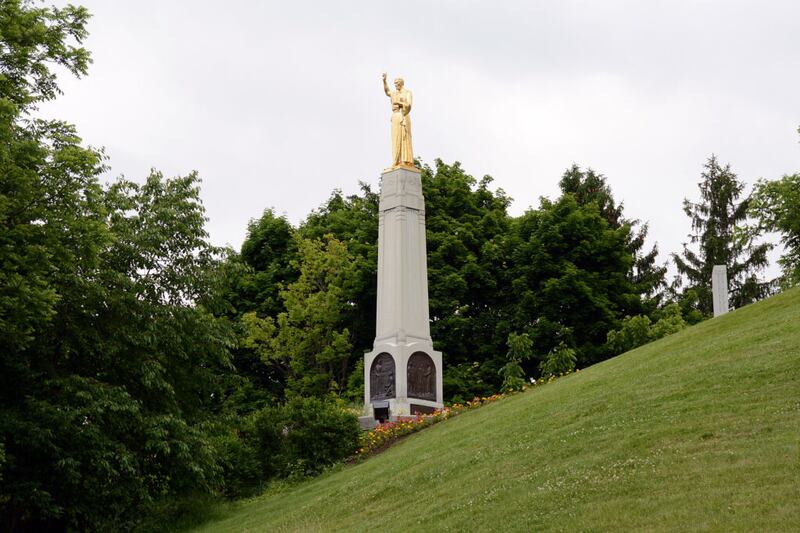
Prior to Godfrey’s remarks, Saltzgiver spoke briefly about the Church’s reforestation project at the Hill Cumorah historic site and visitors’ center.
The Hill Cumorah is where the Angel Moroni delivered to Joseph Smith an ancient record from which he translated the Book of Mormon.
“This is an opportunity for us to see that hill as a sacred place, where we can contemplate the beauty of the Restoration and the wonderful things that the Lord has given us there,” Saltzgiver said.

So far crews and volunteers have done the following:
- Removed pageant-related infrastructure and all other non-historical facilities.
- Rehabilitated some trails and the monument, including the addition of new benches and access to the top of the hill for people in wheelchairs or who need a ride in a golf cart.
- Improving some of the wayfinding and interpretive signage to help people navigate the hill.
- Regilded the Angel Moroni.
- Planted thousands of seeds on the hill to start the reforestation process. Wild grass and flowers are also growing on the hill.
Obviously, Saltzgiver said, the reforestation project will span many years.
“When we’re talking about reseeding an old growth forest, this is something that is going to take a little while,” he said. “The hill, for a little bit, may go through what we would call a shabby teenage phase, where it’s a little unkempt, a little wild for a little while. Then it will reemerge as the old growth forest that it once was.”
