



The huge, new Conference Center pipe organ now being built is expected to be a hallmark in organ design and engineering, just as the various organs in the Tabernacle were in their time.
"Nothing quite like this has ever been attempted because there is no room anywhere that is quite like this one," said John Longhurst, Tabernacle organist.
The new organ will have a 5-manual console, 130 ranks of pipes and 7,667 individual pipes and will have some non-pipe sounds such as chimes, bells, harps and celesta. By comparison, the Tabernacle organ has 206 ranks of pipes with 11,623 individual pipes.
"A job like this comes to an organ builder just once in a lifetime," said Jack M. Bethards, president and tonal director of Schoenstein & Co., of San Francisco, Calif., which holds the contract for the new instrument. "The full capacity of the Schoenstein plant is now dedicated to this job, and several other firms are involved in providing specialized components for the organ."
He described the sound of the Schoenstein organ as having "a rich, mellow warmth that includes a wide variety of tone colors from the softest, most ethereal, to the fullest, most noble and thrilling sounds." His instruments, he said, are American Romantic with "an eclectic tonal approach that incorporates elements from the 19th and early 20th century European organ building practices."
While the Tabernacle organ was designed for the fine acoustics of the pioneer-made dome, the new organ will have to amplify its resonant tones into the vastness of the 21,000-seat Conference Center. While it is true that the new center has been designed and engineered by experts in acoustics, the very size of the center is the organ builder's biggest challenge.
"I can tell you what the organ is going to produce and it's going to be a glorious sound," said Brother Longhurst. "The great unknown quantity is the space in which it sits. An organ depends on the room to act as its sounding board." And he said, "the Conference Center is a work in progress."
"We are optimistic that all of the expertise, all of the engineering, all of the consulting, all of the planning, all of the interfacing that has taken place on this project over the last three years will come to fruition and bring about an incredible result."
A separate sound system for music will amplify the organ and the choir, he said. "This system consists of two technical towers in front of the room, supplemented by an Electronic Reflected Energy System that offers options for enhanced reverberation.
"With a choir of more than 300 singers, quite a healthy sound is required to be heard above them, so several large scale stops are included," he said. "We are optimistic that this organ will serve the musical functions required of it in this space of unprecedented size."
Because the building has to be complete before the organ can be installed, the organ will not be functional when the center opens next month. Rather, the installation will continue through the summer of 2000. The instrument should be heard for the first time during October general conference. Final regulation of each pipe for optimal volume, speech and tone quality will continue for another six months, bringing the work to completion in April 2001.
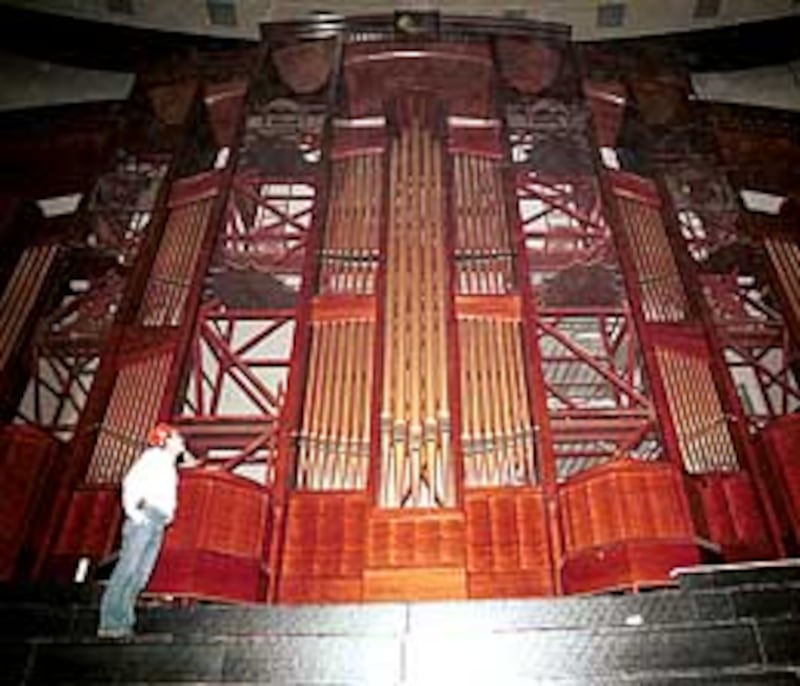
While the organ will not be installed by April 2000, the facade and case of the organ will be. A Salt Lake City company, Fetzers Inc., has constructed a massive cherry wood case for the display pipes. The case is 75 feet wide and 42 feet high. Of the 148 pipes in the facade, all but 20 of them actually speak.
Brother Longhurst said that the appearance of the organ will be as dramatic as its sound. All the veneer used on the case comes from a single cherry tree. The case, together with the sweeping pipe arrangement, will create "a grand effect."
Just as the pioneers turned to boat builders to design and build the curved roofs of many 19th century houses of worship, modern builders have turned to boat builders again, he said.
"Some of the curved areas on the facade were extremely complicated, involving compound curves like the hull of a boat. So a consortium of boat builders in Port Townsend, Wash., was engaged to construct those elements of the case."
Brother Longhurst said that the new organ will have expanded capacities from the organ in the Tabernacle.
"Because technology exists that did not exist then, we are able to do more things. For example, in the Tabernacle, when we're preparing an accompaniment or a new solo, we will frequently have one of the other organists out in the hall listening to the registration. He or she will listen to hear if the balance is correct, if everything sounds as it should. Ideally, you would like to go out there yourself and listen to what you're doing. With this organ you can. The organ has a playback feature that will replicate a performance."
Richard Elliott, also a Tabernacle organist, added that the console of the new organ has been designed to be similar to the Tabernacle organ "so it would require a minimal amount of adjustment when transferring a piece of music from the Tabernacle organ. Nevertheless, the sonic contrast will probably be significant, and will require a substantial adjustment."
Clay Christiansen, a Tabernacle organist, said that the new organ will have a variable tremulant that "allows the player to use his foot to increase or decrease the undulating speed of certain of the organ's more orchestral sounds." He said that the Conference Center organ will have a lower bass range than even the Tabernacle organ, "to a frequency of about 13 cycles per second."
Nothing, it seems is ordinary about the Conference Center and, certainly, the organ being installed is anything but ordinary.
