



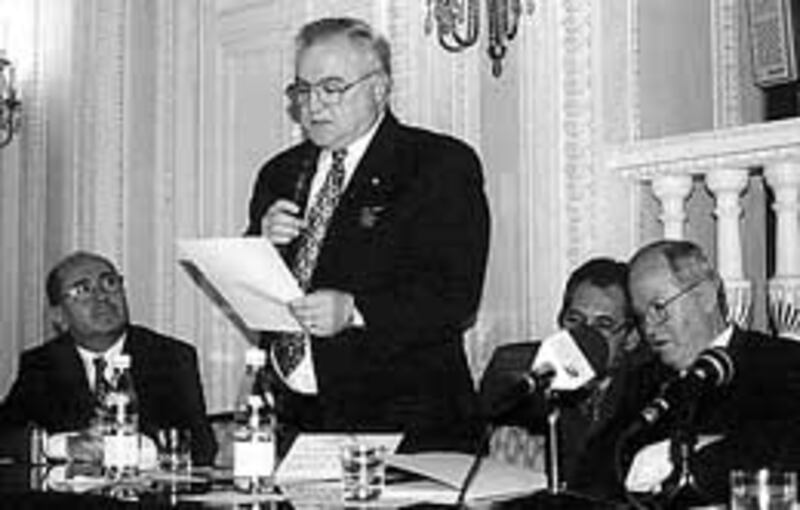
WARSAW, Poland — In the festive, ornate Baroque-era ballroom of Warsaw's Raczynski Palace, the contemporary home of the Polish National Archives, the famed Potocki Archive was returned to Polish officials by Church leaders in an emotional ceremony before an audience of more than 100 guests and news media on Dec. 19, 2000. The Potocki Archive, which documents the history of a powerful family in the Polish empire, is considered a Polish national treasure.
The Potocki family, which fled Poland during World War II, was one of the most prominent in the Hapsburg Empire which ruled much of Europe prior to World War I.
According to knowledgeable Polish historians, this archive constitutes a 7,500-document, 10,000-page treasure trove of historical records from the 15th through 19th centuries preserved by one of Poland's most famous, wealthy and influential families. Many documents are considered "priceless."
For the past 15 years, these stacks of aging pages were preserved in the vaults of Brigham Young University's special-collections library. The university bought the papers in 1985 from a Swiss document dealer. The papers, some of which were signed by Polish kings and included documents dating to the 16th century, were in good condition. At the request of the country, Church and university leaders made the decision to return the 93 bundled packages to their homeland.
Daria Nalecz, a noted historian of 20th Century Poland and current general director of the archive, said it was "one of the happiest days of my life," an event that "only comes once or twice during a person's whole career."
She described the richness and value of the collection and expressed the gratitude of the archives, the government and the Polish people for these documents. She praised the cooperative spirit of the members of the Genealogical Society of Utah with whom she had negotiated the agreement, as well as the generosity of the Church and BYU. She also expressed satisfaction that through this cooperation, the Genealogical Society would be able to acquire from the national archives important Polish family history documents of importance to the Church. The national archives, in turn, would obtain state-of-the-art microfilm copies of these documents.
Other Polish scholar-historians were also invited to participate in the event. Historian Professor Teresa Zielinska presented a brief overview of the Potocki family and its contributions to Poland and the Polish state. She described their power, wealth and service to the Polish crown and interrelationships with other prominent Polish royal and aristocratic families, as well as with the governments of Russia and Austria-Hungary that held sovereign power over most of the Potocki lands during the time of Poland's partition from 1795 to 1918.
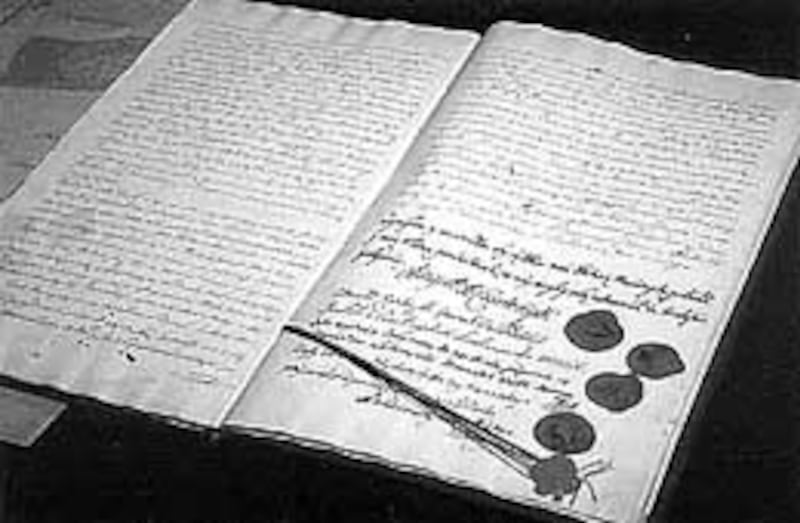
She was followed by Jaroslaw Zawadzki, an archive specialist on this collection and on the family seat at Lancut, the family's palatial residence, where the family presided over its vast holdings and gathered its archive, library and valuable art collection. He called attention to the origins and quality of the documents, using a few examples, including a letter from the Polish patriot, Tadeusz Kosciuszko, an American Revolutionary War hero, who sought to democratize Poland in the late 18th century and led a failed uprising in pursuit of his goal.
Mr. Zawadzki praised the Potocki family for its interest in preserving documents and noted that such family archives were unusually valuable in Poland because of its long years of dismemberment and partition. He also noted how there were no state and no institutions that would preserve its heritage. He then called attention to a selection of the documents on display in the room and the excellent condition of the collection.
Mr. Zawadzki's remarks elicited a vigorous and spontaneous response from two family members, Roman and Jan-Roman Potocki, who expressed gratitude for new knowledge about their family. They also expressed appreciation to the Church and Brigham Young University for buying, preserving and returning this part of the archive to Poland.
The Church was represented by Elder John K. Carmack of the Seventy and president of the Europe Central Area, President Douglas F. Tobler of the Poland Warsaw Mission, and Raul Rios, the European supervisor of the Genealogical Society of Utah. President Tobler, a BYU historian who had participated in BYU's purchase of the Potocki Archive, also represented the university.
Elder Carmack's presence was appropriate because of his well-known interest and love for history and documents, and for his years of service as Executive Director of the Church Historical Department. In prepared remarks he told of the Church's significant and long-term commitment to historical preservation, how Church pioneers brought the documents of the Restored Church with them across the plains to Utah — in two boxes — and how the Church, from the beginning, had actively supported the return of the Potocki Archive to Poland because "it was something from which all parties benefited," and because "it was the right thing to do."
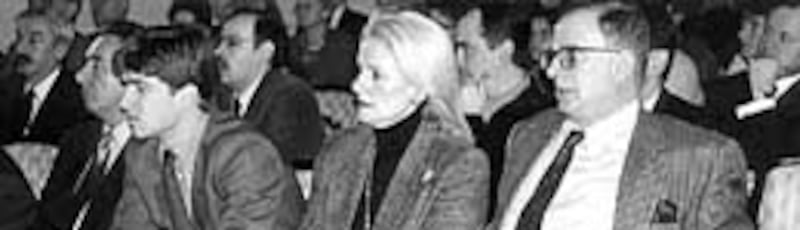
Elder Rios explained to the audience the purpose and work of the Genealogical Society of Utah, a matter many Poles have an interest in because of their fascination with family history as a hobby and from reading newspaper accounts of the Church's vast, worldwide microfilming program, including work under way in Poland.
"For this material, first of all, to still be in existence and then to be returned, has a great significance to the people of Poland," Brent Griffiths, Europe area manager for the Genealogical Society of Utah, said in a statement.
"These historical documents will help them have a sense of who they are, of their roots, of where they come from, of the challenges that their forefathers faced and the successes that they had as well."
The Polish National Archives has been scouring the world for papers that were scattered during World War II. They first became aware of the BYU collection during a visit in 1994 with a genealogy group. The documents were microfilmed before being returned to Poland so that BYU researchers could continue studying them.
