



On Oct. 15, Sea Trek 2001 made a donation of labor and love to the Church Humanitarian Center, donating 17 boxes containing more than 1,200 school bags and three dozen bandages for tropical diseases and leprosy. The items were made by dozens of Sea Trek participants while sailing slowly across the Atlantic Ocean in three tall ships.
The Church sends school bags to school children in underdeveloped countries and includes the breathable and washable bandages in disaster relief medical kits.
Working on sewing projects while on board ships has an immigrant connection. Church history shows that on many sailing ships, saints who emigrated to Zion in the mid-19th century occupied some of their trans-Atlantic time sewing tents and wagon covers to be used during the journey across the plains.
In that tradition, Sea Trek participants took needle and thread in hand to contribute to the Church's humanitarian work. However, they also served as crew on the sailing ships and did the service projects during sparse free time.
Church Humanitarian representatives in England arranged for a dozen bolts of heavy fabric and dozens of sewing kits with thread, needles, thimbles, draw strings, yarn and crochet hooks to be loaded on the Statsraad Lemkuhl, the Christian Radich, and the Europa at Portsmouth, England. Officers on each ship agreed to let the bulky materials come aboard, provided storage space, and showed interest in the projects as they progressed. First, the bolts of cloth had to be hand cut with scissors, using proper measurements for the school bags. Then the bags had to be stitched around two open edges, a draw string pinned around the top, and then the top sewed down over the drawstrings.
On the Europa, Becki Toone of St. George, Utah, was relieved from the twice-daily four-hour ship work shifts in order to coordinate the sewing projects. Most passengers on the Europa hand sewed school bags during the morning devotional, the daily Church history class, or the entertainment hour each evening. Sewing became competitive, with a daily tally posted on the main cabin blackboard. Ship crew members checked daily to see how the production was going.
No one could keep up with Sister Toone's husband, Paul, who hand-sewed 50 bags. During the nine-day sail from Portsmouth to the Canary Islands, the Europa passengers sewed about 200 bags. After that, the ship's Captain, Klaas Gaastra, permitted Sister Toone to use the ship's only sewing machine. With help cutting and pinning and inserting drawstrings, she and others produced another 425 school bags by the time the ship reached Bermuda 19 days later.
Also on the Europa, Dee McBride of Murray, Utah, crocheted some 20 bandages for leprosy patients. Five men on board crocheted or knitted at least one bandage — a four-foot bandage takes most people more than 20 hours to hand-produce.
On the biggest ship, the Statsraad Lemkuhl, from the start of the crossing, the captain let the company sew with the heavy duty sewing machine used to fix the sails, and the seamstress appointed on that ship machine sewed 600 school bags.
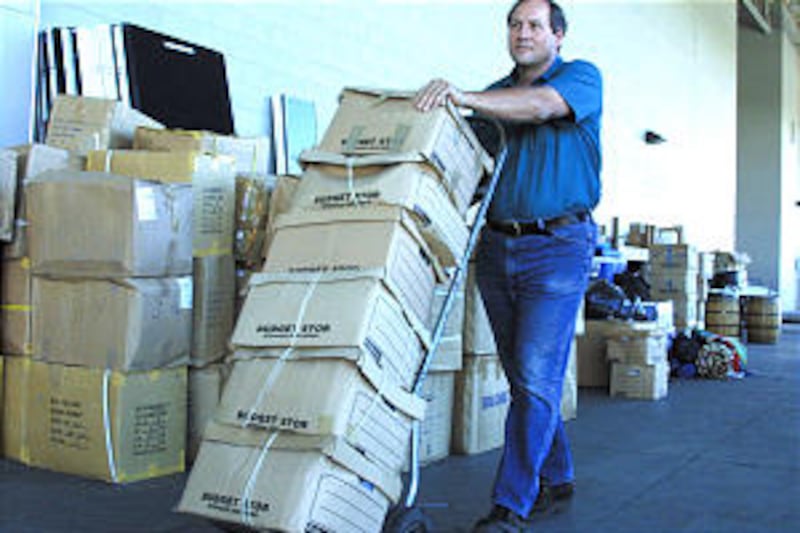
At New York, the 17 cartons of bags and bandages were transferred to a Sea Trek truck hauling materials to Salt Lake City, where the cartons were delivered Oct. 15 to the Humanitarian Center for distribution around the world. For Sea Trek participants, working on the bags and bandages was a labor of love and a chance to be of service even while "locked" away from the world in crossing the ocean.
