



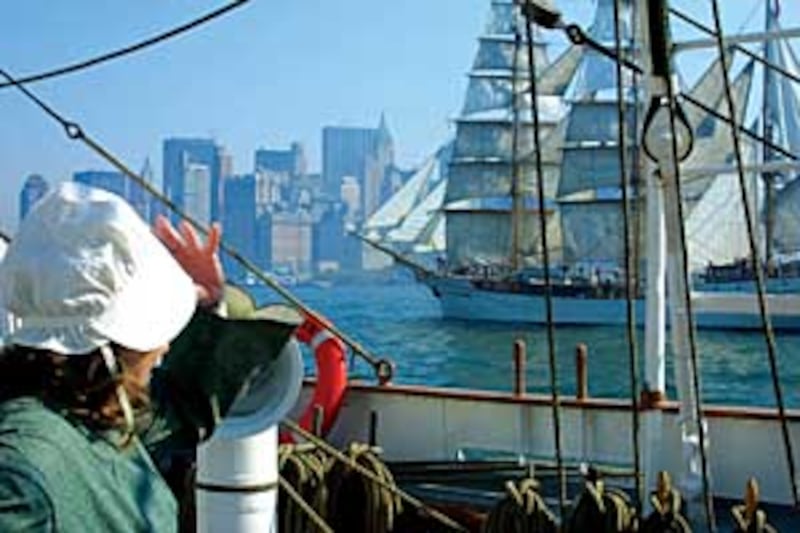
NEW YORK — Softly singing "America, the Beautiful," followed by a teary moment of silence in the early morning while anchored in New York Harbor near the Statue of Liberty, passengers aboard the Christian Radich culminated on Oct. 4 their Sea Trek 2001 commemoration of their ancestors' immigration to America from Europe and the British Isles.
The Radich was one of three Sea Trek ships that crossed the Atlantic.
Excitement began building aboard the Radich a day earlier with singing and dancing on the main deck beneath sprays of dark rigging and a broad path of moonlight. Some arose several times in the night to catch a first glimpse of the New York skyline.
Deep feeling was also added as the view of Manhattan opened through the heavy morning mist; it was minus its two most prominent towers. Grief for that scene was felt by many.
The moments of reflection were few, however, as the captain ordered all hands to help with sailing. Sails were hoisted, trimmed and tacked, rope coiled as the three ships paraded up the Hudson River, then turned and sailed back to the Museum of Intrepid Sea, Air and Space.
The ships proceeded to put on a show for New York. The Europa's sails were up and the Radich followed suit. The Lehmkuhl raised her sails and followed. At the mouth of the river, the three ships pulled even and sailed together into the channel with the great towers of New York in the background. Then the ships formed a line with the Statsraad Lehmkuhl in front and the Europa bringing up the rear.
Silence was observed as the parade passed the site of the World Trade Towers where a waft of dark smoke still hung and the wreckage could be seen through the haze from the river. The ships then hauled down their sails and pulled in at their docks, ending 59 days of an imaginative, daring commemoration of 150 years of Mormon immigration and leaving in its wake a place in Church history.
The commemoration, Sea Trek 2001, included eight tall ships gathering passengers in a dozen European ports. It also included three of the ships, crossing the Atlantic over a three-week period and arriving to media attention and ceremonies in New York.
Among the commemoration's most powerful impacts were the invisible cords of family bonds between passengers and their ancestors. These were tied as passengers experienced some of the same challenges of their forebears.
Dean May, a leader aboard the Christian Radich and a history professor at the University of Utah, observed, "We've had amazing experiences. We've seen some 200 people coming and going. We've had as many as 61 people and they have all gotten along extremely well."
He said most have been thrilled to be on board and "almost everyone has a shadow of the gathering and the gathered in their minds."
The Radich's captain, Gunnar Silfverborg Utgaard, said the passengers were very patient and polite.
"After weeks and weeks at sea, I would expect more internal friction among them. I am very pleased and a bit surprised at all their consideration under close and tight conditions."
The close and tight conditions aboard the ship led to many insights among the passengers. Esther Hebrew, 80, returned home aboard the Radich after serving as a health missionary in the Romania Bucharest Mission.
"It's been great, but we are sort of ready to be home," she said. "Every day I tried to associate what I do [with the tasks of my ancestors], and certainly they had no recreation in the ocean, or make-do swimming pool on deck as we did. My testimony has really grown that so many people came to a new land and accepted authority from the missionaries and then from their local leaders. And they often spoke different languages."
Also returning from a mission, Cynthia Ginn of Capistrano, Calif., experienced sea sickness on the way, and, she said, some homesickness. "The fact is that I am going home and I can't wait to see my family and friends. My ancestors were leaving never to see their friends and some family members again. It hits me harder to think of what they were leaving. I am very grateful for them."
The sense of isolation was graphically illustrated by the Sept. 11 tragedies. The first inkling they had of those events came from an e-mail, which was so bizarre they hardly believed it. Additional e-mails followed and finally a small photograph.
Their dependency on the weather was illustrated by the heat of the early trip when they slept on deck to escape the tepid heat in quarters. On Sept. 30-Oct. 2, the Radich was subjected to gale-force winds upwards of 50 miles per hour and the subsequent large waves. The passengers, who served as crew aboard the ship, climbed 100-foot rigging to haul in the sails. About a third to half of the passengers were down with seasickness for more than one day. (See related story.)
Sailing aboard a three-masted, fully rigged sailing ship with a mission to train its passengers in 19th-century nautical knowledge was an experience in itself. The passengers were divided into four-hour watches each 12 hours.
They steered at the helm, served lookout and safety watches, scrubbed the quarters, trimmed, hauled in, and raised sails, polished brass and coiled rope. Some worked on humanitarian projects provided by the Church.
The watches produced lasting friendships and, in the wee hours of the morning, dancing and singing.
Spiritual moments also developed. On Sunday, Sept. 30, as the wind was increasing and the seas grew rougher, a testimony meeting was held and passengers shared feelings.
Ilene Ferris of the Parleys 6th Ward, Salt Lake Parleys Stake, has 18 direct line ancestors who immigrated to America from Scotland, Denmark, Sweden and England. One Swedish family had a baby, a child and a teenager who died of measles during the voyage across the Atlantic. A fourth had her sight impaired for life.
"Not having lost a child, I cannot totally put myself in their shoes," she said. But she did experience some seasickness and "I can empathize with the seasickness, and the bad water and not being able to eat, and can understand why my Scandinavian ancestors did not write about it. It was so difficult they did not want to tell about it."
Jan Doornbos of the Copperhill 6th Ward, Hunter Utah Copperhills Stake, and his son, Israel Curtis, joined Sea Trek in Portsmouth, England. An immigrant from the Netherlands, he learned of Sea Trek and it triggered his emotions because of his European connections, including service in the Dutch Navy and a mission to England.
"To be on a tall ship with its many, many sails up and steering the ships and the wind pushing you forward over the ocean is an incredible feeling."
E-mail: jhart@desnews.com
