



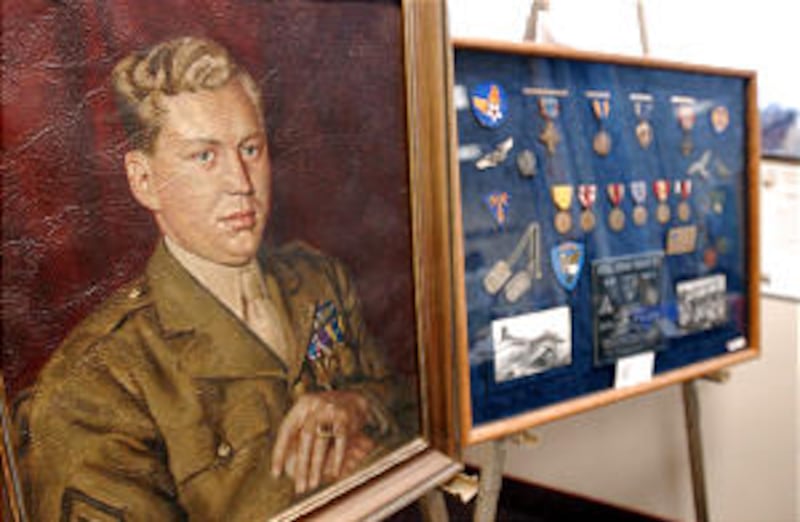
For Irel Barrus, the BYU Saints at War conference Nov. 10 was a time to remember.
A time to remember the 17 months and three days he spent in Europe during World War II. A time to remember his infantry march across France and his service in the Battle of the Bulge in Belgium. A time to remember both the physical and emotional wounds he received in action.
Mostly, it was a time for him to celebrate the faith and hope that sustained him during the worst world war in recorded history.
More than 300 Latter-day Saint WWII veterans gathered for the first conference — held one day before Veterans Day, weeks before the anniversary of Pearl Harbor and at a time when the United States is again at war.
The conference highlighted the two-year effort by BYU Church History professors Robert C. Freeman and Dennis Wright to gather letters, journals, photographs and verbal or written accounts of the war — many of which servicemen had never shared even with their families.
The team worked not only to document the experiences of Church members involved in the war, but also to identify what set Church members apart from other soldiers — the missionary work, the priesthood in action and the humanitarian efforts. They wanted others to know that Church meetings were held in foxholes, that one American soldier marched across Germany humming "Come, Come, Ye Saints" in a vain effort to identify German members serving in the German Army, and that a group of Latter-day Saints desperate for more favorable circumstances built their own chapel in Italy. They want Church members to know that veterans like E. James Carlson took the sacrament from .50-caliber shell casings on makeshift benches under shelters made from tarps.
They wanted Church members to know that amidst war, many LDS soldiers actually found peace.
In spite of "the awfulness of what they dealt with, they came home and raised families, had successful careers, became grandparents and temple workers," said Brother Freeman. "Their faith in God saw then through and let them move beyond that."
World War II began Sept. 1, 1939, when Nazi Germany invaded Poland. Two days later Britain and France declared war on Germany. Then in December 1941, after the Japanese attack on Pearl Harbor in Hawaii, the United States entered the war. At the height of the war, an estimated 100,000 LDS servicemen, from numerous countries, fought on both sides of the battlefield. An estimated 5,000 LDS servicemen were killed in combat.
Most veterans attending the conference had contributed to the project: an archive in the L. Tom Perry Special Collections Library of the BYU Harold B. Lee Library now houses more than 1,000 accounts. As a result of the project a book, Saints at War: Experiences of Latter-day Saints in World War II, includes more then 200 stories and hundreds of images and a KBYU Saints at War documentary will air on both KBYU and on BYU-TV.
Brother Freeman and Brother Wright said they felt an urgency to preserve the stories of LDS veterans; more than 1,100 American veterans are dying each day. The Saints at War project is in partnership with the Veterans History Project, a larger effort being undertaken by the Library of Congress.
During the daylong Saints at War conference, Elder Marion D. Hanks, an emeritus General Authority, offered the keynote address. Quoting Alma 60:36, "I seek not for power, but to pull it down. I seek not for honor of the world, but for the glory of my God, and the freedom and welfare of my country," Elder Hanks drew similarities between the Book of Mormon prophet and the Latter-day Saints who fought in WWII.
Andrew C. Skinner, Dean of Religious Education at BYU, added that the conference was not held to glorify war. "But I think we can be grateful and we can articulate that gratitude every day of our lives because our freedoms have come at the expense of others."
He paid tribute — with the veterans and their families in attendance — to both the living and the dead, both men and women, both Allied and Axis soldiers, and both officers and enlisted personnel.
Irel Barrus traveled from Pittsburg, Calif., for the conference. His daughters, Leslie Becker of San Antonio, Texas, and Delayne Wilson of West Jordan, Utah, joined him there. They wanted to learn more about the war that shaped their father's life. They are glad his experience is preserved at BYU for future generations.
While Brother Freeman and Brother Wright will continue to collect World War II accounts, they now plan to shift their focus to LDS veterans who served in Korea and Vietnam. Brother Freeman said the project has given him a deep appreciation for all veterans.
"They are the heroes I heard about and learned to love but never met," he said.
E-Mail: sarah@desnews.com
