



KIRTLAND, Ohio — If Kirtland — a once-bustling frontier community that rivaled Cleveland in the 1830s — had developed in recent decades like surrounding communities with shopping malls and tract homes, important Church history sites would likely have been disrupted or destroyed, making any restoration effort impossible.
Yet, these historic sites — some long since covered with mud — have remained generally untouched by development, said Steven L. Olsen, chairman of the Kirtland historic sites restoration project, making it possible after all these years to re-create elements of Kirtland the Prophet Joseph Smith would have known.
The restoration is timely since the city of Kirtland is considering installing a sewer system that will likely attract new development, Brother Olsen said. "These sites could have been lost if the Church had not already devised a four-part restoration plan."
Two phases of the project have been completed, with the third to be completed next spring, and the fourth in 2003.
The first phase was completed in 1984 when President Ezra Taft Benson dedicated the restored Newel K. Whitney store located in historic Kirtland known as Kirtland Flats. Here the School of the Prophets was held and 17 sections of the Doctrine and Covenants were received. It also served as the headquarters of the Church while the Prophet Joseph Smith and his family lived there.
The second phase of the restoration plan was completed Oct. 28, 2001, when President Gordon B. Hinckley dedicated the John Johnson farm in Hiram, Ohio. The site is prominent in history as the location where the Prophet received 16 revelations while living there, including Section 76 of the Doctrine and Covenants. (See "John Johnson home will have place in history," Church News Nov. 3.)
The third phase of restoration is expected to be completed in the spring of 2002. It includes construction of a new visitors center, restoration of the Whitney home and reconstruction of the John Johnson Inn originally located across the street from the Whitney home on Chillicothe Road.
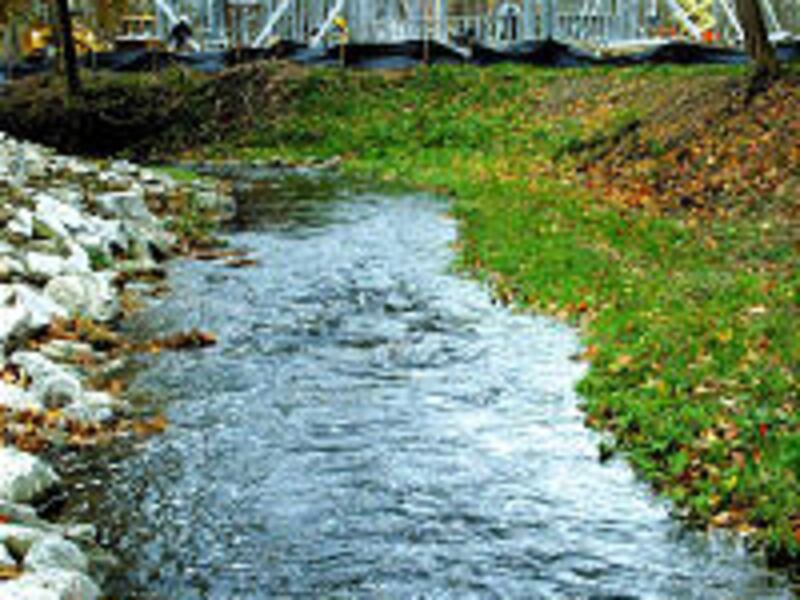
The visitors center will be representative of the buildings of the 1830s when many mills were situated on the Chagrin River.
From the large picture windows in the visitors center, visitors will overlook a branch of the Chagrin River. Visitors will also view the site of the original sawmill used to cut lumber for the Kirtland Temple, and the ashery used to make soap.
The inn was originally built in 1813 by Peter French, a large land-owner and distiller in the Kirtland area. With the proceeds from the sale of the Johnson farm, the Church purchased much of French's holdings in 1833. The inn was given to Johnson as his stewardship.
The inn was destroyed by fire in 1914. Later, a gas station and a tavern were built on the site. Researchers were able to pinpoint the location by using historical photographs. While the ground had been disrupted, the foundation was sufficiently preserved to identify the specific size and shape.
Phase four of the project calls for replicas of an ashery, sawmill and schoolhouse to be built with an anticipated completion in 2003. Each building figured prominently in history. Exact locations were unknown until researchers began digging a few months ago. After excavating about four feet, a rock foundation and wood flume of the sawmill were found, as well as the foundation of the ashery.
Also, the construction of a new road diverting traffic around the historic sites was opened Aug. 1. The road has made the area safer for visitors and more conducive to the spiritual message of the vicinity. It was a 10-year project that required cooperation from city, state and Church leaders.
Prior to the new road, two major roads converged at a four-way stop in front of the Whitney Store creating noise as well as safety and pollution concerns.
"Some pass through Kirtland thinking they can see all there is to see in only several hours," said Elder David Brown, director of the visitors center. "But with the new restorations, visitors will want to schedule several days."
E-mail: shaun@desnews.com
