



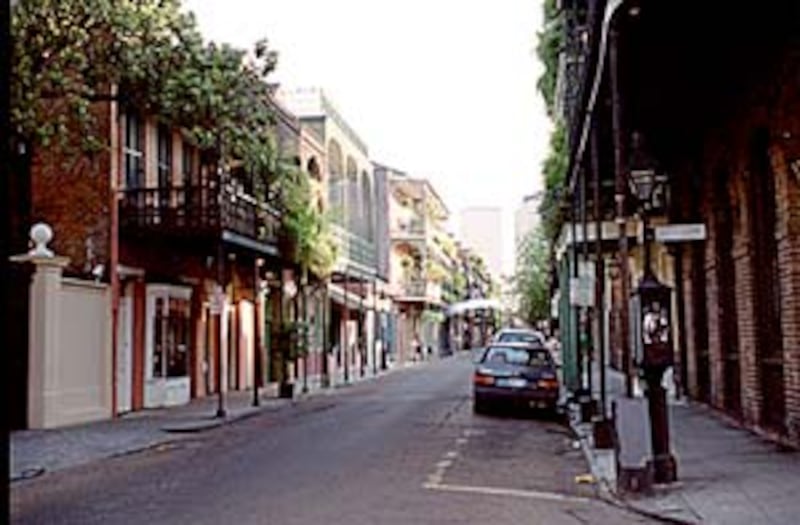
From across the Mississippi River, LaMar T. Merrill looks to the New Orleans French Quarter.
This is probably where some early Church agents stood, watching for steamboats carrying Latter-day Saints immigrating West, he says. The French Quarter, he continues, looks much the same today as it did then.
As historian of the New Orleans Louisiana Stake, Brother Merrill has spent the last three years reading historic journals and letters, studying maps and photographs and interviewing the stake's pioneer members.
But, he says, so much of the history can be captured from this place, where steamboats that now carry tourists still ply the river.
From 1841 to 1855, more than 17,000 Church members arrived in New Orleans — the port of entry for saints emigrating from Europe. Most then traveled up the Mississippi to St. Louis and on to Nauvoo, Ill., or later the Salt Lake Valley.
Church agents helped orient the new members, warned them of local thieves, showed them to the Customs House, and secured for them a steamboat to go up the river.
Some early members, Brother Merrill said, never left the boat. Others found their way to the French market, which had been part of the city since the 1700s, eager to buy fresh vegetables. A few even stayed in New Orleans, attending a small branch of the Church made up for the most part of immigrants detained in the area by lack of means to continue the journey.
"It is incredible," says Brother Merrill. "Life in the French Quarter really hasn't changed much. . . . At Christmas time we come here to buy the yule log. . . . For New Year's, we buy cream puffs."

Driving through New Orleans, Brother Merrill can point out where early missionaries — sent by Joseph Smith at the request of two members in New Orleans — rented a room over the Mechanics Exchange for the Church to meet.
He can point out the building near Jackson Square, where Church agents rented an office. He drives by the Customs House and by an area named Brigham's Court for Brigham Young.
However, the Church's second prophet probably never visited New Orleans, Brother Merrill explains. "Brigham Young sent some people here to buy some supplies. He may have ordered some metal and iron work." But because of rumors, the name stuck.
While working on the stake history, Brother Merrill has also learned about the places where early members would have attended Church, of the hard benches they sat on and even of the egg carton some used as a sacrament tray.
He has read of LDS women who were pulled into the Mississippi River while trying to get water; of the 90 saints who died just north of New Orleans when the boiler on the steam boat Saluda exploded; and of the Church agents who lived in New Orleans, but never fell victim to cholera or yellow fever like so many residents of the city.
And for him the journey early members took up the Mississippi through his hometown is not just historical, but also personal.
A descendent of John and Janet Kerr Stoddard who traveled from Scotland through New Orleans in 1848, Brother Merrill still has a trunk and other items probably carried by his third great-grandfather on that journey.
After arriving in Utah, John Stoddard died. But his son, David, started a furniture factory in Cache Valley, Utah, and eventually founded a sawmill in Rexburg, Idaho.
Looking at the lives of his ancestors, and hundreds of other Church members, Brother Merrill thinks of the account where locals in New Orleans in the 1850s called Church members "lowlifes" that wouldn't amount to anything. Then he thinks of the Church today that has more than 11 million members worldwide and where in Louisiana there are more than 25,000 members, seven stakes and a temple.
E-mail: sarah@desnews.com
