



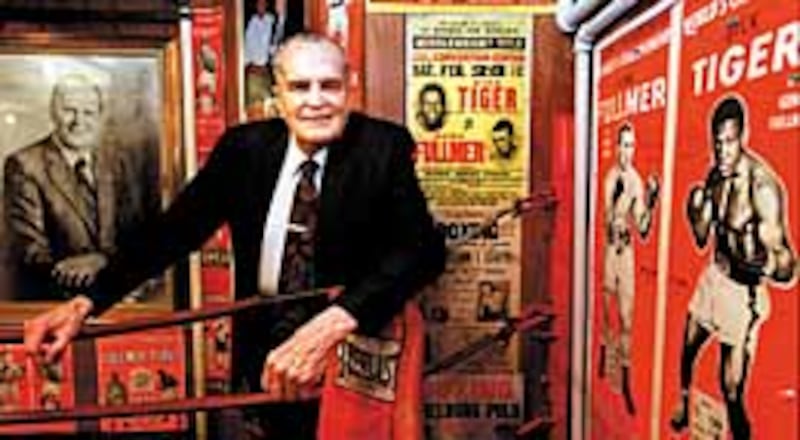
In his mind's eye, Marv Jenson witnessed scores of joyous Nigerian faces when he heard the news of the revelation to President Spencer W. Kimball in 1978.
That happy June 1 manifestation meant every worthy male member of the Church could hold the priesthood. For the first time, all the people of the world could participate fully in the gospel. Like thousands of others, Brother Jenson had spent years prayerfully anticipating such news.
He had come to love Nigeria and her people in a roundabout way in 1963. At that time he was a celebrated boxing manager traveling to western Africa with his fighter, Gene Fullmer, a Church member.
Fullmer had fought Nigerian Dick Tiger twice in the United States, losing his middleweight title in the first bout and battling to a controversial draw in the rematch. Jenson and the former champ agreed to fight in Tiger's homeland in hopes of reclaiming the world champion's belt. Brother Jenson had arranged a pre-fight visit to Nigeria to ensure the country was prepared for a championship prizefight.
He stopped by President David O. McKay's office prior to making the trip. As the manager of a famous LDS boxer from Utah, Brother Jenson was certain the Nigerians would ask him about the Church and why blacks could not hold the priesthood. He asked the prophet how he should respond.
Brother Jenson remembers President McKay taking his hand, looking at him squarely and answering without hesitation.
"He told me: 'You can tell them that they'll be able to hold [the priesthood] at some time — all worthy males will be able to hold the priesthood at some time, but no one knows when it will be."
A short time later, Brother Jenson found himself inside a Nigerian television studio being interviewed by the station owner about the prospective fight. Brother Jenson always traveled with a set of LDS scriptures. At the end of the interview, the owner asked him about his scriptures. The men talked about the holy books and the station owner was interested. He asked Brother Jenson where he could buy his own scriptures.
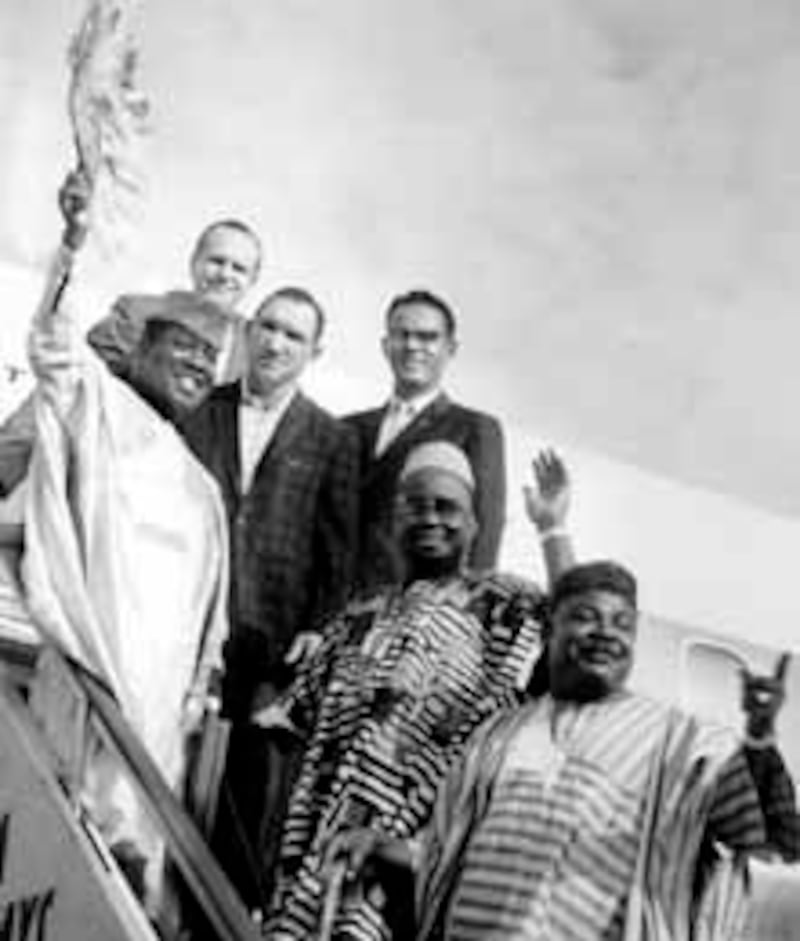
"Here, you can have mine," offered Brother Jenson. Then he repeated a prophet's words regarding the priesthood to the station owner.
"It was perfect what President McKay told me to tell him," Brother Jenson said. "The owner said, 'I'll buy that.' "
The fight was scheduled a short time later. Gene Fullmer and his entourage were received as heroes. The Nigerians would spot the American fighter and chant his name. A parade was held for the visitors in the city hosting the fight.
While preparing for the fight, Brother Jenson talked often about his faith.
"There were thousands of Nigerians who were calling themselves Mormons," he said. Many asked him about appropriate songs to sing. Brother Jenson promised to get them LDS hymnals.
The emergence of the Church in western Africa is a fascinating account. E. Dale LeBaron, a BYU professor and an authority on the history of the Church in Africa, said during a Nov. 3, 1998, BYU devotional that many Nigerians, along with fellow Africans from Ghana, had requested information about the Church in the 1960s. Some asked for baptism. They were told: "The time is not yet. You must wait," Brother LeBaron said.
"As they waited, they shared their knowledge and testimony of the gospel with others and organized congregations," Brother LeBaron said. "It was reported that in the 1960s there were over 60 congregations in Nigeria and Ghana, with more than 16,000 participants, none of whom were baptized."
Brother Jenson recalls the faithfulness of the Nigerian "Mormons."
"They didn't have the priesthood to bless the sacrament, but they held their meetings and were just waiting for someone to tell them what to do," Brother Jenson said.
The people "were just ripe" for baptism, he recalled. Still, he never sensed any hostility among the would-be Church members during his trip in 1963. "They were anxious to hold the priesthood, but they weren't having trouble over it," he said.
Gene Fullmer never regained his title. Brother Jenson stopped the bout after his fighter suffered a nasty cut near his eye. The group returned to Utah without a champion's belt, but Brother Jenson remained hopeful of a bright future for the Church in Nigeria.
Like thousands of others, he rejoiced over President Kimball's 1978 revelation allowing his Nigerian friends and millions of others the opportunity to enjoy all the gospel's blessings.
"It was great," Brother Jenson said. "I just recall every second of it."
E-mail: jswensen@desnews.com
