



Just as Western television was coming to the Pacific island nation of Fiji in 1995, Harvard researcher Anne Becker jumped at the opportunity to study how media affect the self-image of teenage girls.
She understood the Fijian culture and had been working in the country since 1982. She observed a people that celebrated healthy appetites and showed great concern for those losing weight.
She believed Fiji housed an environment that would be untouched by excessive dieting; 2,000 years of tradition and an appreciation for robust body types backed her up.
So in 1995, before network television saturated the island nation, she talked to school girls, documenting their attitudes about the body and dieting. Three years later she went back and did the same thing.
"I expected to find no effect of media on girls," said the assistant professor of psychiatry and medical anthropology at Harvard Medical School.
Instead, 62 percent of the Fijian high school girls she interviewed in 1998 reported dieting, citing the things they saw on television as the major motivator to rebel against a culture where dieting was historically unheard of.
Those who watched television three nights per week were more likely to see themselves as too fat and more likely to diet. And from 1995 to 1998 the percentage of young women who induced vomiting in order to become thinner jumped from zero to 11 percent.
"Suddenly, it was as if someone pulled blinders off them and said, 'Look, you are fat. You don't measure up,' " said Dr. Becker, director of research at the Harvard Eating Disorders Center.
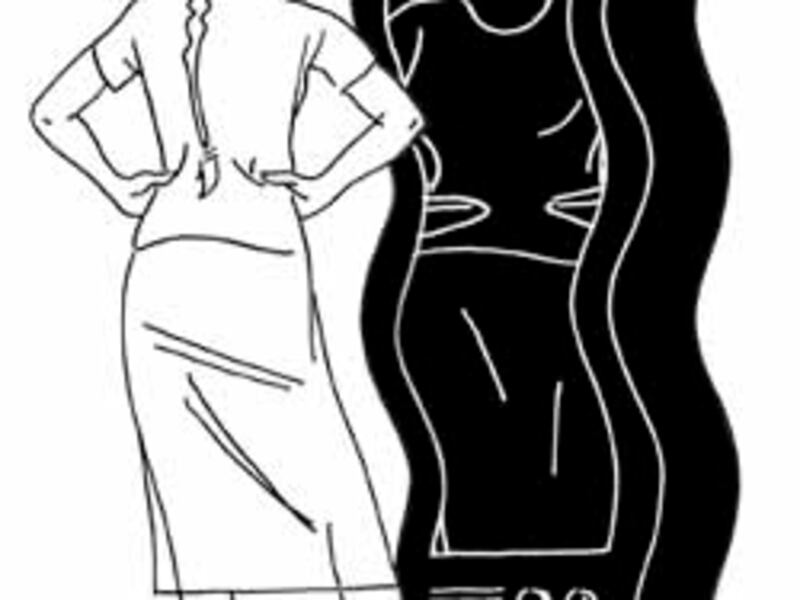
Media — which every year seem to portray thinner and thinner women as beautiful — clearly have an effect on the way people look at their bodies, said Diane L. Spangler, a BYU professor of psychology. The media portray the image that "in order to be happy and have good relationships, I need to be thin."
Young women in the Church, she added, are not exempt from letting societal pressures dictate their body image.
"LDS men across the board have a higher body satisfaction than non-LDS men," she said. "[The Church] has a pretty pro-body doctrine. It seems like the doctrine affects the men. But for women the societal push is so strong."
She said college-age women are at elevated risks for developing an eating disorder in a quest for thinness. Among high achieving women attending a competitive university such as BYU, the rate of unhealthy self-images is even higher.
"Not everyone will look the way the media talk about thinness," she said. "Nor is that consistent with our doctrine."
Dr. Spangler said that her research indicates one of the things that moderates the effects of the "thin ideal media" are parents and peers. How much parents adhered to the thin ideal matters, she said. Young women whose parents encourage them to lose weight are at a higher risk to develop eating disorders than those whose parents don't. Young women who feel like they are supported and valued inherently are at a lower risk of eating disorders.
It seems natural for parents and Church leaders to talk to their children about the lack of morality, tasteless language and immodest dress, or the use of alcohol portrayed in the media. However, Dr. Spangler emphasized, "We need to go an additional step." Parents need to talk to their children about how they feel about the way they look.
A telephone poll by People magazine in late 2000 surveyed 1,000 women, asking about their bodies and how the images of Hollywood's stars influenced their self-esteem. Only 10 percent of the respondents said they were completely satisfied with their bodies and 80 percent said the images of women on TV and in movies, fashion magazines and advertising made them feel insecure about how they look. (People, Sept. 4, 2000.)
After years of research and working with the Harvard Eating Disorders Center, Dr. Becker said that, unfortunately, today there are still no easy answers to this problem.
Parents, she said, need to communicate with their children about the images they see. "A lot of young women take the images they see really concretely. They need to understand it in a context, to say this is not a realistic size or way to look."
Dr. Becker added that constructive dialogues about the media will help. "Maybe we need to start earlier," she said. "Maybe we need to advocate to the people who produce media that we would appreciate greater diversity."
Until that day, however, she said, it is unrealistic for people to totally turn off their televisions and put down their magazines. Instead, the world needs more people who can be television and magazine critics, who can interpret the images before them and put them into context. "It is part of our culture to enjoy that kind of entertainment," she said.
