


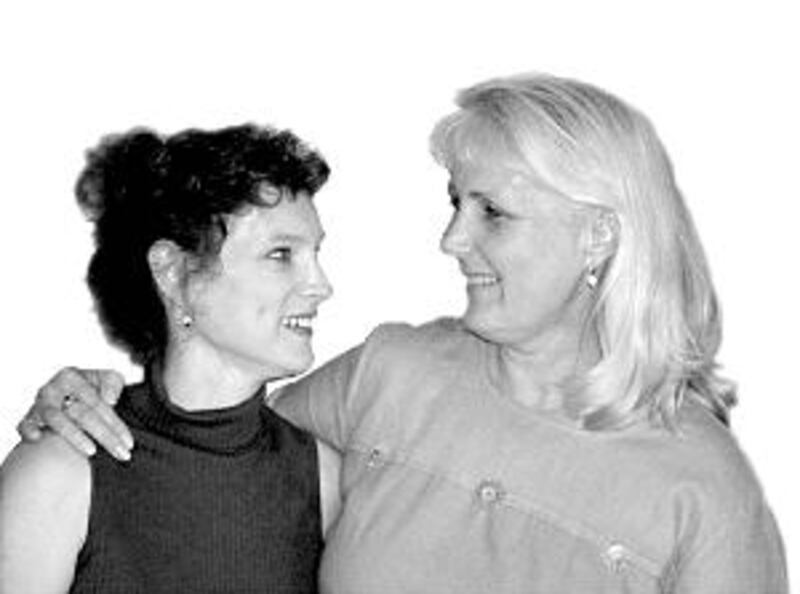
DALLAS, Texas — We are the most unlikely of friends, she and I: the Jewish physician from New York and the stay-at-home Mormon mom of six from Utah, both a long way from home in Dallas. If our friendship had been put through a computer matching service, I doubt we would have made it past the first hurdle.
I remember when Wendy Harpham's family moved to the neighborhood. Her next-door neighbors told us there was a dad from Delaware who was a professor at the nearby university, and a mom from New York who was an internist. The dad was a non-denominational Christian, and the mom was Jewish.
There were children around the same ages as my youngest ones but I figured that was moot. I obviously wouldn't see them at Church, and would probably see only fleeting glimpses of the nanny in the schoolyard. Besides, a woman with a busy medical practice, I assumed, would have little desire to discuss the color of the hospitality napkins for PTA.
Funny thing about assumptions — they can cut away the very roots of something that could flourish and grow if given a chance. I am forever grateful that assumptions were cast aside.
My first recollection of Wendy came on a humid summer day while sitting next to her on the sidelines in my sticky plastic lawn chair watching our 5-year-old daughters try to hit a baseball off a 3-foot tee. I immediately sensed that this was a woman with great passion for her children. It would be an understatement to say that there were some "slow" times during the endless games, but that gave us a chance to visit.
I learned over the next many weeks that Wendy was being treated for another recurrence of cancer, the same cancer that claimed Jackie Kennedy. I learned that she had been forced to give up the medical practice she loved. I learned that she had begun writing books and articles in an effort to put her trial in perspective and hopefully give strength to others.
But it's what Wendy didn't say that drew me to her. Though optimistic about the largely experimental last-chance treatment she was enduring, I could sense that as a physician she knew the odds and was very frightened. I could also sense that though she loved being a doctor, she was fighting for her life so that she could live for her husband and children. And, I sensed that in her vulnerable state, she had sought and found solace in a deep and abiding faith that God is there and that there is purpose and meaning in life. On those points, we became soulmates.
Our husbands, Ted and Carl, are an equal mismatch. Ted, the theologically loose philosopher and professor, and Carl, the low-key devout Christian returned-missionary engineer, decided to coach the girls' "Ladybugs" soccer team together. For six years the girls had a blast, but not nearly as much fun as the dads.
Sitting in the stands, it was almost more fun watching those two coaches. No two men ever coached who were more committed to those little girls having a great time. Winning was OK — but these two guys were the consummate dads. On that point, they became friends.
We were thrown together at every turn. Our youngest daughters, Heidi and Jessie, quickly emerged as gifted athletes. Soon we were sitting through basketball as well as soccer and softball. They became great friends. Our youngest sons, Dane and William, refused to be left out and soon they were playing together at soccer, baseball and basketball and just "chilling out" together after school.
When the girls were in fifth grade, Wendy's older daughter started playing serious club volleyball. Wendy talked me into putting Heidi on a recreational team that Wendy was volunteering to coach. I didn't see how I could work one more sport onto the calendar, but Wendy insisted. It was often humorous to watch this mother, who had spent more than a decade making life or death decisions for her patients, running up and down the volleyball court shouting instructions to her little team. She was not a volleyball player, but she attended her older daughter's practices and took copious notes on everything the coach did and then would "diagnose" and "heal" the flaws in her 10-year-olds. Our daughters are now teenagers and play in big-league club volleyball, which has become the passion of my daughter's life. I also know that Wendy took naps every day so her chemically-weakened body would have energy to hold practice.
Over the years, we have talked about virtually everything. We will always have differences, particularly religious differences. But the key is we have so much love and admiration for one another, differences are treated with great respect. Wendy and her family have been at every baptism, wedding reception, musical and missionary event. We have been at every Bar and Bat Mitzvah and regularly search for the most fun Hanukkah presents.
We respect one another, not because of any particular belief or practice, but because we are in awe of each other's dedication and sacrifice to our respective faiths. We both know that sacrifice is key to developing enough faith to endure. I wept with joy when her daughter finished the last phrases of the difficult Hebrew passage at her Bat Mitzvah, and Wendy cried when I put my son on the plane to Moscow, Russia, for two years. She stood in silent awe on Temple Square and in the new Conference Center. We choked up together at the Holocaust Museum.
She has often said that we must be sisters. Someday, I hope she will know how literally true that is.
When I call Wendy, we laugh about whether I'm calling Wendy doctor, Wendy author, or Wendy mother. When she calls me, it may be to have me proofread a passage from her latest book, or raid my Rolodex for a caterer for the next Bar Mitzvah, or for help navigating the strange world of girls' choice dances at the high school. But our greatest ties are in our common ground as women who cherish our families and treasure life.
At this moment, Wendy is in a long and promising remission. I don't think about recurrence. I can't. It would cheat me out of enjoying my friend today and, besides, it would make her mad. One of us likely will be at the other's funeral. I pray daily for that to be many years away, and for the survivor to be very old, and very gray, and very wrinkled, because that will mean that two unlikely friends have shared a lifetime.
Sister Erickson is a member of the Dallas 4th Ward, Richardson Texas Stake, and serves as the stake community relations specialist.
