



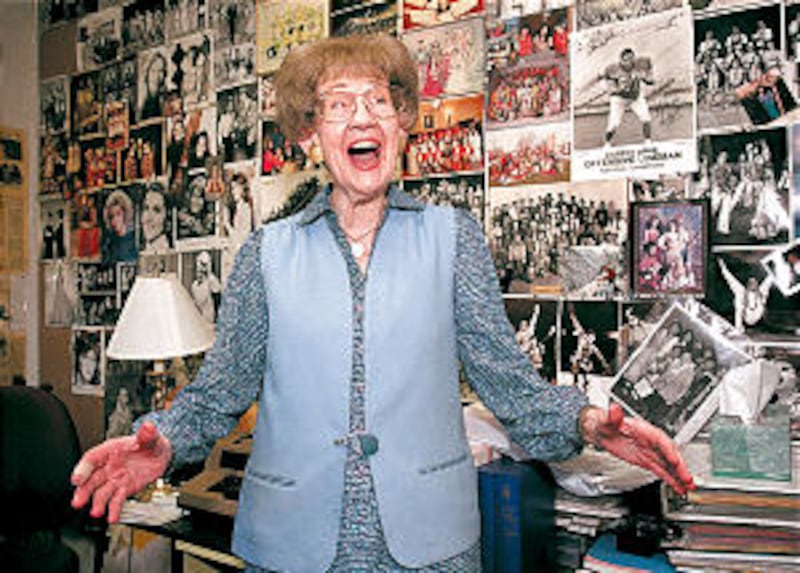
PROVO, Utah — In 1952, Janie Thompson was young, bubbling with enthusiasm and held the distinct promise of someday seeing her name in bright lights.
She had just returned from serving a mission in Wales and had been invited to resume her place as vocalist in the popular Ike Carpenter Band in California.
Her path in life suddenly seemed clear.
But when she arrived in Los Angeles to join the band — just as she stepped across the threshold of her roommate's home — "The phone rang," she said. "It was a representative of President Ernest L. Wilkinson's office asking me to return to BYU to direct the student program bureau.
"My heart sank," she said. This was not the plan. Her dreams were dashed. But she had been taught by devoted parents to accept every opportunity to serve. With tears in her eyes, she returned to Provo.
When she reported for work that fall, "They didn't know where to put me," she said with a chuckle. "My first office was a desk in a basement hallway of the Maeser building. Space at BYU was always at a premium."
Now 49 years later, as hundreds of lifelong friends greeted her during an open house honoring her on her 80th birthday Aug. 25, she was able to measure how her life has exceeded her wildest ambitions.
"I have been everywhere," she said, taking a line from one of her songs. "I have received such countless blessings that it is overwhelming to me."
Standing on the very floor where many of her BYU performing groups trained, friend after friend filed by to thank her for her vim and vigor and love.
"I remember them as they were," she said. "They looked great, although I hadn't seen some of them for many years."
Sister Thompson is credited with developing many of BYU's highly influential international performing groups that have offered wholesome entertainment and opened missionary doors for decades. But in the heart of countless students and spectators, she is endeared by her bubbly love of life, and the gospel.
From behind her basement desk, during those early years at BYU, her original assignment was to develop student talent and prepare groups for performance as a public service by the university.
It was an important assignment that she took seriously, though she felt the performing groups had higher purposes than merely entertaining at high schools and local functions.
She saw performing groups as ambassadors for the Church who could open doors for missionary work.
She was determined to succeed. At times, that meant wheeling a piano into the ladies rest room when the custodians weren't looking so she could hone and perfect routines without disruption. Standing at the keyboard, she'd play while tapping out the dance routine with her feet.
For 29 years, until she retired in 1984, she directed BYU's Program Bureau performing groups. For a string of years she organized a new group each year to meet entertainment demands. The two groups still performing are the Young Ambassadors and the Lamanite Generation, now known as Living Legends, both of which have been active for more than 30 years each, under uniquely capable directors.
Music has always been a part of Sister Thompson's life. As the oldest of seven children, she was raised in a musical family in Malta, Idaho. "My mother and father were so musically talented," she said. Her father sang bass while her mother was a dramatic soprano. "She was the best singer the Lord ever put on the earth," she said.
Sister Thompson played the piano from the time she was tall enough to reach the keys. "If you've got talent, you can't stop it," she said, breaking into song, remembering the first tune she plunked out on the piano.
A heavenly hand has guided the performing groups from the beginning, Sister Thompson said. "We were successful because we were clean-cut, fun and performed fast-moving programs with good music, modest but attractive costumes, and enjoyable but non-suggestive humor. The students sparkled with the joy of life and it showed in their performances."
The first opportunity to perform overseas came in 1960. Sponsored by the U.S. Defense Department, the BYU troupe, "Curtain Time," entertained servicemen in the Pacific. Cast members had been warned that the only way to entertain a military audience was with scanty costumes and coarse humor.
When they arrived in Naha, on the island of Okinawa, they learned that an audience of rowdy Marines had recently "thrown things at another college group and booed them off the stage."
During the devotional prior to their performance, Sister Thompson emphasized that they would not alter the show and encouraged cast members to do the best they'd ever done and, "just be their exemplary selves."
From the moment they stepped onto the stage shouting "Curtain Time, Curtain Time," Sister Thompson said, the audience was infected with our enthusiasm. "They became our favorite audience of that tour."
The show ended with an upbeat patriotic theme that had the Marines standing with tears in their eyes while clapping and clapping.
The Defense Department invited performing groups only once every two years. But so successful was this tour and the next tour in 1962, that the military altered its rule and invited BYU groups to perform every year for 14 consecutive years until 1976 when BYU changed its touring policy.
The full measure of good may never be known, but Sister Thompson has received enough feedback to nearly fill a large book she is preparing that recounts the spiritual results of her groups.
She recalled an incident in the mid-1980s when a former performer was sitting with her husband at a luncheon attended by many regional representatives who were in the Salt Lake City area during general conference.
During the luncheon, this performer mentioned to a regional representative from the Philippines that she had been to his country in 1965. She described the night her troupe performed in the palatial home of a member. The regional representative listened with increasing interest as he realized that he had attended that very performance as a 15-year-old non-member teenager. He remembered the show well enough to describe the cowgirl costume she wore in the opening act.
He then told how his family had not been interested in the Church, but they were impressed with the missionaries and accepted an invitation to attend the show. The feelings of the evening motivated them to reconsider their attitude toward the gospel, which led to their eventual conversion.
Another incident that highlighted the missionary value of the performing groups came one day in the 1970s as Sister Thompson was walking through the Wilkinson Center on the BYU campus. A young man "obviously in a hurry to class," abruptly stopped and said, "I've been meaning to tell you something. I first learned of the Church in 1965 when I was a wounded serviceman from the Vietnam War, recovering at the Clark Air Force Base in the Philippines."
He recounted how performers came into the hospital and went throughout the rooms greeting and singing to the wounded. "I felt something special about your group and I wanted to learn more about your Church," he said. As a result, he joined and served a mission before enrolling as a full-time student.
"I didn't even get his name," Sister Thompson said.
Sister Thompson continues to sing and perform for select audiences. Her voice is clear and her fingers are nimble on the keys. She doesn't feel any older, she says, but she knows the mirror doesn't lie. Still, despite the change in hair color and the number of birthday candles, it's as true today as it was years ago when it was written, "Anyone who tries to bottle the essence of Janie Thompson will have a hard time capturing all the bubbles."
