



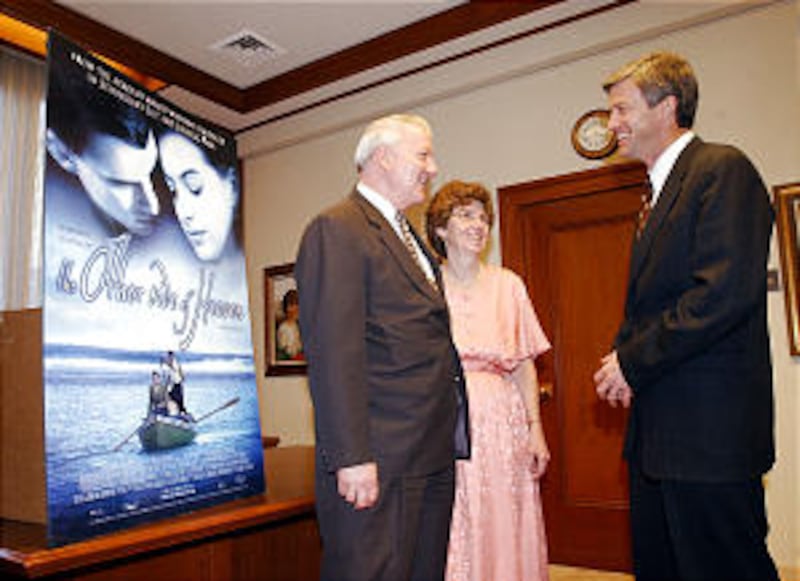
When Elder John H. Groberg was serving the Lord as a young missionary in Tonga in the 1950s, he could not have known his experiences one day would be played out on movie screens for millions of viewers to see. In fact he would have resisted the idea.
"Jean [his wife] and I were very uncomfortable with the idea of having our lives on the 'silver screen,' " he told a BYU Devotional congregation last Dec. 4. "It may be some people's dream but it definitely was not ours."
But now, on the verge of the major North American release April 12 for "The Other Side of Heaven," Elder Gro- berg of the First Quorum of the Seventy is confident about the movie's ability to do good, and he hopes as many people as possible go to see it.
Released beginning in December on a regional basis to theaters in Utah, Idaho and Arizona, the movie has done well, according to Mitch Davis, the film maker and BYU graduate from Franktown, Colo., who conceived, wrote and directed it. It has garnered a spot in the top 10 regional platform-released movies of 2002.
"A lot of people advised us to think a little bigger, to take a bigger jump," Brother Davis said, "plus the fact that, particularly among Latter-day Saints, word from Utah has spread out across the country. People are clamoring for it, so we decided this was the best thing to do. This has never been done before within the LDS arena, and it really does put the movie onto the national stage," Brother Davis said of the national release.
Elder Groberg is convinced such widespread exposure is desirable.
"I think its mission, the 'measure of its creation,' so to speak, has not yet been realized," he said during a recent interview in his office. "The scriptures say the Lord speaks to each generation according to its own language and ability and so forth. And for good or for evil, the language of a lot of the youth today and a lot of the world today is movies."
He has been surprised and gratified at the rapt attention shown by young people as he has spoken at firesides and other engagements regarding the subject matter of the film. "You just see them really thinking deeply about these principles."
Not the least among the principles is faith. Adapted from his 1993 book, In the Eye of the Storm, (now titled The Other Side of Heaven) the movie touches on his harrowing misadventures just getting to his field of labor. (It took three months of sea travel marked by delayed passages and missed connections. His mission president utterly lost track of him.) Later on is depicted the incident Elder Gro- berg has related in general conference in which a father hands him the lifeless body of his boy who has fallen from a mango tree with the expectation that the missionary, who "has the power," make him well again.
"I truly feel I learned lessons there that I'm not sure I could have learned anywhere else," he mused. For example, one event depicted in the movie is a hurricane that wiped out the food supply on the island where he was serving. It also destroyed the one means of communication with the outside world: a single telegraph line. For 8 1/2 weeks famine beset the people as they waited and watched for a sailboat to bring food and supplies.
"I was pretty much skin and bones by now," he wrote in the book. "At times I wasn't sure which side of the veil I would end up on, but it didn't matter. All that mattered was that God was in His heaven, and He knew me and my situation; He would see that what was right was done, for as far as I knew, I had done all I could."
He said he has had people write and ask him what he meant by that. "And all I've been able to say is: Just read what I said in the book. I'd always believed in life after death, but when it comes down to where it is a reality rather than a theory, then I don't know whether that's faith or that's faith becoming understanding."
Brother Davis, a former bishop of the Castlewood Canyon Ward, Parker Colorado Stake, said that at the outset, Elder Groberg counseled him to "try to find a way to make a movie that would touch the light of Christ in all mankind."
As a result, it seems viewers who are not members of the Church are the ones to have been most profoundly affected by it, Elder Groberg and Brother Davis agreed. For example, the Grobergs told of a 10-year-old girl from Israel who saw the movie in Tempe, Ariz., with her parents and who reported that the movie taught her you don't have to have a lot of worldly possessions to be happy and that there is a power that will help you get through things if you are helping others.
Brother Davis said one young man who saw the picture at a preview screening "found me afterwards and grabbed me by the hand and tearfully said, 'I want you to know that seeing this movie made me want to join your church just so I could go on one of your missions.' And we actually are working on that."
He said the movie has gained a number of fans in high places, including the chairman of one of the major studios in Hollywood, who, after screening "The Other Side of Heaven," said, "We want to do everything we can to help your movie succeed so that we can make more like it."
Indeed, Jack Valenti, the high-profile chairman of the Motion Picture Association of America, has engaged the motion picture for showcasing to members of Congress at the MPAA's theater in Washington, D.C., April 17.
"There has been a tremendous amount of discussion in Washington and in Hollywood post-Sept. 11 about what Hollywood can do to inspire and serve America better on the heels of that violent, horrific incident [referring to the terrorist attacks on America]," Brother Davis said. "So Jack Valenti has sort of seized on this particular film as an example of the kind of thing we may want to have more of in the future."
And though Elder Groberg is anxious not to be perceived as "tooting [his] own horn" (an ironic bit of imagery, since the movie depicts him playing his trumpet both before and during his mission), he agrees with Brother Davis that the motion picture box office is something of a voting booth in which people convey their preferences to movie makers. That is, good people ought to support good entertainment that uplifts and conveys principles of righteousness while avoiding entertainment that does not.
"The studios are paying attention; they're listening; they're watching carefully," Brother Davis noted.
E-mail: rscott@desnews.com
