



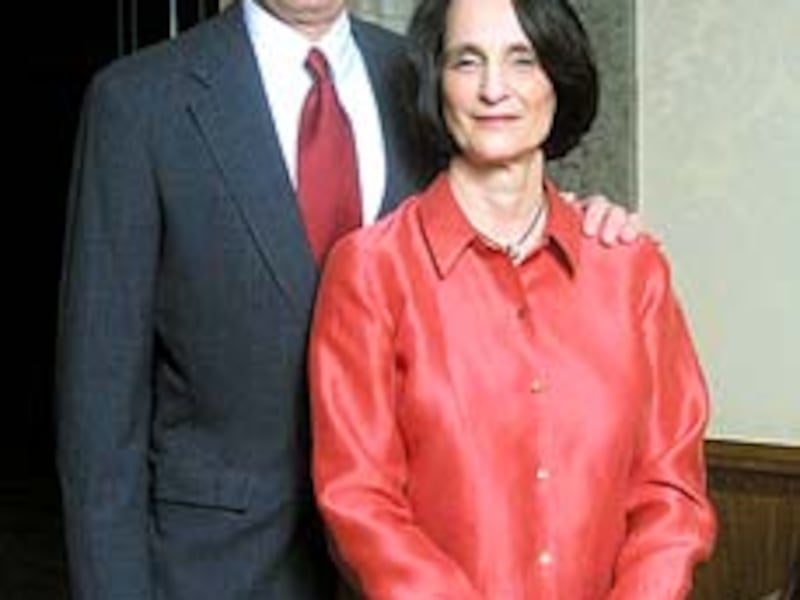
Anne Clark Pingree was a young bride when she accompanied her husband, a U.S. Air Force flight surgeon, to France in 1963. There, in the Loire Valley, she had some of her earliest experiences with Relief Society in an unheated Quonset hut with six or seven other "sisters" in the middle of a deserted airstrip.
The young woman learned not only the lessons of Relief Society, but also its purposes.
"This was my first experience with Relief Society, and it was a sweet, tender one that really shaped my feelings about Relief Society and the strength of a unified sisterhood. It's all there, the foundational principles of Relief Society and the concept of our being covenant women who are united in a righteous cause, who serve and strengthen and encourage one another," Sister Pingree said during a recent interview.
She knows of which she speaks. She has strengthened and been strengthened in France, Nigeria and throughout the United States with other covenant women of Relief Society — and with good women of other faiths and cultures. She will now take it a step further as second counselor in the newly called Relief Society general presidency, to which she was sustained April 6 during general conference. (Please see May 18 and May 25, 2002, issues for profiles on new Relief Society General President Bonnie D. Parkin and first counselor Kathleen H. Hughes, respectively.)
In her office in the Relief Society Building, Sister Pingree keeps an ebony carving of an African woman. The woman, who is expecting a child, holds one child by the hand, has another on her back and is balancing a large pot on her head. Sister Pingree said the carving, which she acquired when her husband, George Cannon Pingree, served as mission president in Port Harcourt, Nigeria, from 1995 to 1998, reminds her of the courage and faith of the sisters she met in Africa — despite their heavy physical burdens. It also reminds her of the courage of women in general.
"Women's lives are really basically the same, whether you are in Africa or whether you are in America. We have the same desires and the same goals in our lives for our children, for our families, for the good of the community and the country that we live in. We work hard to make a difference, a righteous difference."
From the time Sister Pingree was a little girl growing up in Bountiful, Utah, women have shown her what making a "righteous difference" means. She especially speaks of the strength and courage of her mother, Maude Erickson Clark, who died of cancer in 1968.
Sister Pingree was a freshman at the University of Utah (from which she earned a bachelor's degree in 1963) when her mother was diagnosed. She lived nine more years. During those and all the previous years, she taught her three sons and three daughters (Sister Pingree was the oldest daughter) "courage and strength and self-reliance and dealing with hard things in life with dignity and strength."
"I was very close to her. I saw through her example of courage the patterns of strength that I hoped I would have in my life through whatever years the Lord granted me. She's been a great strength and a great example to me even though she hasn't been in my life since the early years of my marriage."
The year Sister Clark died, Brother and Sister Pingree were living in Rochester, Minn., where he had begun a fellowship at the Mayo Clinic in 1965. There, living in a small housing unit for students, Sister Pingree met women of many faiths and many walks of life, including some from Norway, Peru, Israel, Finland and Australia.
It was there that the first of the Pingrees' children was born. "I was nervous and we were far from home and as we were getting ready to go to the hospital, my next door neighbor who was from Australia came to me. She had gathered a little bouquet of violets and she gave them to me, just in the spirit of love and kindness. She said, 'Everything will be all right.' That's what the women were like. There's something powerful when women of all cultures reach out to each other and draw each other in."
This pattern continued in Sister Pingree's life as she and her husband lived for a short time in Georgia, where he pursued more surgical training. They soon moved back to Salt Lake City where they reared their family.
It was during these years that Sister Pingree used her college major in English to further one of her life's commitments — the cause of literacy. She volunteered with Literacy Volunteers of America. And from 1990 to 1995, that last year leaving for Nigeria, Sister Pingree served on the Relief Society general board, helping promote Relief Society's literacy program using Church Educational System materials.
"I really believe that if women are literate, there's strength in families. If a woman is literate, if a woman can read the scriptures, if she can share her testimony of the Atonement, if she can sign her name, she is empowered in every possible way. She doesn't have to live on borrowed light."
She remembers one woman she met in Nigeria who struggled to learn to read and write. The woman, lean and muscular from farm work, learned to hold her pencil and learned to form letters and to read simple phrases from the CES literacy materials.
"I think of women who walked long distances over the sandy jungle trails, yet they are happy for these opportunities to maybe gain skills that will help them find a means to provide for their families. Every woman was an example to me."
Example has been the power behind the life of the new second counselor in the Relief Society general presidency.
E-mail: julied@desnews.com
