



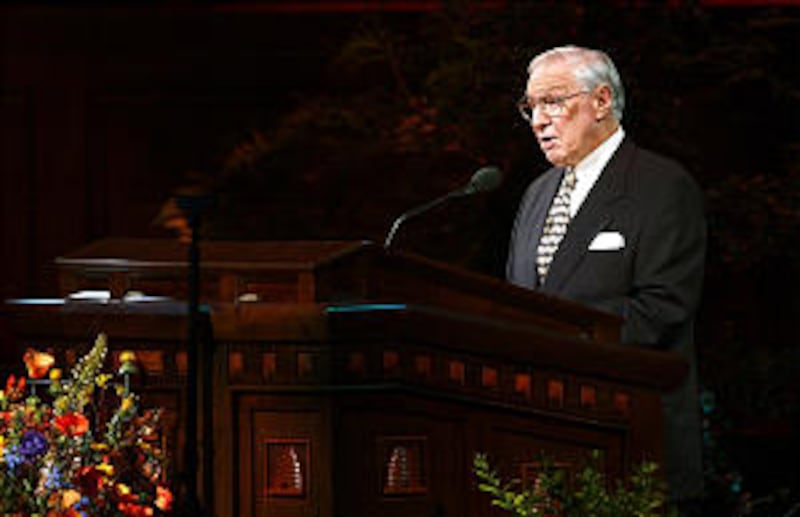
President James E. Faust's recounting of "one of the many unheralded faithful pioneers" highlighted the Church's annual Pioneer Day Commemoration held in the Conference Center July 20, in a program graced with the Mormon Tabernacle Choir, Orchestra at Temple Square, guest conductor Crawford Gates and concert violinist Jenny Oaks Baker.
The hourlong program was carried over the Church's satellite system to stake centers and other locations.
President Faust, second counselor in the First Presidency, drew modern-day lessons from the example of pioneer Susan Melverton Witbeck, who was born in England and lived with her grandparents. She was 12 when her stepfather took her to hear a Mormon elder. She was quietly baptized when she was 14 without telling her grandparents, with whom she was living.
"Two years later, someone told her grandparents, and her grandfather was so disturbed and enraged that he gave her the choice of giving up her religion or her home, which was dear to her," President Faust related. Though she adored her grandparents, she could not deny her religion, so she sorrowfully left home, relying on the kindness of other Latter-day Saints and her own labor of making gloves for her support.
She immigrated to America and joined with the Israel Evans Handcart Company, which left Iowa City, Iowa, on May 22, 1857.
President Faust quoted this from her own account: "For days before we reached Salt Lake, relatives of some of our group had come out to meet them and take them to the home of loved ones waiting for them. Our company was constantly getting smaller. As each happy load pulled on away from us, it began to slowly dawn on my mind that there was no one to meet me, and no home to go to, when I reached my destination. The feeling of loneliness kept increasing, until the last night we camped, before reaching Salt Lake, I could control my feelings no longer. I wandered away from the camp, threw myself upon the ground, and gave way to all my stored up heartache."
It happened that Captain Evans, searching for mules that had strayed, heard her sobbing. She opened her heart to him "with all its loneliness and fears," she wrote. "He comforted me, and told me I would be welcomed by all the saints, and that many homes would be opened to me, and maybe some proposals of marriage would be made too. . . . All he told me was true."
President Faust commented: "And so it is with us today. We go forward with a different set of challenges than our pioneer forebears had. These modern challenges are more subtle. They may not be as physically exhausting, but in some ways they require a different kind of spiritual strength to resist the sometimes overpowering influences of our time. In the spirit of the pioneers, together we welcome and embrace one another in the community of saints to which we all belong. We go forward with our lives in devotion, loyalty and integrity."
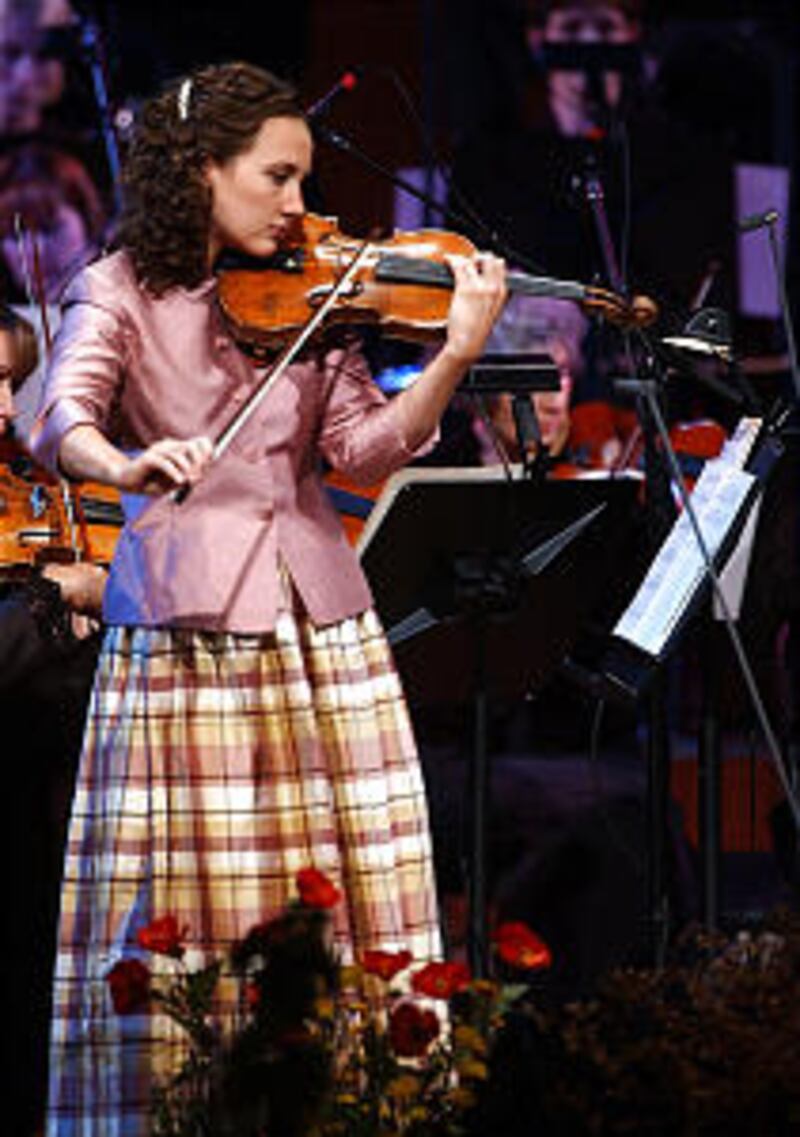
During the music portion of the program, Brother Gates, famed Latter-day Saint composer and arranger, conducted the orchestra in his quiet "Reverie" on the well-known Latter-day Saint pioneer hymn "Oh Ye Mountains High." Sister Baker, a member of the National Symphony Orchestra in Washington, D.C., soloed on violin, backed by soft strings and harp.
Later, Brother Gates and Sister Baker returned to the podium for an orchestra rendition of Brother Gates' familiar hymn "Our Savior's Love." (Hymns, No. 113.) This arrangement was characterized by a broad introduction subsiding into sublime violin strains backed by lush orchestration.
In 1947, a much younger Crawford Gates was commissioned to compose the score for the now-famous musical "Promised Valley" commemorating the hundredth anniversary of the Pioneers' entrance into the Salt Lake Valley. For this year's Pioneer Day Commemoration, he conducted the choir and orchestra in two songs from that musical, "The Wind Is a Lion," and "Valley Home."
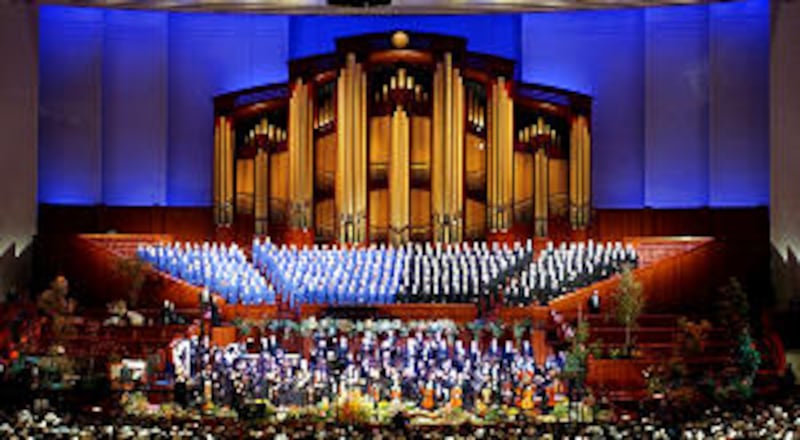
Under the baton of Craig Jessop, the choir and orchestra opened with "They the Builders of the Nation" and continued with "Come Thou Fount of Every Blessing." Mack Wilberg led the choir and orchestra in a regal arrangement of "High on the Mountain Top" with emphasis on the Conference Center Organ. He also conducted the groups in "Faith in Every Footstep," K. Newell Dayley's composition commissioned for the Church's 1997 Pioneer Sesquicentennial. The program closed with "Come, Come, Ye Saints," the pioneer anthem written during the exodus in 1846 by William Clayton.
President Gordon B. Hinckley conducted the program, expressing thanks to the choir (which, he said, "has a pioneer history of its own") to the orchestra, and to the other musicians involved. "How proud the pioneer musicians of this Church would be of this tremendous choir and orchestra who serve so faithfully, contributing their time and their talents for the entertainment of people across the world," he exclaimed.
Elder Bruce D. Porter of the Seventy gave the invocation and Sister Gayle M. Clegg, second counselor in the Primary general presidency, gave the benediction.
E-mail: rscott@desnews.com
