



Judy Canty Martin has the heart of a family history researcher.
The slight, grandmotherly, part-Native American author has published three books of her ancestral heritage. Most recent is "My Father's People," a complete history of the Catawba Nation. In the pages of this copy-machine book assembled over a span of 30 years is captured personal histories and anecdotes from three centuries. Each one gives evidence of the love of this labor by Sister Martin.
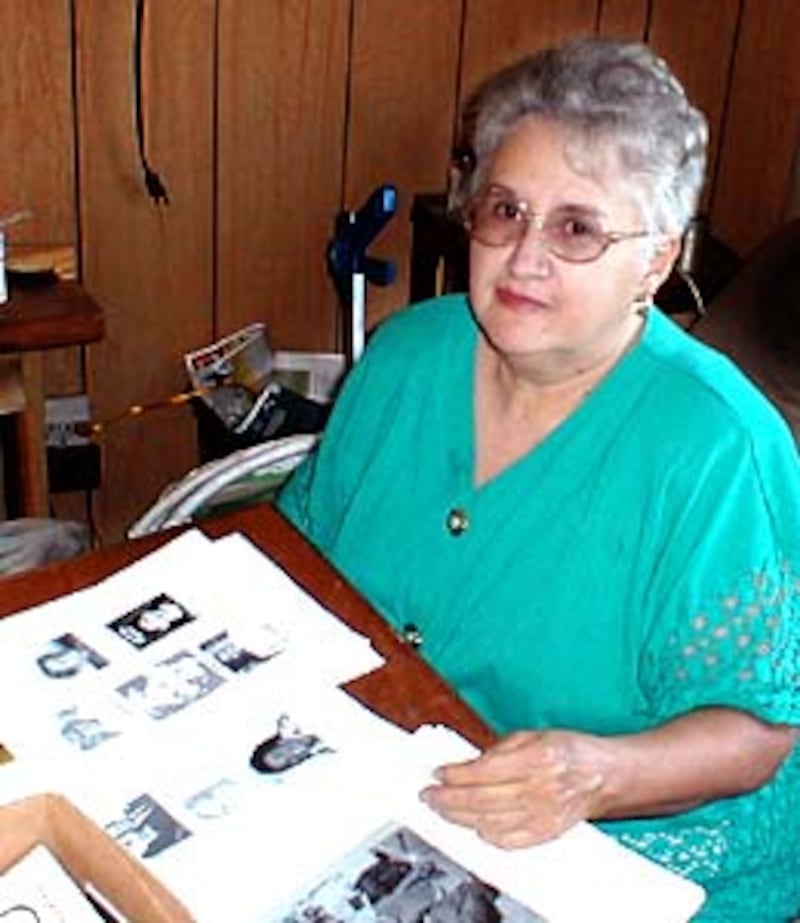
"I have always been interested in history," she said. "I can't describe what keeps me tied to it. I don't know."
Sister Martin has been driven on the subject for 32 years, representative of so many family history researchers who devote their lives to this area of study. Her interest in family history spills over to her Cortez 4th Ward, Durango Colorado Stake, where for many years she supervised Spanish name extraction.
As a youth she didn't think much about who she was until someone used a racial slur and "adversity made me more determined." She would learn that overcoming adversity was a family trait that went back many generations.
As she began her research, her husband was a well-employed tractor mechanic in Alamosa, Colo. But during that time in the 1980s when many farmers lost their farms and were foreclosed on, he was laid off and without work for a year. They relocated from Sanford to Cortez, Colo.
"We managed to keep it together, but it was tough financially," said Sister Martin.
Her husband, Forrest L. "Frosty" Martin, continued to be a source of great encouragement to her regarding her Indian ancestry.
"I can still see him standing in the background with a smile of understanding and pride," she said. "He loved Indians."
She grew in understanding of her Catawba forebears who died before she was born: her grandfather, John Alonzo Canty; her great-grandfather, James Patterson; and great uncle, Pinkney Head. Her grandfather had died without talking about his history, a typical trait of this people, she was to learn. So she began to dig and found that a contingent of converts from Catawba, York County, S.C., had come to Colorado in the 1880s. She continued the search, but scraping up even enough change to pay for birth certificates was a challenge. She found a Catawba history book at the library and checked it out so many times that her cousins finally took up a collection and bought her a copy.
Other hardships came with the loss of family members. The most recent was the most difficult with the death of her husband in 2002.
But along the way, unexpected rewards of a spiritual nature came her way. She learned that the Catawba tribe dated back to the 16th-17th centuries. A conglomeration of smaller tribes, the Catawba never fought against the government, but fought with them in the Revolutionary War and assisted them in other skirmishes. She learned the Catawba were a spiritual people who had joined the Church in South Carolina against adversity in the 1880s.
Such was the opposition that one journal noted: "The mobs are so bad that Elders Bingham and Cragun hid in the woods and were piloted through the swamps for 30 miles by [Catawba converts] James Patterson and James Watts."
Between threats that sometimes materialized into mobs that shot at and once whipped a missionary, the Rock Hill Branch was organized in Catawba in 1884 with 25 Catawba among the 31 members.
Two convert ancestors, Alonzo Canty and Pinkney Head, were called on a mission to the Cherokee in North Carolina. "We was glad to think we was worthy to go and teach others the gospel," wrote Elder Head in his journal.
Elder Head's family was among five Catawba families who left South Carolina between 1885 and 1890 to settle in the West. They came by wagon to the Mississippi and then by train to Sanford, Colo.
As Sister Martin researched on, she completed her Genealogy of the Western Catawba. She also found the missionary journals of Elders Joseph Willey and Pinkney Head, which she published.
Other personal rewards included finding unknown cousins. Her grandfather had a half-brother in South Carolina with descendants. She also found many cousins in the West. Some of these often felt isolated in the community because of their Indian ancestry. The family started drawing closer as she contacted one and then another for information. They began to have more family connections and appreciate their roots more.
"I have seen cousins who did not know the other existed 15 years ago go on vacations together and exchange letters," she said. "It has been a remarkable thing to watch. So not only are the genealogical requirements filled, but families have been reunited."
Another source of support was her uncle, William Franklin "Buck" Canty, among the first Native Americans called as patriarch in 1962 in Sanford, Colo.
"He was more than an uncle to me, more like the grandfather I had never known," said Sister Martin.
In 1982, Sister Martin walked into his shop where he was working with a piece of wood and singing funeral songs, knowing his time was short.
"I had not been able to hear him speaking of death," she said. "He knew it was near; I was not ready. I finally let him talk about it."
They spoke of his eventual demise. He said he would discuss genealogy with their forebears. He promised "to send a COD letter." In just a few months, the aged patriarch died in that wood shop.
A few years later, Harvey Gardner, regional representative, came to the stake seeking Native American names for temple work, and announced a special temple day.
"I jumped at the chance and spent one whole night and day typing the forms and getting [names] ready for the temple," she said. On that special temple day, April 26, 1986, work was done for much of the Catawba tribe ancestry.
"April 26th was [Uncle Buck's] birthday," said Sister Martin. "There was my COD letter."
E-mail: jhart@desnews.com
