



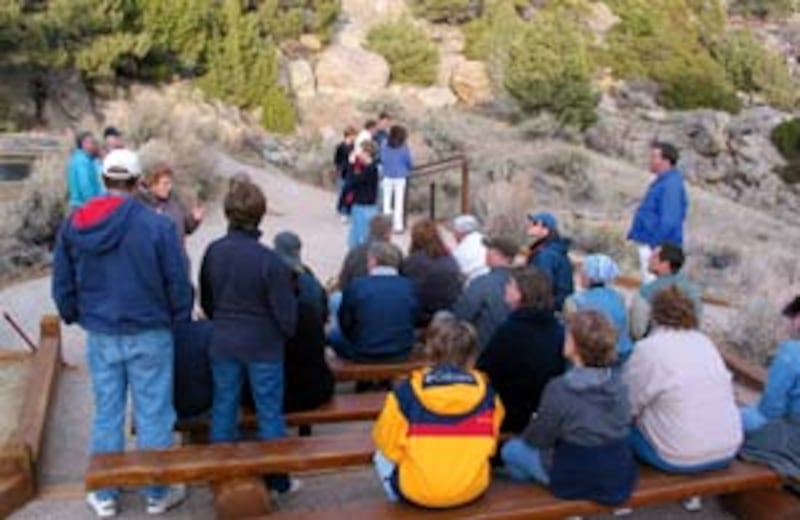
ALCOVA, Wyo. — The sacred nature of Martin's Cove in central Wyoming, where Mormon Handcart Pioneers suffered hardship and death in the late fall of 1856, has been affirmed by President Gordon B. Hinckley.
The words from his dedicatory speech at the Martin's Cove visitors center on May 3, 1997, are etched on a marker at the beginning of the trail that goes from the center to the cove:
"We hope that a spirit of peace and reverence and sacred remembrance will hover over this whole area as a beneficent cloud on a hot summer day, and that those who here perished will not have died in vain.
"I make a plea. Go in a spirit of reverence and respect, and know that you are walking on hallowed ground."
It is the spiritual feelings that attend a visit to the area that brings tens of thousands of youth of the Church to the Mormon Handcart Historic Sites in Wyoming each year, missionaries assigned to the site readily declare. Most of the visitors come as part of ward and stake youth conferences.
But that same spirit can be a blessing to families and other visitors looking for an edifying as well as enjoyable vacation or weekend getaway, the missionaries add.

Everyone is welcome and admission is free. Large groups are dealt with efficiently and out of the way so that families and others can drop in and share the experience.
What you will find
The Martin's Cove Visitors Center is designed to handle all visitors and help them have an enjoyable as well as spiritual experience. A visit can easily fill an entire day.
The visitors center itself is located in the ranch house originally built by the Sun family which homesteaded the ranch. Drop-in visitors are met by missionary-guides at the door and taken through the rooms of displays that explain the history of the area. That includes its place on the Mormon, California, Oregon and Pony Express trails.
The displays provide a visual and verbal account of the Martin and Willie handcart companies which were struck down by early, severe snowstorms on the plains of Wyoming, and then delivered by rescuers from Salt Lake City.
On the grounds of the visitors center is the Peoples of the Sweetwater Museum. It is relatively small, but displays many artifacts related to the area.

Also near the visitors center is a replica of Fort Seminoe, the small facility that gave the Martin Handcart Company some shelter from the blizzards. It is built just feet away from the excavated original location.
Handcarts can be checked out at the visitors center. There are carts set aside for drop-in visitors, besides the many available for groups. For most people, the logical handcart pull is along the 1.3-mile trail to the bottom of Martin's Cove. Handcarts are not permitted in the cove itself, but there is a handcart parking lot near public rest rooms.
The walk through Martin's Cove is about two miles long — a gentle uphill climb to the top of the cove and then downhill back — on a good trail. There are interpretive signs along the way and missionaries at the top who have stories to tell and will answer questions. Members of the Martin Company sought meager shelter in the cove, suffering horrifically with several dying in the cold.
After exiting the cove, visitors can pull their handcarts straight back to the visitors center or can detour a short distance to the footbridge. It crosses the Sweetwater River near the place where young rescuers from Salt Lake City carried the cold and weary handcart-company members across the icy water.
There are missionaries at different locations to answer questions and point out the significance of various sites.
Back at the visitors center, there are public rest rooms, drinking water and many picnic tables. There is also ample parking, including for recreational vehicles.
There are no commercial business or services, including food.

How to get there
Martin's Cove is not somewhere you pass through to get somewhere else. It is pretty much a destination location. Though Muddy Gap and Alcova are relatively close, they provide barely any services. You can reasonably expect to drive to Casper or Rawlins — each about 60 miles away — to find real "civilization."
From I-80, the turnoff to Martin's Cove is in Rawlins. Take U.S. Highway 287 north about 44 miles to Muddy Gap, then turn right on State Route 220. It is about another 20 miles to the Martin's Cove Visitors Center turnoff which is well signed and easy to find.
If coming from the west, there is a route more in line with the Mormon Pioneer Trail. Exit at Rock Springs onto U.S. Highway 191 and go north 40 miles to Farson. There, turn right onto State Highway 28. There are pioneer sites with interpretive signs along that route including South Pass, the road to Rock Creek Hollow where the Willie Handcart Company was rescued, and Sixth Crossing which provides handcart trekking access for groups to Rocky Ridge and Rock Creek Hollow. Information is available there about access to Rocky Ridge and Rock Creek Hollow.
About 70 miles from Farson is the Lander turnoff. Turn right there on U.S. Highway 287 for 63 miles to Muddy Gap and then turn left onto State Highway 220 to get to Martin's Cove.

If traveling through Casper, take State Highway 220 southwest to Martin's Cove.
Other routes along minor roads can be identified on a Wyoming map.


E-mail to: ghill@desnews.com
