



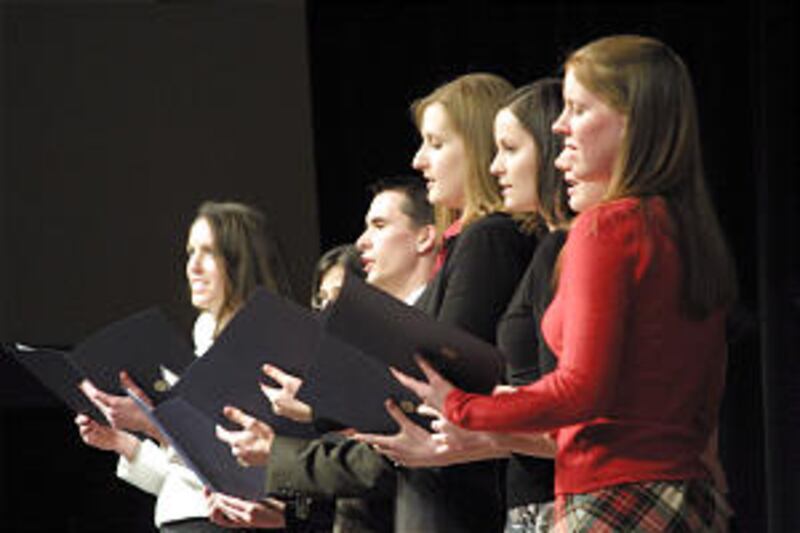
PROVO, Utah — Temple ordinance work depends on family history work, said President Boyd K. Packer, Acting President of the Quorum of the Twelve.
And it is a work that "cannot be stopped nor subdued nor slowed down," he said. "It is eternal work. Blessings will accrue to all of you who have part in it and have interest in it. You can't touch family history work, and you can't touch temple work without receiving spiritual blessings."
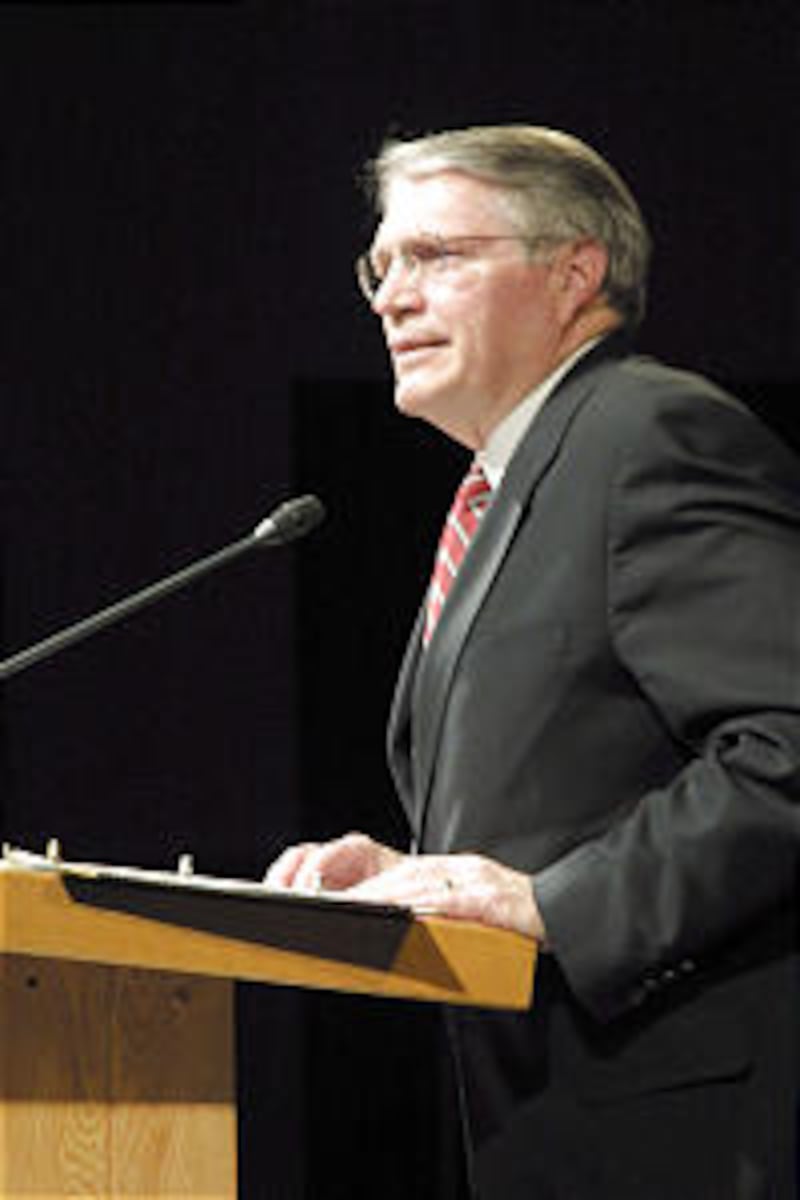
President Packer spoke briefly at the conclusion of the annual BYU Family History fireside Feb. 24, held in the Joseph Smith Building auditorium. The featured speaker was Elder Paul E. Koelliker of the Seventy, executive director of the Temple Department, who gave an overview of temple work in this dispensation.
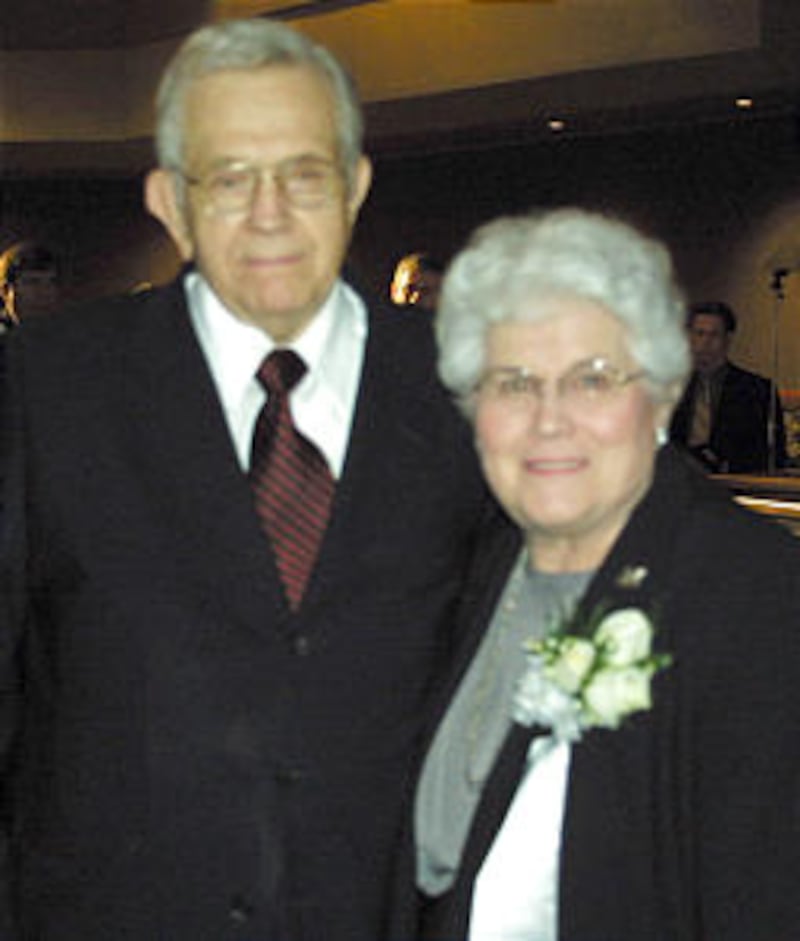
President Packer was accompanied by his wife, Donna, who was one of three honored by the BYU Family History Department for her lifetime commitment and excellent research.
She is "one who has given lifelzong service to family history, is an avid and a very competent researcher," said President Packer. (See page 11 for more information about those honored.)
He spoke of his experience many years ago of searching through President Wilford Woodruff's journal of 1894 that recorded a revelation "on the matter of adoption and endowment," but the journal did not record what that revelation was. (Adoption at that time referred to a common practice of being sealed to a prominent Church leader instead of to one's ancestors.)
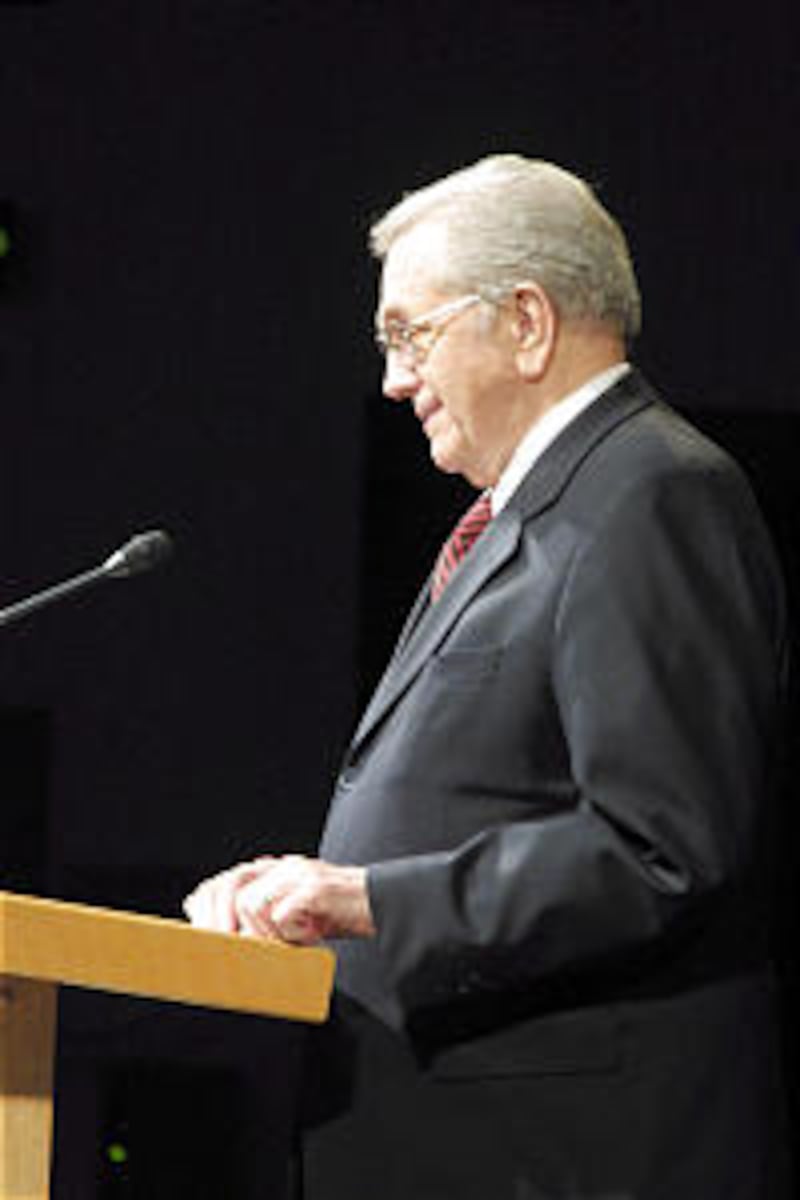
Speaking in general conference shortly after, President Woodruff "said he'd met with the Brethren of the Twelve and 'Never did anything come before us with more conviction and certainty than what happened. I met with the Brethren on the matter of adoptions and endowments . . . and then he said: I want the Latter-day Saints from this time forward to search through the records of their kindred dead and trace that line as far back as they can.' "
That, continued President Packer, "was the certified beginning of what would be now known as family history work."
The Genealogical Society of Utah was organized soon afterwards, and "the work has unfolded step by step until you see now a great Family History Library and all the technical things we have to make it possible."
He said that some years ago, he and Sister Packer were in England at Oxford University in the company of a wonderful English couple, Richard and Marjorie Moore, who were head of the All-British Society of Family History. Mrs. Moore told them that "we didn't get very far at first in pulling these little organizations together from all over England when it was known as the English Society of Genealogy. We changed the name to family history and then it exploded.' "
A few weeks later, then-Elder Packer made a proposal to change the name of the Genealogical Department to the Family History Department and the proposal "was approved in that meeting in just a few minutes' discussion." (Mrs. Moore died Feb. 26 in an accident in South Africa where she and her husband had gone to do family history research.)
President Packer concluded his comments, telling of how members of the First Presidency and Quorum of the Twelve each testified of "The Living Christ," in 2000. They recorded both a printed and videotaped testimony of Jesus Christ and His divinity.
Each of the Brethren was given a choice of where to be videotaped, and President Packer chose to stand before the altar in the Kirtland Temple, where " 'Elijah the prophet, who was taken to heaven without tasting death, stood before us, and said:
" 'Behold, the time has fully come, which was spoken of by the mouth of Malachi — testifying that he (Elijah) should be sent, before the great and dreadful day of the Lord come—
" 'To turn the hearts of the fathers to the children, and the children to the fathers, lest the whole earth be smitten with a curse' " (Doctrine and Covenants 110:13-15).
In his fireside address, Elder Koelliker also spoke of the Kirtland Temple, the first erected in this dispensation. This temple, he said, was completed in 39 months, after great sacrifice and efforts by the members.
From that humble beginning, 122 temples are now operating. Temples have come to 31 states, and the District of Columbia in the United States and 37 countries worldwide; it is an "absolutely amazing miracle" and the fulfillment of the Lord's promise.
Elder Koelliker described the coming forth of the temple ordinances, including baptism for the dead. The first endowments were administered in the Nauvoo Temple on Dec. 10, 1845.
"Each one of you who participated in the dedication of the rebuilt Nauvoo Temple undoubtedly remembers feeling the witness of the Spirit when President Hinckley spoke in that dedicatory service," he said.
Each temple is evidence of the commandment to build temples and the attendant blessings that come, said Elder Koelliker. He emphasized the importance of temples, and of the blessings that come to those who make and keep their covenants. He also described "how seriously the prophets have taken the commandment to build, design and operate them."
"The commitment to temple building is not a trivial matter, Brothers and Sisters." It has been a significant focus of every president from Joseph Smith to the present.
In temple dedicatory prayers, the innermost thoughts of the Church presidents — prophets of God, are revealed for our view, he said.
He noted that in the past eight years, President Hinckley has participated in more than 300 temple dedicatory sessions.
"While participating in some of these dedicatory sessions, I have to confess I have felt a clear witness of the value and impact of temples and the covenants and services that are found there." The thrill of attending a dedication has never diminished, he said.
Today, the temple ceremony has been translated into 80 languages and recorded in 78 languages.
Instrumental in the early translations was a young man, Gordon B. Hinckley, then working under the direction of President David O. McKay as the first temple films and translations were made. He then described the remarkable period between 1998 and 2000 when the number of temples surpassed 100.
President Hinckley introduced the concept of smaller temples in October 1997 general conference, and announced the first three such temples. A year later, the Church president announced 30 of these smaller temples.
"In this program we are moving on a scale the likes of which we have never seen before," said Elder Koelliker. "In the existing operating temples of today, 58 are so-called smaller temples."
As President Hinckley has reminded us, continued Elder Koelliker, " 'Family research would serve no other purpose than the satisfaction of curiosity if the temple work did not follow. Likewise only a portion of the purpose of temples could be met if there were not family history research.' "
Elder Koelliker concluded with his testimony that temples are holy places where members will be blessed as they redouble their efforts in the great redemptive work that takes place therein.
E-mail to: jhart@desnews.com
