



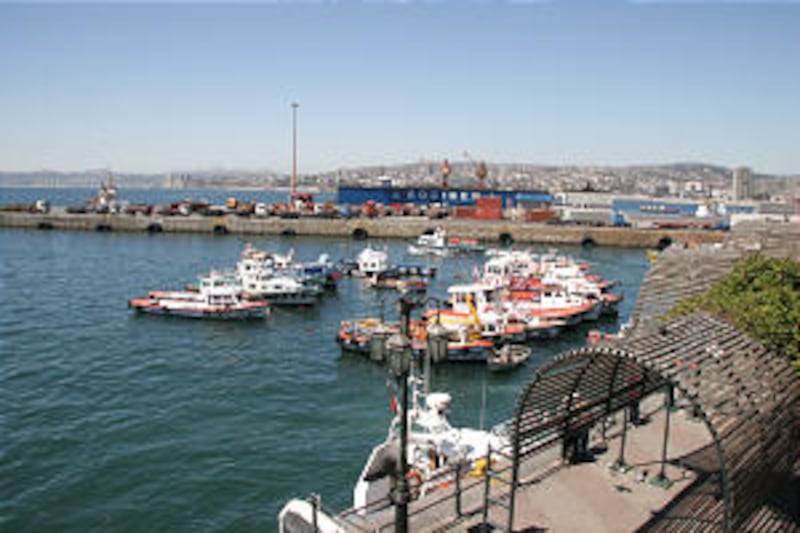
VINA DEL MAR/VALPARAISO, Chile — Folks with an itch for Church history and travel likely have a "must-see" list of LDS-themed locales. Some are obvious: Nauvoo, Ill. Kirtland, Ohio. Palmyra, N.Y.
Other entries on the list might include the Mormon Colonies of northern Mexico, Martin's Cove, Wyo., or perhaps the storied spots of Preston, England.
Adventuresome LDS travelers shouldn't forget to look south in their history hunts.
More than a century before it recorded its first baptism, Chile forever etched its place in early Church history. The Chilean port city of Valparaiso was the intended rest spot for the weary LDS passengers and crew of the ship Brooklyn in May of 1848. The Brooklyn had left New York City three months earlier "determined to flee Babylon, either by land or by sea." It was bound for California in a desperate, dangerous voyage that took the seafaring pioneers below Cape Horn, then along Chile's massive stretch of Pacific coastline.
Valparaiso, sadly, would remain but a wish for the Brooklyn. Desperate for provisions and battling nasty weather, the ship was forced to anchor on Chile's remote Juan Fernandez Island far off the coast.
Five years would pass before the Church — in the person of Elder Parley P. Pratt of the Quorum of the Twelve and his small contingent — would finally step foot in Valparaiso. Confounded by the language and civil war, Elder Pratt was forced to abandon his plans for missionary work in Chile and left the country after only five months. The gospel seed that would one day take root and blossom in Chile for the Church was not ready to be sown, reported Elder Pratt. First, further preparation was needed, including the translation of the Book of Mormon into Spanish.

Elder Pratt left Chile hopeful for the Church's future. Valparaiso, however, would be a sad personal memory for the apostle. Elder Pratt and his wife Phebe lost their infant son, Omner, while serving in the area. The baby was buried, ignominiously, high atop Valparaiso's hilltop suburbs in a humble cemetery relegated for "dissidents" of the Catholic Church. The cemetery, along with the baby Pratt's grave site, remain. A plaque was placed at the child's grave site on Nov. 10, 2001, in memory of the Pratts' labors and painful loss.
With Elder and Sister Pratts' departure, the Church in Valparaiso and throughout Chile lay dormant for decades. Then in 1923, assistant Church Historian Andrew Jenson visited Valparaiso, its twin port city of Vina del Mar and other regions of Chile and reported that the entire continent was "a field ready for the harvest."
Agrarian metaphors are appropriate for the Valparaiso and Vina del Mar region located along Chile's central coast about a two-hour drive west from Santiago, the nation's capital. The stretch of land that connects Santiago and the coastal cities is rich with some of the world's finest produce. During a tour of Chile, Elder L. Tom Perry of the Quorum of the Twelve noted that he and his fellow apostles enjoyed Chilean grapes at a recent meeting. Even the arid region's ubiquitous thorny cacti — called tunas in Spanish — are squeezed into a refreshing, sweet juice.
The Church here is also deep-rooted and fruitful. Missionary work formally began in Chile in the late 1950s, and a branch was soon in operation, serving the young members from Valparaiso and Vina del Mar. The cities enjoyed the sort of growth perhaps envisioned more than a century earlier by Elder Pratt. The Vina del Mar Stake became Chile's second stake in 1974. A stake in Valparaiso was organized three years later. The Chile Vina del Mar Mission was formed in the late 1970s and continues to serve both cities. Included among the area's converts was Gonzolo Sepulveda, a soccer-loving Chilean who was contacted by the missionaries while he was a self-proclaimed cynical college student at one of "Valpo's" many universities.
Brother Sepulveda said the gospel message spoke to him. He was touched by the things he learned from the missionaries.
Like many other local converts, Brother Sepulveda became a quick study in gospel learning and leadership. He has fulfilled local priesthood callings and now serves as an Area Seventy and a spokesman for the Church in Chile.
Rapid growth is often accompanied by a few growing pains. Several stakes from the Valparaiso/Vina del Mar region were discontinued in recent years in an effort to consolidate strong priesthood leadership.

The recent rededication of the Santiago Chile Temple will provide much of the spiritual mortar for such development, said Quilpue Chile Stake President Gabriel Parra Hidalgo, a Church employee who presides over his Vina del Mar-area stake. "Many from our stake participated in the (temple) open house and had many wonderful, personal experiences."
President Parr Hidalgo's sentiments are echoed by Elder Francisco J. Vinas of the Seventy and president of the Chile Area. Valparaiso, Vina del Mar and its fellow Chilean cities can be "a beacon to the Church," Elder Vinas said. "We have all the necessary conditions."
Sources: Lorin K. Hansen, Voyage of the Brooklyn; Rodolfo Acevedo, Los Mormones en Chile.


E-mail to: jswensen@desnews.com
