



With the recent passing of President James E. Faust, second counselor in the First Presidency, Latter-day Saints have opportunity to observe the Lord's hand in replenishing the leadership councils of the Church, this according to revelation and long-established pattern.
A worthy man will be called, set apart and sustained as a counselor in the First Presidency to fill the vacancy created by the death of President Faust. If things run true to form (and there have been occasional exceptions in the past), that man will be selected from the Quorum of the Twelve. If so, that will occasion the calling of another apostle to fill the vacancy in the quorum.
Thus, now is an opportune time to review the history, form and function of the First Presidency and its companion council, the Quorum of the Twelve.
First Presidency
Christ promised to give to Peter "the keys of the kingdom of heaven," instructing him, "whatsoever thou shalt bind on earth shall be bound in heaven: and whatsoever thou shalt loose on earth shall be loosed in heaven" (Matthew 16:18).
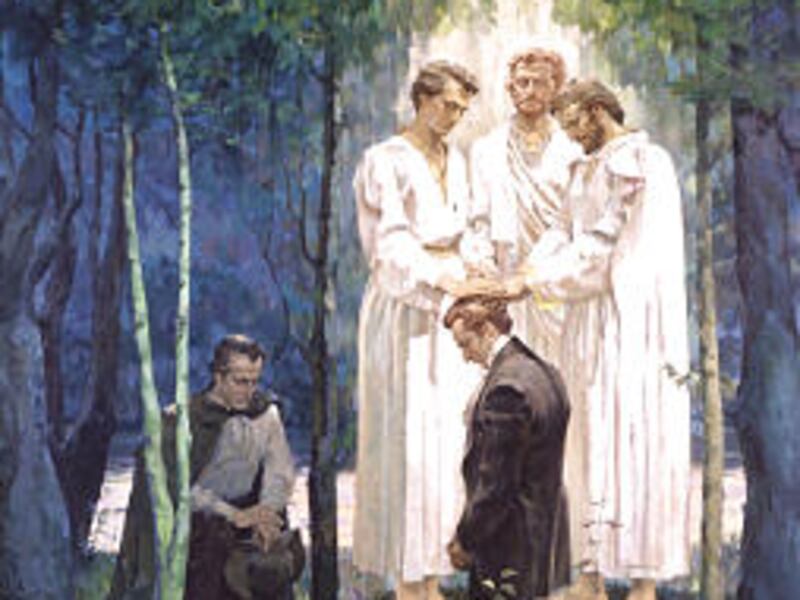
On the Mount of Transfiguration in the incident recounted in Matthew 17:1-11, Peter, James and John received those keys, defined as "the rights of presidency, or the power given to man by God to direct, control and govern God's priesthood on earth" ("Keys of the Priesthood" in Guide to the Scriptures). Thus ordained, Peter, James and John filled the role that the First Presidency does today in directing the affairs of Christ's Church on earth following His death.
In this, the latter-day dispensation, the three apostles came to earth as resurrected beings and conferred the keys of the kingdom upon the Prophet Joseph Smith, thus restoring priesthood authority to the earth (see Doctrine and Covenants 27:12-13). The organization of the Church soon followed, on April 6, 1830.
As with other doctrines and instructions, the concept of the First Presidency as an administrative body emerged in the latter-day Church as understanding was received "line upon line, precept upon precept" (see Doctrine and Covenants 98:12; see also 42:61).
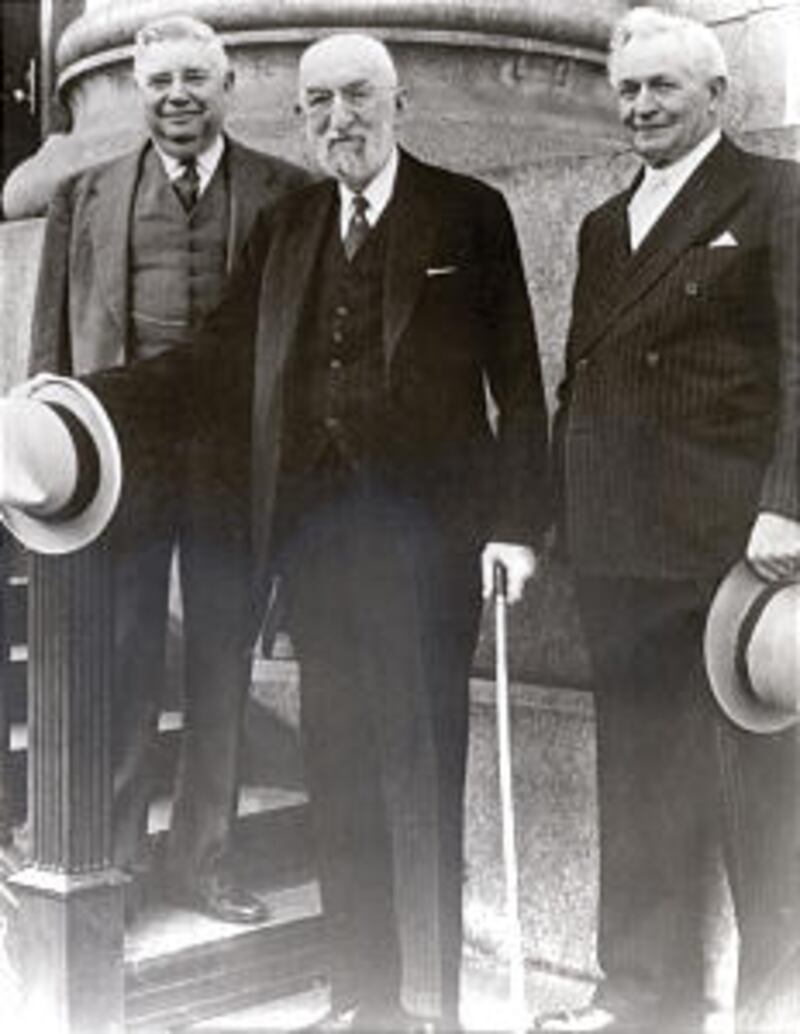
On Jan. 24, 1832, Joseph Smith was ordained as President of the High Priesthood, with Sidney Rigdon performing the ordination. Two months later, he learned more about that office by revelation and, accordingly, selected Sidney Rigdon and Jesse Gause as his counselors. Jesse Gause became disaffected and was excommunicated the following December; Frederick G. Williams was then called as counselor in March of the following year (see Milton V. Backman Jr., The Heavens Resound: A History of the Latter-day Saints in Ohio, 1830-1838, p. 241).
Further divine direction would come in a revelation on March 28, 1835, wherein the Lord stated:
"Of the Melchizedek Priesthood, three Presiding High Priests, chosen by the body, appointed and ordained to that office, and upheld by the confidence, faith and prayer of the church, form a quorum of the Presidency of the Church" (Doctrine and Covenants 107:22).
Though the revelation specified three men, it did not forbid the calling of additional priesthood holders to the presidency. Such a precedent had been set with the appointment in 1834 of Oliver Cowdery as "assistant president" and Joseph Smith Sr. and Hyrum Smith as additional counselors (see Backman, p. 242). The precedent has been continued from time to time.
Brigham Young Jr. and Albert Carrington, for example, served as additional counselors to President Brigham Young. In more recent times, Thorpe B. Isaacson and Alvin R. Dyer both served as additional counselors to President David O. McKay, and the current Church president, Gordon B. Hinckley, was an additional counselor for a time to President Spencer W. Kimball before being called as second counselor (see Deseret Morning News 2007 Church Almanac, pp. 58-59).
Typically, when a new counselor in the First Presidency has been needed, the man has been selected from among the Quorum of the Twelve. That has not always been the case, however. J. Reuben Clark Jr. was not even a General Authority at the time of his call as second counselor to President Heber J. Grant on April 6, 1933. He was not ordained an apostle until Oct. 11, 1934, after being sustained as first counselor to President Grant (see Church Almanac, p. 56).
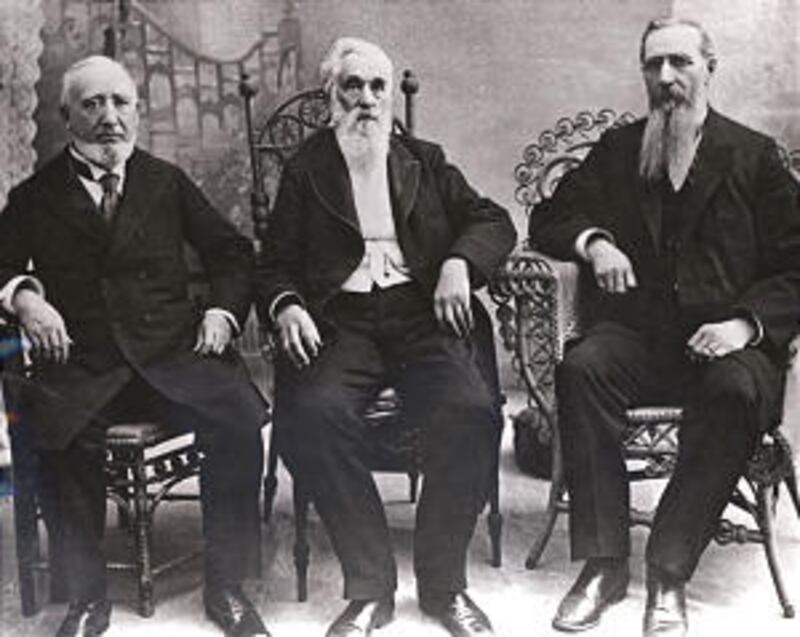
In the formative days of the Church, the Lord gradually unfolded knowledge pertaining to the First Presidency, stating, for example, that "the duty of the President of the office of the High Priesthood is to preside over the whole church, and to be like unto Moses ... to be a seer, a revelator, a translator, and a prophet, having all the gifts of God which he bestows upon the head of the Church" (Doctrine and Covenants 107:91-92).
That same revelation designates the Quorum of the Twelve as being "equal in authority and power to the three presidents previously mentioned" (verse 24).
President Gordon B. Hinckley posed the question, "How can they be equal in authority?" and, in answer, gave this 1906 quotation from President Joseph F. Smith: "I want here to correct an impression that has grown up to some extent among the people, and that is, that the Twelve Apostles possess equal authority with the First Presidency in the Church. This is correct when there is no other Presidency but the Twelve Apostles; but so long as there are three presiding Elders who possess this authority in the Church, the authority of the Twelve Apostles is not equal to theirs. If it were so, there would be two equal authorities and two equal quorums in the Priesthood, running parallel, and that could not be, because there must be a head" (see Gordon B. Hinckley, "The Quorum of the First Presidency" Ensign, December 2005, pp. 46-50).
In the same article President Hinckley noted that there have been lengthy periods with no quorum of the First Presidency, namely, following the death of Joseph Smith, when Brigham Young led the Church as president of the Quorum of the Twelve for three and a half years. Likewise, following the death of President Young as Church president, the Twelve led the Church for three years and two months before the First Presidency was again reorganized with John Taylor as president. Following his death, a period of a year and nine months passed before the reorganization of the First Presidency.
"As a practical matter," President Hinckley wrote, "the Twelve and the Seventy are given much of the responsibility, under the direction of the First Presidency, for the ecclesiastical affairs of the Church. This includes the proclamation of the gospel to the nations of the earth and the administration of the various programs involving the members of the Church."
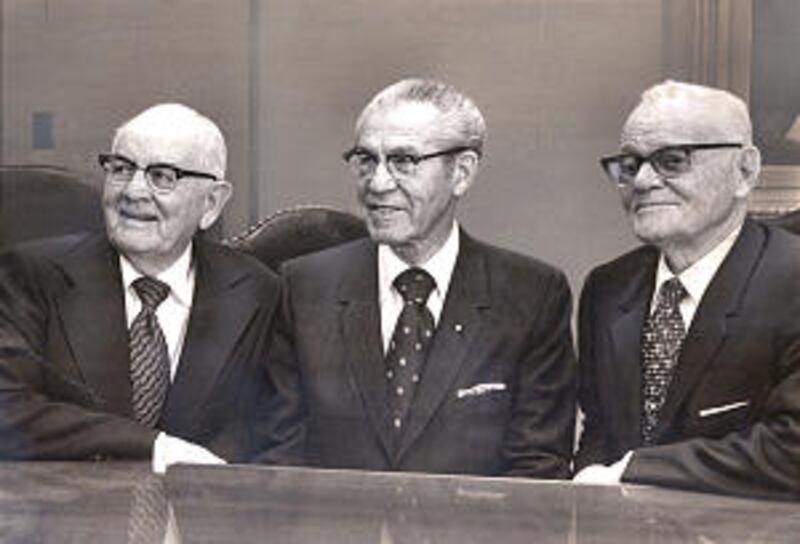
Affirming that much revelation has come to the Church since the Standard Works were accepted, President Hinckley wrote, "It comes now as it has come in the past.... There is a still, small voice. It comes in response to prayer. It comes by the whisperings of the Spirit. It may come in the silence of the night."
While still a counselor in the First Presidency, President Hinckley gave an October 1990 general conference discourse on the role of counselors. Though he spoke generally of presidencies in the Church, his remarks apply particularly to the First Presidency.
Speaking of a counselor as "a partner" to the president, he said: "Such a partnership provides a safety valve. The wise writer of Proverbs tells us that 'in ... counsellors there is safety' (Proverbs 11:14). When problems arise, when difficult decisions face us, it is wonderful to have those with whom we can talk with confidence and trust....
"Even the President of the Church, who is Prophet, Seer, and Revelator, and whose right and responsibility it is to make judgment and direct the course of the Church invariably consults with his counselors to determine their feelings. If there is a lack of unity, there follows an absence of action. Two counselors, working with a president, preserve a wonderful system of checks and balances. They become a safeguard that is seldom, if ever, in error and affords great strength of leadership" ("'In ... Counsellors There Is Safety'," Ensign, November 1990, p. 48).
Quorum of the Twelve
The term apostle is derived from a Greek word meaning "one sent forth" (see Bible Dictionary, "Apostle," p. 612).
During His earthly ministry Christ established the office of apostle. He selected 12 men and gave them as a body the authority to direct the ministry of His Church after His death and Resurrection (see Matt. 28:19-20; see also Acts 1:2).
Among the elements of the gospel restored in the latter-day dispensation was the office of apostle, conferred first upon Joseph Smith and Oliver Cowdery (see Doctrine and Covenants 20:2-3). Thereafter, the Quorum of the Twelve Apostles was established on Feb. 14, 1835 (see History of the Church 2:181-189).
"As in former days, the senior Apostle presides over the Church and has the responsibility to announce new doctrine or changes," wrote Edward J. Brandt, manager of the Evaluation Division of the Church's Correlation Department ("'And He Gave Some Apostles' (Ephesians 4:11)," Ensign, July 1999, p. 14). That includes the selection, under divine inspiration, of a worthy man to fill any vacancy that might occur in the quorum, just as Peter, as president of the Church in former days, directed the calling of a new apostle, Matthias, to fill the vacancy occurring with the death of Judas Iscariot (see Acts 1:15-16; 21-26).
Brother Brandt noted that the responsibilities of the Quorum of the Twelve include teaching the gospel, building up and setting in order the Church, and being special witnesses of Jesus Christ and His resurrection.
E-mail to: rscott@desnews.com
