



A catchphrase that early on became pervasive during the presidency of Gordon B. Hinckley was "bringing the Church out of obscurity."
That was, perhaps, inevitable during the administration of a man who, as a young missionary in England, had pioneered the use of filmstrip presentations and placement of articles in the popular press as means for proclaiming the gospel. Small wonder such a tone would be set during his presidency when, after his mission, he went to work almost immediately for the Church leadership as executive secretary of the fledgling Radio, Publicity and Mission Literature Committee, earliest forerunner to today's Public Affairs Department of the Church.
The phrase, of course, is an allusion to a passage of scripture, in what the Lord designated as His preface to the doctrines, covenants and commandments given in this dispensation: "And also those to whom these commandments were given, might have power to lay the foundation of this church and to bring it forth out of obscurity and out of darkness" (Doctrine and Covenants 1:30, emphasis added).
In 1933, young Gordon Hinckley had already earned a degree from the University of Utah with an eye toward pursuing graduate studies at the prestigious Columbia School of Journalism in New York City. During his mission, he wrote essays for the Church periodical in England, the Millennial Star, and in February 1935, his article, "The Early History of the Latter-day Saints," appeared in the London Pictorial Magazine. Frustrated with a lack of materials available for missionaries to use in their proselytizing, his mission president, Elder Joseph F. Merrill of the Quorum of the Twelve, directed him to prepare several filmstrips incorporating the existing technology — black-and-white transparencies — for missionaries to use as teaching aids.
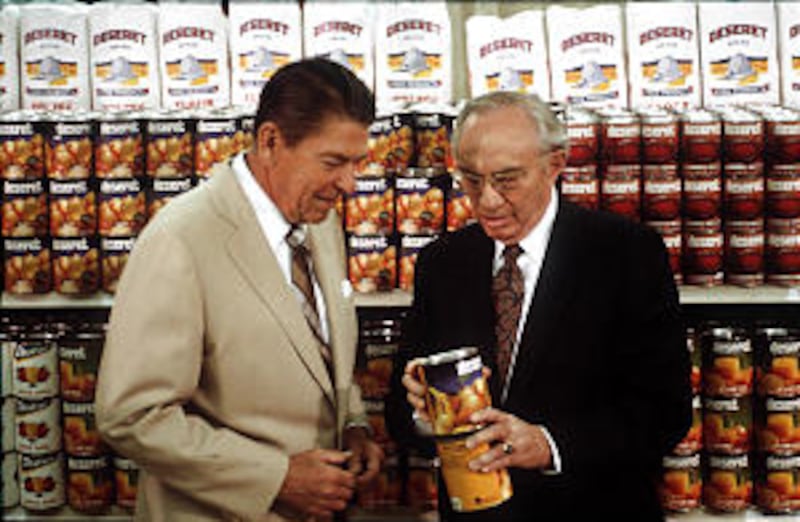
It foreshadowed things to come.
Church employment diverted him from plans to pursue a graduate degree in journalism after his mission. As executive secretary to the committee, he produced filmstrips, which, because they were such a novelty at the time, got missionaries into the homes of contacts. "Do you know the romance of a celluloid strip and a beam of light?" he asked in the lead of his May 2, 1936, Church News article extolling the virtue of this medium for teaching the gospel, then so new that the slides had to be hand tinted for color.
Later would come his involvement with the "Fullness of Times" radio series, 39 half-hour programs mostly written by Gordon Hinckley and produced in Hollywood for airing on up to 500 radio stations with no cost to the Church. For the 1939 World's Fair on San Francisco's Treasure Island, he facilitated the construction of a Church exhibit, a model of the Salt Lake Tabernacle in which organ recitals were presented while a slide presentation highlighted Temple Square, Church history and gospel principles.
It was while working for the committee in 1947 that Gordon B. Hinckley wrote the concise book on Church history that is still published today under the title Truth Restored. For many years it has been used by missionaries and other students and teachers.
"One immediate and even remarkable consequence of his employment," wrote his biographer, Sheri L. Dew, "was the opportunity to be tutored in matters of the kingdom by the Lord's schoolmasters" (Go Forward With Faith, Salt Lake City: Deseret Book Co., p. 104). Thus, long before his call as a General Authority, Gordon B. Hinckley was steeped in experience with Church administration, particularly as it pertained to presenting the message of the gospel to the outside public. As a General Authority, he would continue to help guide the use of emerging technology in presenting the restored gospel to a wide audience and would shepherd the Mormon Tabernacle Choir, one of the most recognizable icons representing the Church.
By the time he became president of the Church in 1995, he was poised to set the tone for a renewed effort to bring the Church out of obscurity. He approached the task with native charm as well as skill and an eminent background, qualities evident at a luncheon and press conference at the Harvard Club in New York City on Nov. 13, 1995. Attending that luncheon was Mike Wallace, the crusty journalist familiar to millions of watchers of the CBS News program "60 Minutes."
Of that occasion, Mr. Wallace would later recall: "I'd been trying for decades to get some top Mormon leader, any top Mormon leader, to talk to '60 Minutes' about himself and his church, and I'd regularly been turned down. ...An investigation was not what I had in mind, but rather an exploration of what kind of individual led the Mormons, how did he get his job, what about Mormons and polygamy, what about Mormons and black folks, and did the leaders of the Mormon Church really believe that tale about Joseph Smith?... Merely the kind of nosy questions we regularly put to all manner of highly placed figures on '60 Minutes.' We hardly expected 'Yes' for an answer....
"So I was totally unprepared for a cordial, even a sunny greeting from Gordon B. Hinckley at the luncheon.... President Hinckley's bespectacled eyes literally twinkled as he good-naturedly allowed that it sounded like an appealing notion; after all, he really had nothing to hide, and he imagined he'd have little difficulty handling whatever queries I loosed at him. He'd heard and answered worse, he was sure, during his young missionary years in London, where he'd taken on whatever the skeptics and nonbelievers had thrown at him in his Hyde Park appearances and/or confrontations" (Gordon B. Hinckley, Standing for Something, New York: Three Rivers Press, Foreword, pp. vii-viii).
Interviews were arranged; the Church president and the journalist — both in their advanced years — got along famously. The program aired on Sunday, April 7, 1996.
With a touch of wry humor, President Hinckley commented some months later: "In a moment of weakness, I said, 'I'll risk it.' Well, we did it. All I can say is, we were blessed. I don't know how many have seen it. I've heard figures up to 40 million.... It's done unlimited good. We've had a number of letters; baptisms have come of it, and it has been a helpful thing for the Church" ("'This thing was not done in a corner"'; Church News, Oct. 26, 1996, p. 7).
On that occasion, his receiving the "Communicator of the Century" award from the Association of Latter-day Saint Public Relations Professionals, President Hinckley remarked that reporters didn't scare him. "I just look upon them as somebody next door," he said. "They have just as many troubles as I do and a few more. And you just be honest with them, check your facts, be sure of your facts so that nobody can dispute what you say, and speak up to them."
Interviews with media representatives were "always a worrisome undertaking, because one never knows what will be asked," he mused in his address at the priesthood session of October 1996 general conference. "These reporters are men and women of great capacity, who know how to ask questions that come at you like a javelin. It is not exactly an enjoyable experience, but it represents an opportunity to tell the world something of our story."
And, as he told the LDS communicators, "We have a responsibility to stand tall and speak out with clarity and with decency and not with boasting, but factually and honestly and candidly."
Thus, President Hinckley made himself accessible many times for various news media interviews, including four appearances on "Larry King Live." The third of those appearances was three days after the terrorist attacks in New York City and Washington on Sept. 11, 2001. The host of the CNN program evidently felt the Church president's spiritual assurance was needed as Americans grieved and worried.
Two seminal events during President Hinckley's administration brought unprecedented worldwide attention to the Church.
One was the sesquicentennial in 1996-97 of the coming of the Pioneers to the Salt Lake Valley. Media outlets around the world trained their focus on a commemorative wagon train that wended its way first from Nauvoo, Ill., to the Iowa-Nebraska border and then to Salt Lake City. Through numerous reports, millions became acquainted with the 19th century history of the Church.
The other event was the 2002 Winter Olympics in Salt Lake City. Under President Hinckley's leadership, the Church was careful to take a supportive but not a dominant role in putting on the Games. In the process, Olympics watchers around the world gained a better understanding of the Church and its members.
With his background, perhaps it was characteristic that President Hinckley during his presidency would write a book directed toward a universal readership and distributed by a national publisher. Standing for Something: 10 Neglected Virtues That Will Heal Our Hearts and Homes appeared in 2000 and soon became a national best-seller.
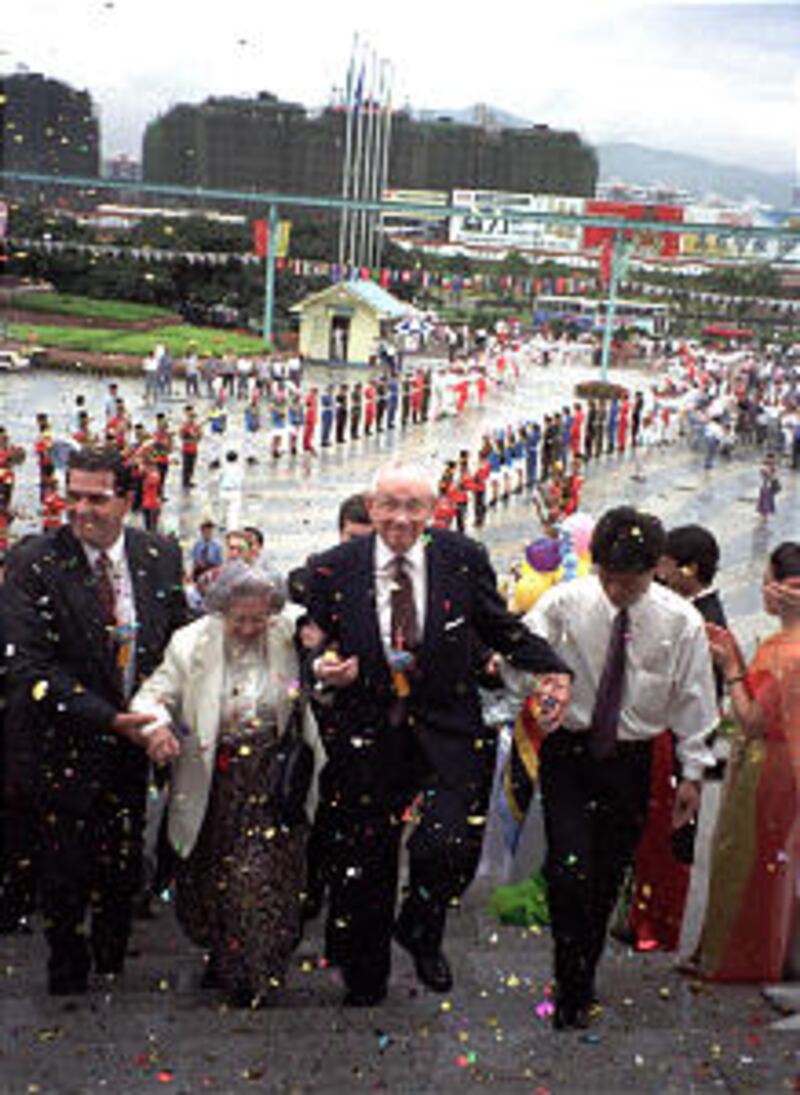
In that book, President Hinckley affirmed, "Regardless of our circumstances, we must ... go forward with faith and prayer, calling on the Lord for His sustenance and direction. We will discover, as the years pass that there has been a subtle guiding of our footsteps in paths of progress and great purpose" (page 121).
In a gospel context, perhaps it was such optimism and resolve that made Gordon B. Hinckley an instrument in the Lord's hand "to bring (the Church) forth out of obscurity."
E-mail: rscott@desnews.com
