



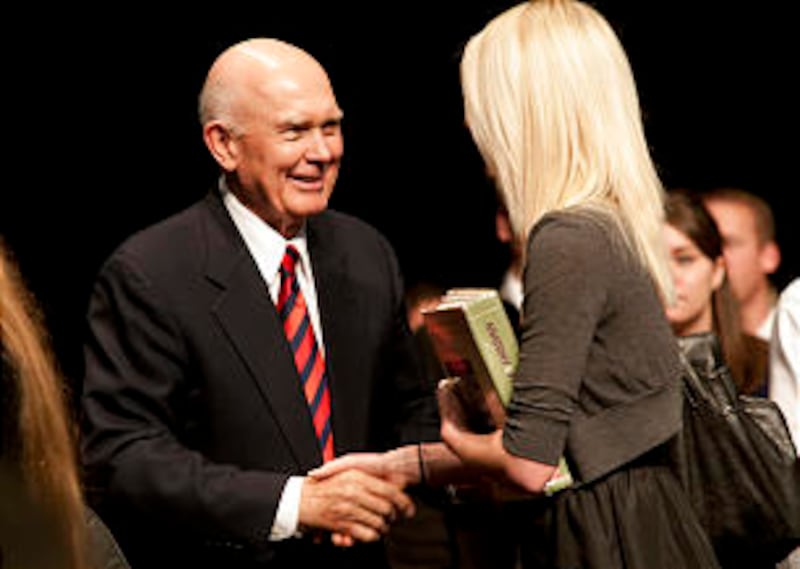
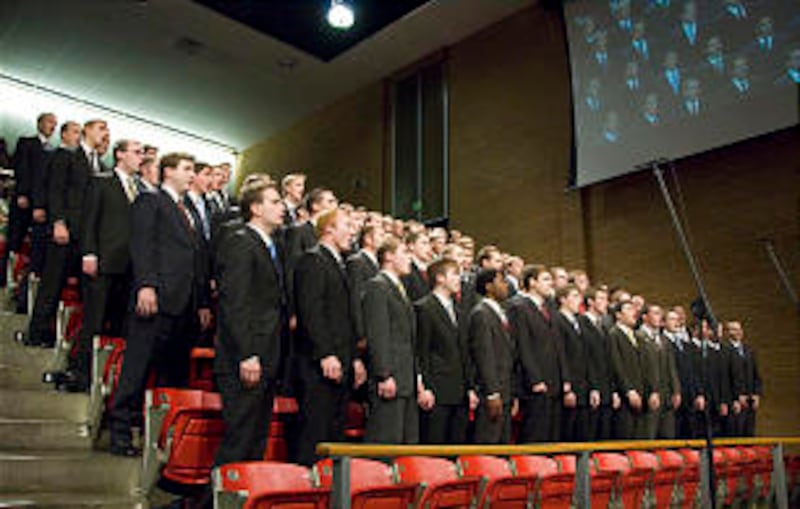
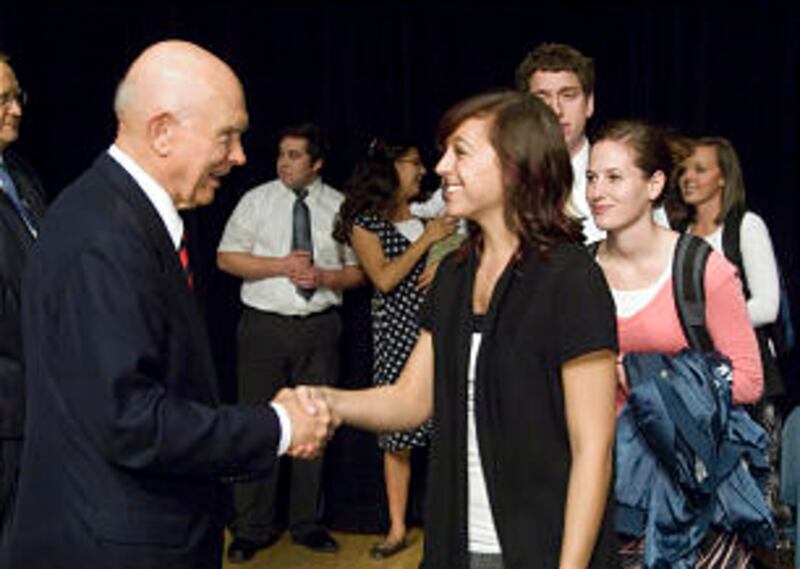
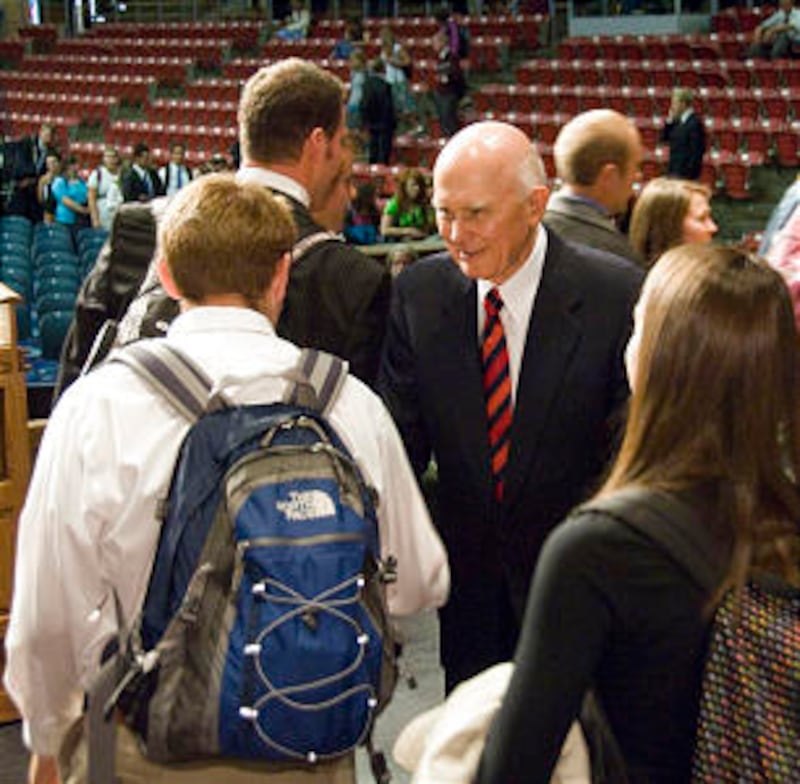
Religious freedom is at risk, Elder Dallin H. Oaks of the Quorum of the Twelve said Tuesday afternoon during the BYU-Idaho weekly devotional held in the Hart Auditorium on the Rexburg, Idaho, campus.
"There is a battle over the meaning of that freedom," Elder Oaks said. "The contest is of eternal importance, and it is your generation that must understand the issues and make the efforts to prevail."
Referencing the religious rights and freedoms available to people living in the United States by the creation of a Constitution by inspired men, Elder Oaks spoke of the importance of those freedoms not only in bringing about the Restoration of the gospel in the early 1800s, but also in religious activities throughout the world today.
"Truly, this nation's most important export is its Constitution, whose great principles stand as a model for 'the rights and protection of all flesh.' On the vital human right of religious freedom, however, many constitutions fall short of the protections that are needed, so we are grateful that the United States government seeks to encourage religious freedom all over the world." This freedom, Elder Oaks said, comes from God.
"We affirm that God is the ultimate source of power and that, under Him, it is the people's inherent right to decide their form of government," Elder Oaks declared.
The principle of sovereignty in the people, as it has been set up in the United States, creates a responsibility for the people to exercise their agency and be accountable for their own actions, he noted.
The guarantee of religious freedom is included in the First Amendment to the United States Constitution. Nevertheless, because governments have legitimate regulatory powers to protect the health and welfare of their citizens, Elder Oaks said, the conflict between the constitutional "freedom of the people and the responsibilities of the government is the central issue of religious freedom.
"The importance of [the guarantee of religious freedom in the U.S. Constitution] should make us ever diligent to defend it," he added. "And it is in need of being defended.
"The greatest infringements of religious freedom occur when the exercise of religion collides with other powerful forces in society. Among the most threatening collisions in the United States today are, one, the rising strength of those who seek to silence religious voices in public debates; and, two, perceived conflicts between religious freedom and the popular appeal of newly alleged civil rights.
"The extent and nature of religious devotion in this nation is changing," said Elder Oaks. "The tide in public opinion in favor of religion is receding, and this probably portends public pressures for laws that will impinge on religious freedom."
In fact, the Proposition 8 election in California [a proposal to restore the law limiting marriage to a man and a woman] "was not about civil rights, but about what equal rights demand and what religious rights protect," Elder Oaks said. "At no time did anyone question or jeopardize the civil right of Proposition 8 opponents to vote or speak their views."
Continuing he said: "The real issue in the Proposition 8 debate — an issue that will not go away in years to come and for whose resolution it is critical that we protect everyone's freedom of speech and the equally important freedom to stand for religious beliefs — is whether the opponents of Proposition 8 should be allowed to change the vital institution of marriage itself."
Noting that the marriage union of a man and a woman has been the teaching of the Judeo-Christian scriptures and the core legal definition and practice of marriage in western culture for thousands of years, Elder Oaks added, "Those who seek to change the foundation of marriage should not be allowed to pretend that those who defend the ancient order are trampling on civil rights."
At the same time, he cautioned that all who conduct resistance to attempts to change the foundation of marriage "should frame their advocacy and their personal relations so that they are never seen as being doctrinaire opponents of the very civil rights, such as free speech, of their adversaries or any other disadvantaged group."
Recognizing the important task of advocating religious freedom, Elder Oaks offered five points of counsel to the young adult audience on how Latter-day Saints should conduct themselves to enhance religious freedom in a period of turmoil and challenge.
"First, we must speak with love, always showing patience, understanding and compassion toward our adversaries," he said.
"Even as we seek to speak with love, we must not be surprised when our positions are ridiculed and we are persecuted and reviled," he said. "Modern revelation commands us not to revile against revilers.
"Second, we must not be deterred or coerced into silence by ... intimidation."
Not only is it a constitutional right, it is also a duty to exercise one's religion, Elder Oaks said, through voting on public issues and participating in elections and debates in the public square and the halls of justice. "While our Church rarely speaks on public issues, it does so by exception on what the First Presidency defines as significant moral issues, which could surely include laws affecting the fundamental legal, cultural, moral environment of our communities and nations," he said. "We must also insist on this companion condition of democratic government: when churches and their members or any other group act or speak out on public issues, win or lose, they have a right to expect freedom from retaliation."
"Third, we must insist on our freedom to preach the doctrines of our faith."
Oftentimes religious people who share the Church's moral convictions feel some intimidation, Elder Oaks said. But no matter the world's view, leaders of the Church do not refrain from taking a stand on current moral issues.
"We will continue to teach what our Heavenly Father has commanded us to teach, and trust that the precious free exercise of religion remains strong enough to guarantee our right to exercise this most basic freedom.
"Fourth, as advocates of the obvious truth that persons with religious positions or motivations have the right to express their religious views in public, we must nevertheless be wise in our political participation," he said.
"As Latter-day Saints, we should never be reticent to declare and act upon the sure foundations of our faith. The call of conscience — whether religious or otherwise — requires no secular justification," Elder Oaks said. "At the same time, religious persons will often be most persuasive in political discourse by framing arguments and positions in ways that are respectful of those who do not share their religious beliefs and that contribute to the reasoned discussion and compromise that are essential in a pluralistic society.
"Fifth, Latter-day Saints must be careful never to support or act upon the idea that a person must subscribe to some particular set of religious beliefs in order to qualify for a public office.
"Wise religious leaders and members will never advocate religious tests for public office," said Elder Oaks. "Fragile freedoms are best preserved when not employed beyond their intended purpose."
If candidates are rejected primarily because of a religious belief or affiliation, the free exercise of religion is weakened at its foundation, Elder Oaks explained.
In order for members to continue their religious freedom and sustain guaranteed personal rights, certain principles must be followed, he added.
"It was the Christian principles of human worth and dignity that made possible the formation of the United States Constitution over 200 years ago, and only those principles in the hearts of a majority of our diverse population can sustain that Constitution today," Elder Oaks said.
"Religious values and political realities are so interlinked in the origin and perpetuation of this nation that we cannot lose the influence of Christianity in the public square without seriously jeopardizing our freedoms," he said. "I maintain that this is a political fact, well qualified for argument in the public square by religious people whose freedom to believe and act must always be protected by what is properly called our 'First Freedom,' the free exercise of religion."
