





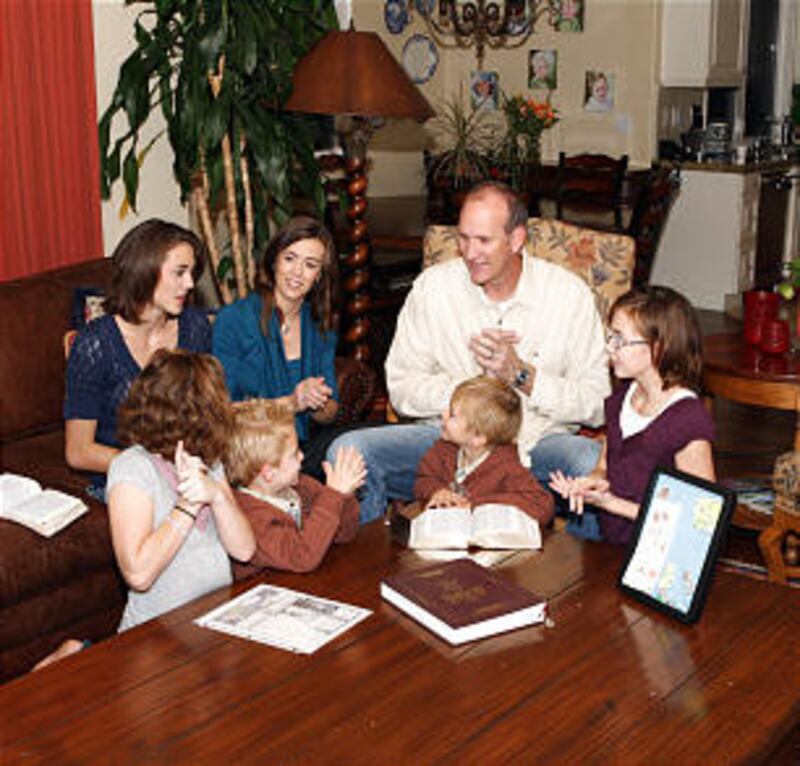
Angi and Jon Hansen hold family home evening each week for two reasons. The first is because they have been promised by leaders of The Church of Jesus Christ of Latter-day Saints that it will make a difference in their family. The second, Sister Hansen said, is that it does make a difference in their family.
"We go to great lengths to block out the demands of the world to spend time with just our family," she said. "We have seen the blessings of that through our children. They love to be with each other. They love to be with us."
Each week the family has a lesson and a short activity. In recent months the Hansens' 4-year-old twins have insisted on playing a hand-clapping game during family night.
The family, Sister Hansen said, has had to be creative and flexible to make family home evening happen. "But," she added, "we are determined to make it happen."
For almost 100 years, Mormon Church leaders have instructed Latter-day Saints to make time each week for family home evening. This is a time for families to study the gospel and participate in activities that strengthen the family spiritually, create family memories and increase love.
The Churchwide effort began in 1915, when President Joseph F. Smith and his counselors in the First Presidency called on parents to gather their children together each week for home evening. Families were instructed to take time to pray and sing together, read the scriptures, teach the gospel to one another and participate in other activities that would build family unity.
In 1970 President Joseph Fielding Smith designated Monday night as the time for family home evening. Since that announcement, the Church has kept Monday evenings free from Church activities so families can have this time together, according to LDS.org.
"All members of the Church should make Monday evening a sacred time, reserved for family home evening," according to LDS.org. "Those who are married should have weekly family home evening with their spouse. As couples have children, they should include them in family home evening, adapting the program to their needs and interests and letting them participate. After the children grow up and move away, couples should continue to hold family home evening together."
Numerous Church presidents have spoken about the many advantages to holding family home evening. Following are quotes from the last five Church presidents:
President Thomas S. Monson: "I begin with family home evening. We cannot afford to neglect this heaven-inspired program. It can bring spiritual growth to each member of the family, helping him or her to withstand the temptations which are everywhere. The lessons learned in the home are those that last the longest. As President Gordon B. Hinckley and his predecessors have stated, 'The home is the basis of a righteous life, and no other instrumentality can take its place nor fulfill its essential functions.' ...
"I like this thought: 'Your mind is a cupboard, and you stock the shelves.' Let us make certain that our cupboard shelves, and those of our family members, are stocked with the things which will provide safety to our souls and enable us to return to our Father in Heaven. Such shelves could well be stocked with gospel scholarship, faith, prayer, love, service, obedience, example, and kindness." ("Constant Truths for Changing Times," April 2005 general conference; Ensign, May 2005.)
President Gordon B. Hinckley: "I am grateful that we as a Church have as a basic part of our program the practice of a weekly family home evening. It is a significant thing that in these busy days thousands of families across the world are making an earnest effort to consecrate one evening a week to sing together, to instruct one another in the ways of the Lord, to kneel together in prayer, there to thank the Lord for His mercies and to invoke His blessings upon our lives, our homes, our labors, our land.
"I think we little estimate the vast good that will come of this program. I commend it to our people, and I commend it to every parent in the land and say that we stand ready to assist you who may not be of our faith. We shall be happy to send you suggestions and materials on how to conduct a weekly family home evening, and I do not hesitate to promise you that both you and your children will become increasingly grateful for the observance of this practice. It was John who declared: 'I have no greater joy than to hear that my children walk in truth' (3 John 4). This will be your blessing." (Teachings of Gordon B. Hinckley, p. 211.)
President Howard W. Hunter: "Take seriously your responsibility to teach the gospel to your family through regular family home evening, family prayer, devotional and scripture-reading time, and other teaching moments. Give special emphasis to preparation for missionary service and temple marriage. ... Next to your own salvation, brethren, there is nothing so important to you as the salvation of your wife and children." ("Being a Righteous Husband and Father," priesthood session of the October 1994 general conference; Ensign, November 1994.)
President Ezra Taft Benson: "Families must spend more time together in work and recreation. Family home evenings should be scheduled once a week as a time for recreation, work projects, skits, songs around the piano, games, special refreshments and family prayers. Like iron links in a chain, this practice will bind a family together, in love, pride, tradition, strength and loyalty." ("Fundamentals of Enduring Family Relationships," Ensign, November 1982.)
President Spencer W. Kimball: "Family home evening provides important training. ... I wonder what this world would be like if every father and mother gathered their children around them at least once a week, explained the gospel and bore fervent testimonies to them. How could immorality continue and infidelity break families and delinquency spawn? Divorce would reduce and such courts would close. Most ills of life are due to failure of parents to teach their children and the failure of posterity to obey.
"Of course, there are a few disobedient souls regardless of training and teaching, but the great majority of children would respond to such parental guidance." (Teachings of Spencer W. Kimball, p. 345-346.)
