



President Henry B. Eyring, first counselor in the First Presidency, was honored April 18 by the Washington Chapter of the BYU Management Society.
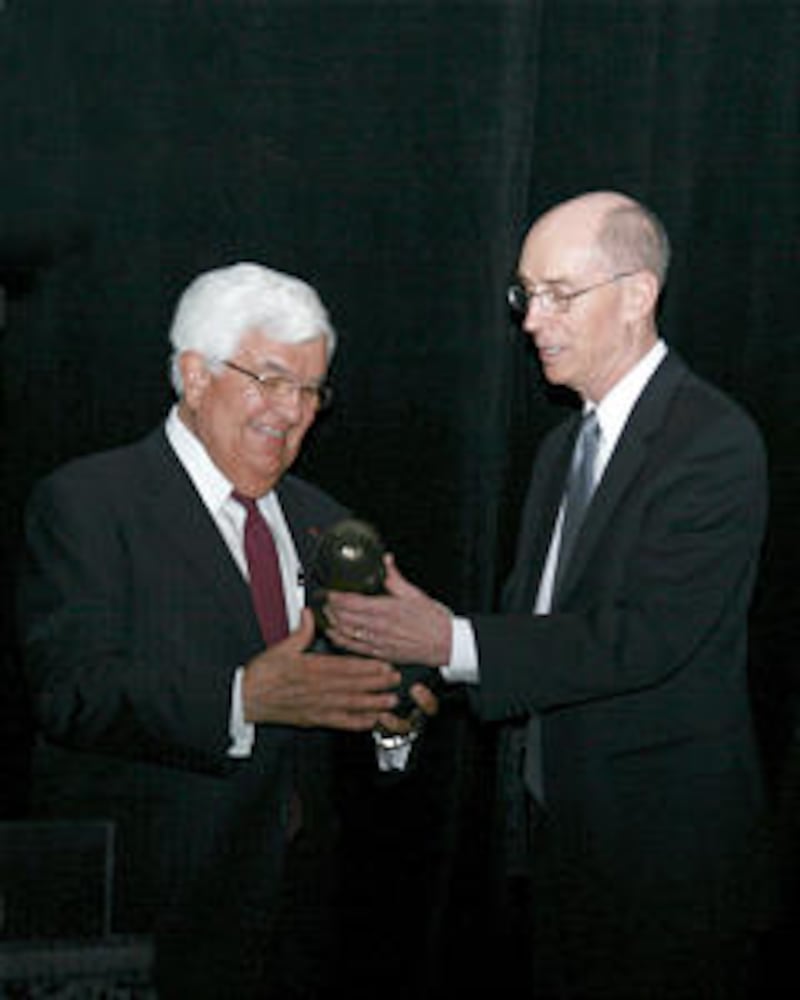
Former U.S. Ambassador to Belgium, Tom C. Korologos, introduced President Eyring, and together with chapter president, Brian Barker, presented him with the chapter's Distinguished Public Service Award for his lifetime of public service.
A graduate of the Harvard Graduate School of Business, President Eyring has served on the faculty of the Graduate School of Business at Stanford University, as president of Ricks College, now BYU-Idaho, and as commissioner of Church Education. He was ordained an apostle on April 6, 1995.
In his address, President Eyring focused on the ways that trust and integrity are hallmarks of great leadership and how ordinary people have opportunities to influence the emergence of great leaders.
"My purpose is to pass along what I've learned regarding leadership and leaders," he said, posing the question of why people decide to follow a leader.
Central to the way that great leaders get others to follow them, President Eyring said, is the character of a man or woman. People will follow the direction of those who do the right thing, he said.
When he was president of Ricks College, President Eyring saw firsthand how such leadership functioned, and how "ordinary people in a climate of trust became leaders." In 1976, while the Eyrings were attending a wedding, the Teton Dam in Idaho collapsed, sending flood waters toward the campus and town. Two of the Eyring children were working on a farm, and two more were being tended at home by a woman. There was no way to reach them or the school because all roads were closed.
Yet, President Eyring slept comfortably in a motel that night because he knew how deeply the people of his community were rooted in moral principles. He expected that they would pray and find the right thing to do.
His sons obeyed their employer's advice to stay and finish the job because he had been their home teacher and they knew and trusted his guidance. They were unharmed, as were his other two children. The college food service manager, who maintained a reserve of food in a spirit of preparedness, called his staff together and prepared 5,000 meals for the flood victims. The campus housing manager, likewise, called his subordinates. That night hundreds of families slept on clean sheets despite losing their homes.
The stake president set up a command post at the student center. People began mucking out flood waters and cutting fallen trees. By the time an official from a national relief agency arrived, the local community had the emergency under control.
Such an outpouring of service is an example of "ordinary people following the leadership of ordinary people," said President Eyring, adding that "the integrity of the follower rose to the integrity of the leader."
One couple who had been out of town returned and went straight to their bishop to ask, "What would you like us to do?"
"They trusted the bishop," said President Eyring, "because of his character and the knowledge that he would tell them what the Lord wanted them to do."
President Eyring also explained how this kind of leadership is true in every endeavor. He referenced the Army Field Manual, which says people of integrity choose the right thing "because their character permits no less." He also made reference to "The Moral Sense," by James Q. Wilson, who wrote that people value those whom they can rely on to act in a principled way.
Pointing out that the Savior was clear about right and wrong, President Eyring counseled people to choose the right, and remember that "when the moral course is hard to find, God gives us help." He added that although people can't always know what is best, they can still know what is right. Likewise, people will follow leaders, not because they are assured of the outcome, but because they know the leader will do what is right.
"All people are accountable to God," President Eyring concluded, saying that making the right decision changes everything, from raising children to running a leadership meeting. "Build confidence that they can know the right thing to do," he advised.
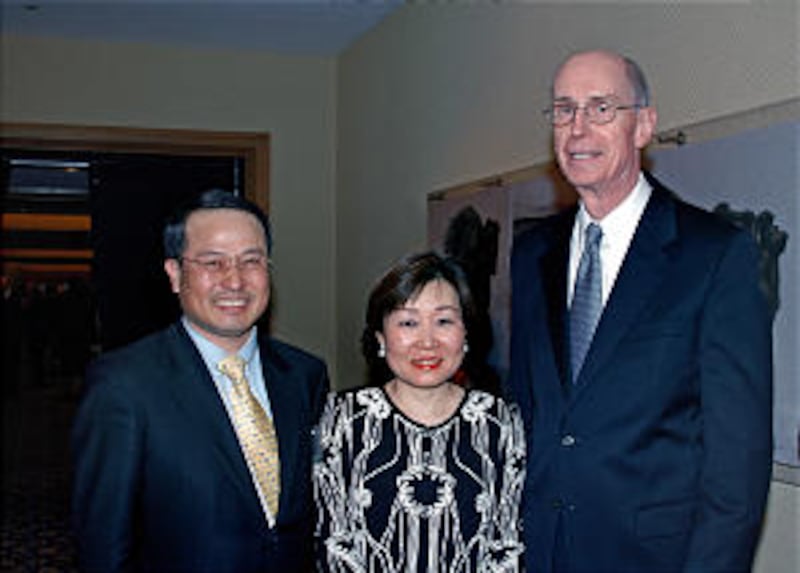
The annual event brings together alumni of the BYU Marriott School of Management, friends of BYU, business and government professionals, and diplomats from around the world. Attending this year were official representatives of Korea, Ukraine, Kazakhstan, Australia and the Philippines.
