



The appetite to possess worldly things can be overcome only by turning to the Lord, and the hunger of addiction can be replaced only by love for Him, said Elder Robert D. Hales of the Quorum of the Twelve.
"He stands ready to help each one of us," he said.
Speaking Saturday morning, Elder Hales directed his remarks to all whose freedom to choose has been diminished by the effects of ill-advised choices of the past.
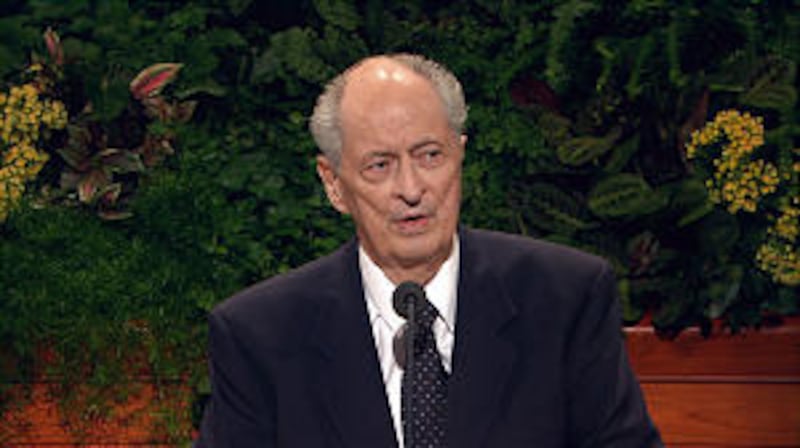
"I speak specifically of choices that have led to excessive debt and addictions to food, drugs, pornography, and other patterns of thought and action that diminish one's sense of self-worth. All of these excesses affect us individually and undermine our family relationships. Of course some debt incurred for education, a modest home, or a basic automobile, may be necessary to provide for a family. Unfortunately, however, additional debt is incurred when we cannot control our wants and addictive impulses. And for both debt and addiction, the hopeful solution is the same — we must turn to the Lord and follow His commandments. We must want more than anything else to change our lives so that we can break the cycle of debt and other uncontrolled wants."
Elder Hales said the challenges of Church members, including those created by their own decisions, are part of their test in mortality.

"We must remember that the adversary knows us extremely well," he said. "He knows where, when and how to tempt us. If we are obedient to the promptings of the Holy Ghost, we can learn to recognize the adversary's enticements."
Success is not measured by how strongly people are tempted, but by how faithfully they respond, said Elder Hales. "We must ask for help from our Heavenly Father and seek strength through the Atonement of His Son, Jesus Christ. In both temporal and spiritual things, obtaining this divine assistance enables us to become provident providers for ourselves and others."
Being provident providers means keeping the basic commandment, "Thou Shalt Not covet" (Exodus 20:17), said Elder Hales.
"Some of us feel embarrassed, ashamed, less worthwhile, if our family does not have everything the neighbors have. As a result, we go into debt to buy things we can't afford — and things we do not really need. Whenever we do this, we become poor temporally and spiritually. We give away some of our precious, priceless agency and put ourselves in self-imposed servitude. Money we could have used to care for ourselves and others must now be used to pay our debts. What remains is often only enough to meet our most basic physical needs. Living at the subsistence level, we become depressed, our self-worth is affected, and our relationships with family, friends and neighbors and the Lord are weakened. We do not have the time, energy, or interest to seek spiritual things."
Elder Hales said when faced with the choice to buy, consume, or engage in worldly things and activities, Church members need to learn to say, "We can't afford it, even though we want it," or, "We can afford it, but we don't need it — and really don't even want it!"
"As we counsel and work together in family councils, we can help each other become provident providers and teach our children to live providently as well," he said.
Elder Hales said the foundation of provident living is the law of the tithe. "The primary purpose of this law is to help us develop faith in our Heavenly Father and His Son Jesus Christ."
In seeking to overcome debt and addictive behaviors, Church members should remember that addiction is the craving of the natural man and it can never be satisfied.
"We must want, more than anything else, to do our Heavenly Father's will and providently provide for ourselves and others,.. Through prayer, fasting, obedience to the commandments, priesthood blessings and His Atoning Sacrifice, we will feel His love and power in our lives. We will receive His spiritual guidance and strength through the promptings of the Holy Ghost. Only through our Lord's Atonement can we obtain a mighty change of heart (see Mosiah 5:2, Alma 5:14) and experience a mighty change in our addictive behavior."
