



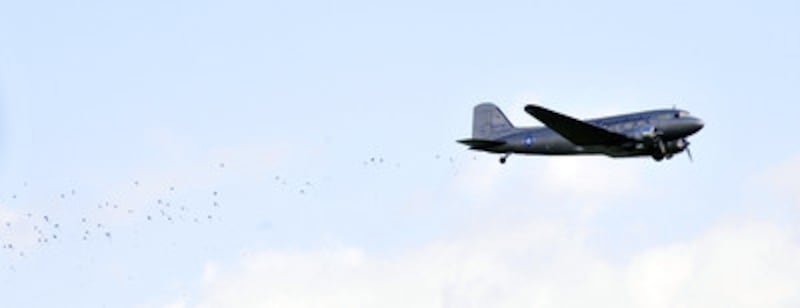
BERLIN — A World War II-era cargo plane dropped hundreds of boxes of chocolate-covered raisins on tiny parachutes into a crowd of tens of thousands on Tuesday, recreating a highlight of the operation that kept West Berlin out of Soviet hands.
Colonel Gail Halvorsen (born October 10, 1920) is a retired career officer and command pilot in the United States Air Force known as the original Candy Bomber or the "Rosinenbomber" in Germany. He was born in Salt Lake City, Utah, and is a member of The Church of Jesus Christ of Latter-day Saints. He is best known for piloting C-47s and C-54s during the Berlin airlift (also known as "Operation Little Vittles") during 1948–1949.
(Church News featured Gail Halvorsen, a member of the Church, in an article published April 26, 2008.)
(Bro. Halvorsen was honored by Hill Air Force Base officials in 2000.)
(Bro. Halvorsen flew in Albania on the 50th anniversary of the Berlin Airlift.)
The drop came on the 60th anniversary of the day the Soviets lifted their blockade strangling West Berlin.
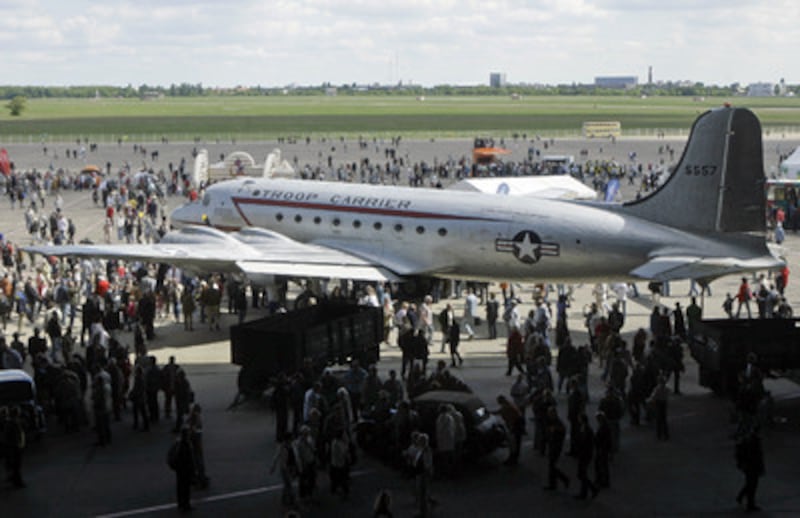
More than 100,000 Berliners turned out in honor of the 120 American, British and French veterans of the airlift who were on hand at Tempelhof, the hub for U.S. planes during the airlift, for the celebrations.
U.S. airlift pilot Gail Halvorsen said the city's approximately 2 million citizens themselves were the unsung heroes.
"They slept in bombed-out buildings with little heat ... but they said we'll never give in," Halvorsen told The AP. "They said we don't have enough to eat, just give us a little — someday we'll have enough — but if we lose our freedom, we'll never get it back."
Halvorsen is probably the best known of the airlift pilots, thanks to an inadvertent propaganda coup born out of goodwill. Early in the airlift, the man from Utah shared two sticks of gum with starving Berlin kids and saw others sniffing the wrappers just for a hint of the flavor.
Touched, he told the children to come back the next day, when he would drop them candy, using handkerchiefs as parachutes.
He started doing it regularly, using his own candy ration. Soon other pilots and crews joined in what would be dubbed "Operation Little Vittles."
After an Associated Press story appeared under the headline "Lollipop Bomber Flies Over Berlin," a wave of candy and handkerchief donations followed.
The airlift itself began June 26, 1948, in an ambitious plan to feed and supply West Berlin, after the Soviets — one of the four occupying powers of a divided Berlin after World War II — blockaded the city in an attempt to squeeze the U.S., Britain and France out of the enclave within Soviet-occupied eastern Germany.
American, British, Canadian, Australian, New Zealand and South African pilots flew 278,000 flights to Berlin over 15 months, carrying about 2.3 million tons of food, coal, medicine and other supplies.
On the operation's busiest day — April 16, 1949 — about 1,400 planes carried in nearly 13,000 tons over 24 hours — an average of one plane touching down almost every minute.
On the ground in Berlin, ex-Luftwaffe mechanics were enlisted to help maintain aircraft, and some 19,000 Berliners — almost half of them women — worked around the clock for three months to build Tegel Airport, providing a crucial relief for the British Gatow and American Tempelhof airfields.
Finally, on May 12, 1949, the Soviets realized the blockade was futile and lifted their barricades. The airlift continued for several more months, however, as a precaution in case the Soviets changed their minds.
"It was the first victory of what became known as the Cold War," said Air Marshal Sir John Curtiss, a British airlift veteran. "It's been rightly said that it did more than just save Berlin — it also stopped the Soviets from expanding their power into West Germany and into the west of Europe."
To this day it still shapes the German view of the Western allies — especially in Berlin. After the Sept. 11 attacks on the U.S. in 2001, some 200,000 Berliners took to the streets of the German capital to show their support for the country that had helped prevent their city falling completely to the Soviets.
"You laid the cornerstone for today's trans-Atlantic relationship," Berlin Mayor Klaus Wowereit told the veterans. "It was a logistic, humanitarian masterpiece that is ... burned in the memory of the city."
German officials and representatives from the countries that took part in the airlift laid wreaths Tuesday at the base of the memorial in front of Tempelhof's recently closed terminal building.
Ed Gere, who as a 25-year-old United States Air Force pilot flew 184 round trips from a British air base in West Germany to Berlin during the airlift, grew teary-eyed as he pointed out on the memorial the names of those who died.
"There's names of some good friends there who didn't make it," said Gere, of Amherst, Massachusetts.
Though neither side resorted to force, 39 Britons, 31 Americans and at least five Germans were killed in accidents during the airlift.
For Tuesday's event, children from Berlin's Boy Scouts of America Troop 46 Freedom Outpost and the John F. Kennedy German-American school spent hours putting together 700 parachutes holding packages of chocolates and chocolate raisins, which were dropped from the DC-3 with Halvorsen on board.
Scout Isaac Dye, 11, said he thought it important to pay tribute to those involved in the events 60 years ago.
"They played such an important role in history," he said.
Halvorsen said the children's' effort was very much in spirit with his thinking at the time of the airlift.
"Without them we wouldn't have an air drop today — they're dedicated in service," he told AP. "For me it was throwing out 'chutes for kids who had no chocolates — that made me happy."
Key events of the Berlin Airlift:
1948:
June 24: A steadily tightening noose of travel restrictions, begun nearly three months earlier, culminates in a full-blown Soviet blockade of Berlin.
June 26: Airlift begins with 32 American C-47 flights bringing 80 tons of supplies — mainly powdered milk, flour and medicine — into Tempelhof airport.
August 12: American and British planes deliver 4,742 tons of supplies, the first time the airlift exceeds the 4,500 daily tons believed necessary to sustain 2 million West Berliners for a single day.
October 26: The Soviet Union vetoes a U.N. Security Council resolution calling for action to resolve the blockade.
December 20: "Operation Santa Claus" brings Christmas gifts to 10,000 Berlin children.
1949:
January/February: Airlift averages 5,500 tons of supplies each day.
February 18: Total airlifted supplies top one million tons.
April 16: The so-called "Easter Parade" operation breaks a 24-hour-delivery record, with some 1,400 flights carrying in nearly 13,000 tons of coal — an average of one plane touching down every 62 seconds.
May 12: At one minute after midnight, the Soviets lift their barricades and restore access from West Germany to Berlin.
September 30: The last of more than 278,000 flights lands in Berlin. Of these, Americans flew nearly 190,000, the combined British, Canadian, Australian, New Zealand, and South African forces flew nearly 90,000, France more than 400. Total payload: some 2.3 million tons of food, coal, medicine and other supplies. Seventy-three Allied airmen and at least five Germans died in accidents during the operation.
