




A bishop recently spoke to Sister Julie B. Beck about a problem he had in his ward. The women, he told the Relief Society general president, don't know how to minister. This was obvious, he continued, because only 10 percent of the Relief Society sisters were completing their visiting teaching each month.
Sister Beck agreed to attend a ward Relief Society meeting and see if she could discover the cause of the problem. "When I got there they sent around a sign-up for about 15 expectant mothers who were going to have new babies," she said. "They needed meals brought in, two meals for each mother. That list filled up just like that. It didn't even make it around the room. Everyone wanted to help."
Instantly, Sister Beck recognized what was happening. "You don't have a ministering problem," she told the bishop. "You have an organization problem."
She wondered if the women had been called correctly, if they had been taught the importance of being a visiting teacher. She wondered if they understood that they have no other responsibility outside of their families that has the potential to do as much good as visiting teaching.
The problem, she told the bishop, would go away if the ward was focusing on people rather than percentages.
Meeting recently with the Church News to discuss the importance of visiting teaching, Sister Beck said the purpose of the inspired program is to minister, watch over and strengthen Latter-day Saint sisters. "Visiting teaching is one of the best ways we can fulfill our lifelong responsibilities to increase our faith and personal righteousness, strengthen families and homes and seek out and help those in need," she said.
"The leadership skills you need — you need to be a minister and you need to be a teacher," she said. "Those are both Christlike skills. They are leadership abilities the Savior had. He was always a teacher. He was always a minister."
In essence, she continued, visiting teachers have those two major responsibilities: to teach and to minister. Most women in the Church understand the teaching part. Visiting a sister with a lesson each month "is the teaching, but it is not always ministering."
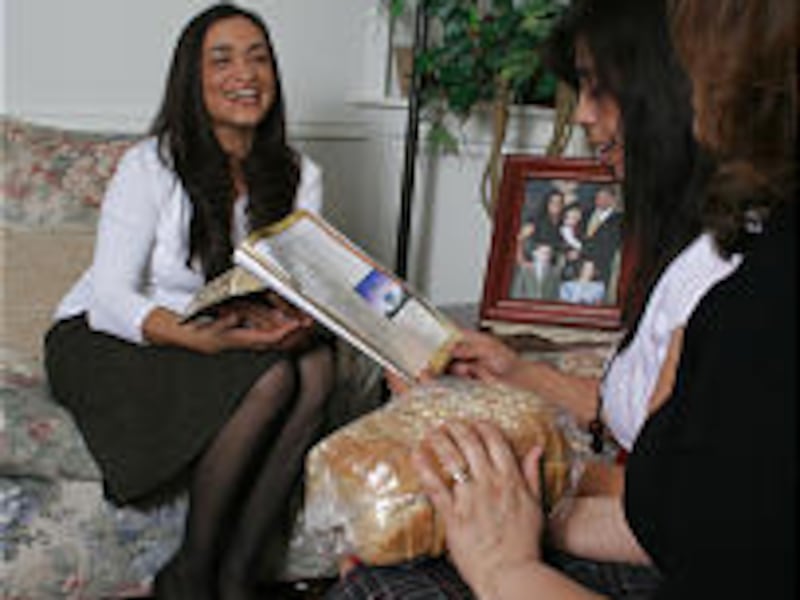
Sometimes, instead of a visit, a sister needs an extra meal or someone to take her children for an hour. Sometimes a sister needs a flower, a note or a phone call or an invitation to go to a social event. Sometimes a sister needs "somebody just knowing her family has the flu."
Visiting teaching is often hard because it is not showy, Sister Beck continued. In visiting teaching "the best work you do no one knows about. You get points only in heaven."
Sisters worry about what they should report, she added. They should give a report about the contact and the spiritual and temporal well-being of the sisters. Most people want to get points here, so they report each month that they have visited and think that their work is done. "But visiting teaching is where you want points in heaven. This is between you and the Lord. He is not here, so you take care of the sisters for Him."
In reality, she said, visiting teaching is never finished. It is more a way of life than a task.
"Some sisters say, 'I will give the lesson via e-mail or I will mail the lesson,'" she said. "There is no substitute for a hug, for personal contact, there is just no substitute for that.
"It can be done at the Church. It can be done at their home. But there is no substitute for that personal contact. That is where people know you care."
Further, said Sister Beck, women don't always get to choose with whom they serve and to whom they make visits. "And that is OK," she said.
"If you don't love your sister, then pray to love her. This is one of those things we do with our faith. We show that we believe in Christ and His gospel and in His way by doing this one thing that gives us the chance to behave as He behaved and do as He did."
Many times companions have a hard time working together because their schedules don't mesh, continued Sister Beck. "So visiting teachers need to work together to find inspired ways to watch over their sisters. Maybe it is one of them visiting and another one doing something else."
The important thing is that they "work as a companionship to tend the people. That can be different than visiting as a companionship."
Partners will need to seek inspiration on how they can work together. "It doesn't mean you need to put on a skirt and go with your companion and sit down the first week of the month and read the whole magazine. You work with your companion to find out how you are going to watch over and strengthen your sister; how you are going to teach and minister to her that month."
Sometimes one woman will need to take the lead, because visiting teaching is also the place where the sisters can accomplish the responsibility taught in Doctrine and Covenants 84:106: Those that are strong can take with them those that need strengthening.
Relief Society presidencies and visiting teachers should follow the policies set by the First Presidency and work in approved companionships. (Visiting teaching groups, where several sisters meet together are not approved.) In essence, the purpose of Relief Society as established by the Lord is to prepare women for the blessings of eternal life. Visiting teachers are an essential part of that, she said.
"We have a daughter who hasn't lived near us, so I have really relied on her visiting teachers to watch over her," said Sister Beck, noting that this daughter has had several children in the time Sister Beck has served in general Church leadership positions.
One time this daughter was in a new ward, expecting a baby and she and some of her children became very sick. Her husband was out of town and she was alone in a difficult situation. The Relief Society president happened to stop by and found the family in great need of some help. Sister Beck's daughter confessed that she didn't know whom to call for help. The Relief Society president said she had been searching for the right visiting teachers for her and she was sorry that the watch care had not taken place.
"Let me guess," Sister Beck's daughter told the Relief Society president, "you are trying to match me up with a friend. What I need is a grandma. I can make my own friends."
So, Sister Beck said, her daughter was assigned to a woman who came and played with her little children once in a while and was willing to watch one child while another went to the doctor. She showed up sometimes with food unannounced. "She did things that I would have done had I lived close to her," Sister Beck said. "It was not everyday help but just being in tune with the Spirit and aware of needs. I was so grateful she had an inspired visiting teacher ministering to her and teaching her."
