



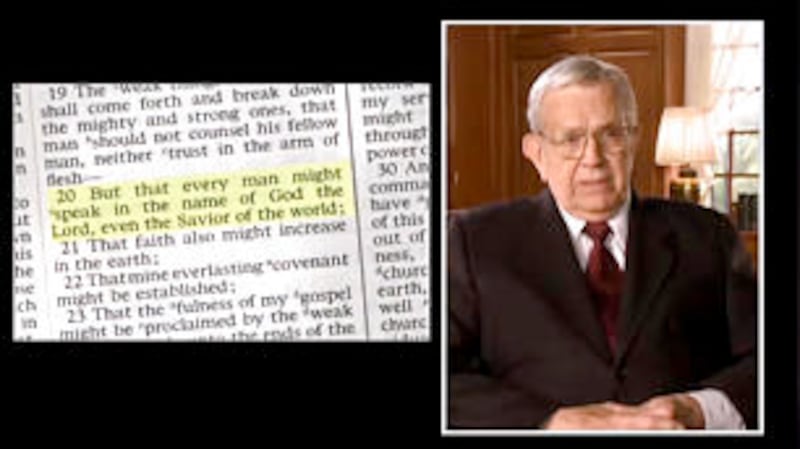
"For my soul delighteth in the scriptures, and my heart pondereth them, and writeth them for the learning and the profit of my children" (2 Nephi 4:15).
At considerable sacrifice, including giving his life, William Tyndale translated significant portions of the Bible to English during the 16th century. In 1830 Joseph Smith published the Book of Mormon after translating it by the gift and power of God. He too gave his life for this incredible work. Much has been written about the LDS version of the standard works, but no visual representation of this miraculous undertaking has ever been produced, until now. At noon on Oct. 3, 2010, (just after the Sunday morning session of conference) BYUTV will air for the first time on television "That Promised Day," a one-hour video documentary detailing the exciting history behind the inspired version of the LDS scriptures. The video can also be seen right now online at byutv.org/thatpromisedday
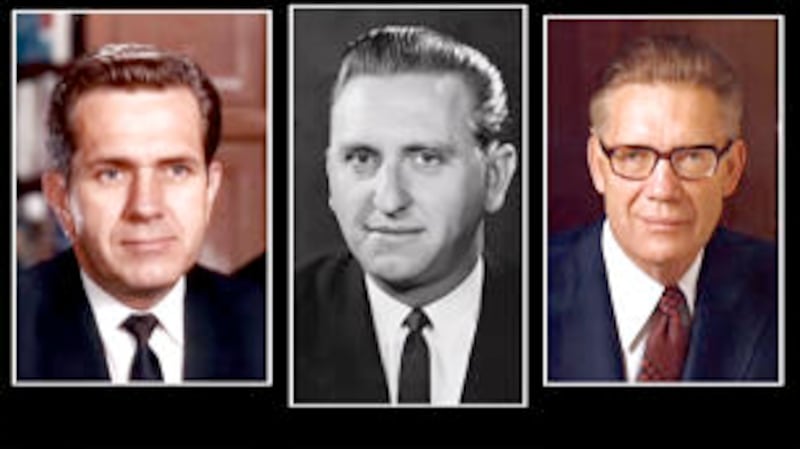
"That Promised Day" tells the story of the modern day miracles that led to the creation and publishing of the complete standard works of the Church. It chronicles the miracles, sacrifices and painstaking work by some of the greatest scholars of this dispensation under the direction of prophets, seers and revelators. President Thomas S. Monson was interviewed exclusively for the film and said, "More people have studied the scriptures, more people have carried the scriptures, and more people have been taught the scriptures and understand the scriptures as a result of the work we're talking about."
President Boyd K. Packer, president of the Quorum of the Twelve, was also interviewed and spoke about the original advisory committee that was put together to produce the LDS edition of the scriptures. He said, "We had President Monson, then Elder Monson. He was a printer. And he was an expert in printing. That's what he did for a living. So he had that pattern. Bruce McConkie was the expert on the doctrine, and I was somewhere in between them. My concern was to have them printed in such a way that the ordinary man could afford them and could handle them."
Early work on the film began with inspiration. In 2008 Fred E. Woods, professor of Church History and Doctrine at BYU, had several promptings to move forward in producing a documentary about the history of the new LDS edition of the scriptures. He later met with Sterling VanWagnen, Director of Content for BYU Broadcasting, at the Crandall Historical Printing Museum, and while they were standing in front of the Grandin Printing Press (the press used for printing the first edition of the Book of Mormon), Brother Woods had a strong spiritual impression. He told Sterling that work on the documentary should commence immediately, and it did. Brother Woods was hired as a co-producer on the film. Brother Woods said, "It was obvious that the hand of the Lord was upon this project from beginning to end."
Sterling VanWagnen became executive producer on the film, and he hired film director and producer Martin Andersen. Brother Andersen too felt an urgency to complete the film before some of those who helped contribute to the original work passed away. He said, "Robert J. Matthews (authority on JST), Robert Patch (Greek language expert), Jim Mortimer (advisory committee secretary) and Daniel Ludlow (advisory committee secretary) all passed away during the production of the documentary. We were fortunate enough to get some interviews before they were gone. We only had audio of an interview with Brother Patch, but we did use that in the film."
Production for the film included interviews with the former president of the RLDS Church, Wallace B. Smith, great-grandson of Joseph Smith, Jr. and RLDS historian Dick Howard. The film crew also went to Cambridge University Press in England. Cambridge was critical in helping the Church produce the LDS version of the King James Bible over 30 years ago.
It was difficult to find employees still at Cambridge Press who had worked on the original project, but two employees were located. The video includes several interviews with staff from Cambridge University Press and details their interesting perspective on the project. Brother Andersen said, "It was both intimidating and awesome to be part of the project. I had several priesthood blessings to help me complete my assignment with inspiration from the Lord. I gained a completely new understanding of the scriptures."
Distribution of the film will be through BYUTV. Derek Marquis, managing director of BYU Broadcasting, said, "The documentary was produced for and will air primarily on BYUTV. Viewers around the world will have the opportunity to view it many times over the coming months as BYUTV is now available in over 55 million homes in the U.S. on cable and satellite and millions more internationally. The program will also be available as a video-on-demand offering for viewers anytime on our website at byutv.org/thatpromisedday."
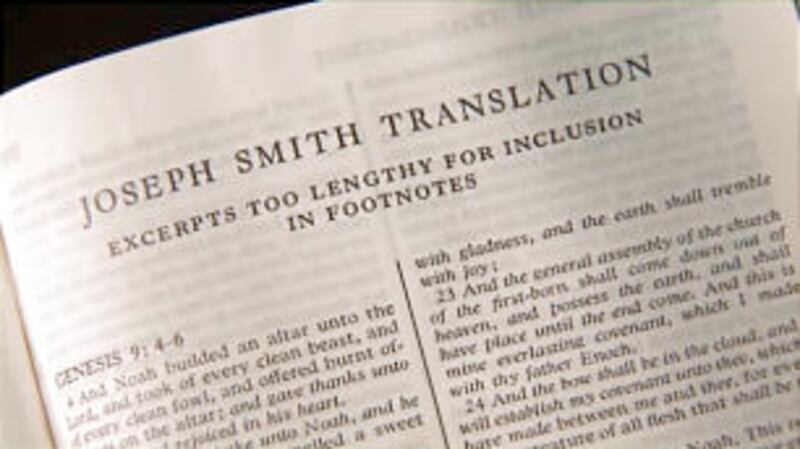
From the Joseph Smith translation to the enormous topical guide, to the myriad of cross references, footnotes, and chapter headings to the informative Bible dictionary, this video production brings greater understanding and respect for the culmination of God's words across geographic and generational boundaries. The spirit of "That Promised Day" is prophetically delivered by Elder Bruce R. McConkie in the film. He said, "Truly this is that promised day when 'every man might speak in the name of God the Lord, even the Savior of the world'" (D&C 1:20).
e-mail: rmorgenegg@desnews.com
