



On Dec. 23, 1805, as much of the world was preparing to celebrate the birth of Jesus Christ, another baby boy was born. Like Jesus, this 19th century baby came forth in humble circumstances and in an obscure village.
Though the world didn't know it at the time, the birth of Joseph Smith Jr. would initiate what is arguably the greatest and most far-reaching chain of events in the history of Christianity since the Savior's mortal ministry itself.
That infant would grow up to hold the apostolic office and thus be a special witness of Jesus Christ, the first mortal man on earth with such authority since the deaths of Peter, Paul and other New Testament figures. But Joseph's role would have further significance, he being the man who, under the direction of Jesus Christ, received the keys of the gospel's restoration in latter days and of the prophesied Dispensation of the Fulness of Times. It was a role with transcendent magnitude, fulfilling scriptural prophecy.
Joseph himself would only begin to become aware of its significance himself at age 14, when, in response to a fervent plea for religious guidance, he saw in their glory the Father and the Son.
In subsequent theophanies and other heavenly visitations, the young prophet would receive further divine tutoring.
Visiting Joseph on Sept. 21, 1823, the Book of Mormon prophet Moroni in angelic form quoted a number of biblical passages, among them this verse from Isaiah:
"And there shall come forth a rod out of the stem of Jesse, and a Branch shall grow out of his roots" (Isaiah 11:1).
Some 15 years later, the Prophet would provide a divinely revealed explanation of this verse in the form of questions and responses recorded today as Doctrine and Covenants 113:1-4: "Who is the Stem of Jesse spoken of in the 1st, 2nd, 3rd, 4th, and 5th verses of the 11th chapter of Isaiah?
"Verily thus saith the Lord: It is the Christ.
"What is the rod spoken of in the first verse of the 11th chapter of Isaiah, that should come of the Stem of Jesse?
"Behold, thus saith the Lord: It is a servant in the hands of Christ, who is partly a descendant of Jesse as well as of Ephraim, or of the house of Joseph, on whom there is laid much power."
Commented Elder Bruce R. McConkie of the Quorum of the Twelve, "Are we amiss in saying that the prophet here mentioned is Joseph Smith, to whom the priesthood came, who received the keys of the kingdom, and who raised the ensign for the gathering of the Lord's people in our dispensation?"
Alexander W. Baugh, professor of Church history and doctrine at BYU commented, "On Dec. 9, 1834, Joseph Smith Sr. pronounced a patriarchal blessing on Joseph Smith Jr. wherein he declared that the Prophet was a lineal descendant and birthright heir to the patriarchal fathers Abraham, Isaac and Jacob, but more particularly Joseph of Egypt. Furthermore, Brigham Young declared that Joseph Smith was a descendant of Joseph through Ephraim (Journal of Discourses 2:269).
"Additionally, Doctrine and Covenants 113:6 states that the 'root of Jesse' as spoken of in Isaiah 11:10 is 'a descendant of Jesse, as well as of Joseph, unto whom rightly belongs the priesthood, and the keys of the kingdom for an ensign, and for the gathering of my people in the last days.' Such wording suggests the individual to be none other than Joseph Smith."
Jesse, in biblical history, is the father of David, making him the ancestor of the kings of Judah and of Christ (see Ruth 4:17,22; 1 Chronicles 2:5-12; Matthew 1:5-6; Bible Dictionary, "Jesse" entry).
Thus the Prophet Joseph Smith fits the scriptural designation of being descended from Jesse and Joseph, of having been endowed with much power, and of having been given the priesthood and the keys of the kingdom preparatory to the gathering of Israel in the last days preceding the Second Coming of the Savior.
Joseph was foreordained to be a witness of Christ at a pivotal time in world history (see History of the Church 6:364; 2 Nephi 3:7-11).
Small wonder that the scriptural volume containing the revelations given to him, the Doctrine and Covenants, would be replete with fervent and profound testimony of the Savior. Among the most striking, commented Steven C. Harper, professor of Church history and doctrine at BYU, are the teachings on the Atonement in Sections 18 and 19.
"I think Doctrine and Covenants 18:10 is the most modest understatement anywhere, since the worth of a soul, we discern in the subsequent verses, is equal to the Savior's infinite atonement," he said. "I like what Truman Madsen said on this point: 'If souls are of value in direct proportion to the concern and sacrifice of our Redeemer, then we know that in the eyes of the Father and the Son, your soul — even yours — and mine — even mine — is of infinite worth'" ("The Savior, the Sacrament and Self-Worth," address given at the 1999 BYU-Relief Society Women's Conference).
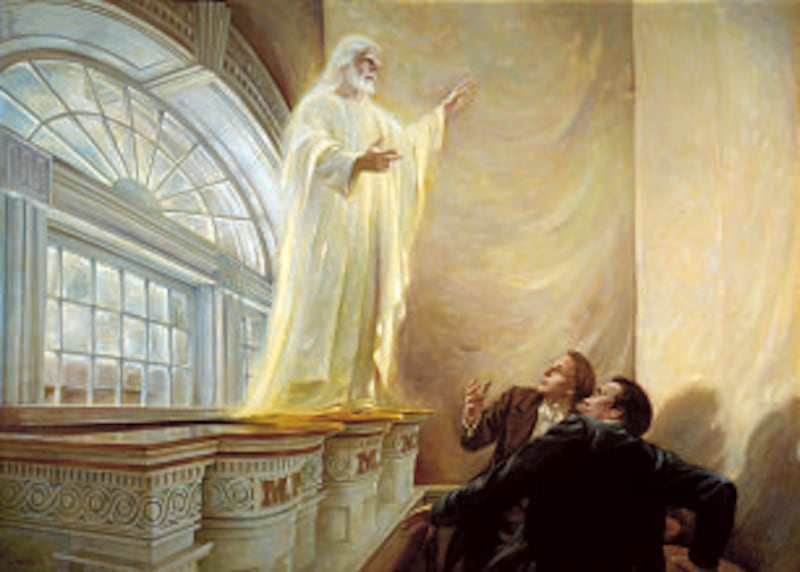
The Doctrine and Covenants also contains accounts of two other personal visitations by the Savior to Joseph, one with Oliver Cowdery at the Kirtland Temple on April 3, 1836. Of this occasion, they testified, "We saw the Lord standing upon the breastwork of the pulpit, before us; and under his feet was a paved work of pure gold, in color like amber.
"His eyes were as a flame of fire; the hair of his head was white like the pure snow; his countenance shone above the brightness of the sun; and his voice was as the sound of the rushing of great waters, even the voice of Jehovah saying:
"I am the first and the last; I am he who liveth, I am he who was slain; I am your advocate with the Father" (Doctrine and Covenants 110:2-4).
The occasion prior to that was with Sidney Rigdon on Feb. 16, 1832, at Hiram, Ohio.
Of that experience, they testified: "After the many testimonies which have been given of him, this is the testimony, last of all, which we give of him: That he lives!
"For we saw him, even on the right hand of God; and we heard the voice bearing record that he is the Only Begotten of the Father —
"That by him, and through him, and of him, the worlds are and were created, and the inhabitants thereof are begotten sons and daughters unto God" (Doctrine and Covenants 76:22-24).
"Over and over they say, we saw, we heard, we bear record," Brother Harper remarked. "It is an expansive Christ-centered text, and right there in verses 22-24, they give the 'last,' — which I take to mean ultimate — testimony that could be given of him, namely that two witnesses saw, heard, felt, and are on record that Jesus Christ is God's Only Begotten Son and the Savior of worlds (plural) and their inhabitants."
