



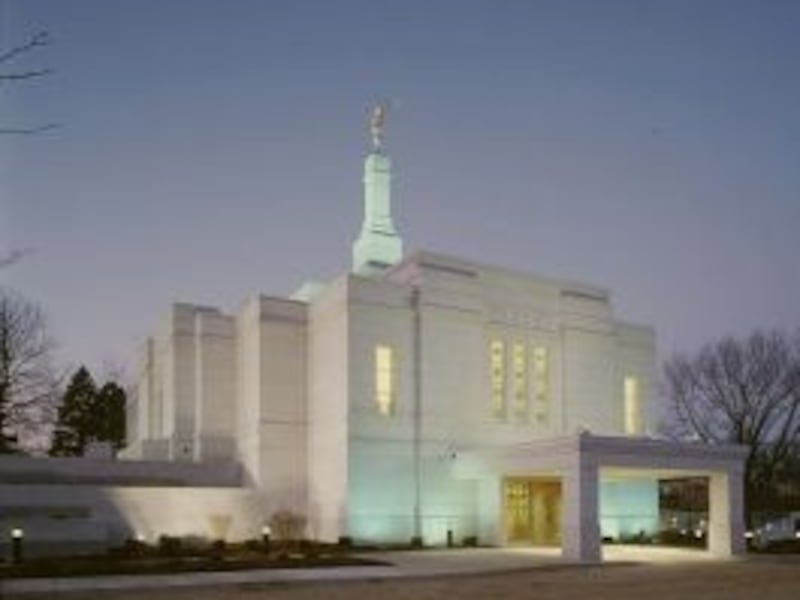
Announced: June 14, 1999.
Location: adjacent to Mormon Pioneer Cemetery and across from Mormon Trail Center; 8283 North 34th Street, Omaha, NE 68112; phone (402) 453-3406; no clothing rental.
Site: 1.92 acre site.
Exterior finish: Bethel white granite.
Temple design: Traditional design.
Architect: Dan Reinhardt of Reinhardt & Associates.
Project manager: Bill Naylor.
Contractor: Lund-Ross Constructors, Inc.
Rooms: Celestial room, two ordinance rooms, two sealing rooms, baptistry.
Total floor area: 10,700 square feet.
Dimensions: 149 feet by 77 feet; 86 feet high.
District: 12 stakes in Nebraska, Iowa, South Dakota and Kansas.
Groundbreaking, site dedication: Nov. 28, 1999, by Elder Hugh W. Pinnock of the Seventy and president of the North America Central Area.
Dedication: April 22, 2001, by President Gordon B. Hinckley; 4 sessions. First session transmitted by satellite worldwide.
Dedicatory Prayer
Done by President Gordon B. Hinckley
O God our Eternal Father, Thou Great Elohim, we bow before Thee in humility and with gratitude to dedicate this Thy holy house. The ground on which this sacred structure stands was hallowed a century and a half ago by the suffering of Thy Saints. Here they stopped temporarily, hundreds and thousands of them on both sides of the Missouri River, while moving westward from their homes in Nauvoo, or from the British Isles and Europe to the valley of the Great Salt Lake. Many of them died here and are buried in the cemetery adjacent to this holy house. Great were their trials. Tremendous their sacrifice.
As we meet together, we envision the wagons and the boats pulling in from the East and the South, while others were leaving these grounds to make the long march up the Elk Horn, along the waters of the Platte, up the valley of the Sweet Water, over the Continental Divide, and finally to the valley of the Great Salt Lake. All of this area, including Council Bluffs across the river and Florence on this side, was once a place of great industry. Here wagons and handcarts were built. Here oxen, cows, and other animals, seeds and plants were gathered together to move to the West. There was, at times, much of levity here. There was also much of sorrow.
Now the generations have come and gone. Our people left here. Then for reasons of employment they slowly returned. Today we have stakes and wards with large congregations. Songs of thanksgiving fill our hearts. Crowning all is the presence of a temple on this hallowed ground.
Acting in the authority of the holy priesthood in us vested and in the name of Jesus Christ, we dedicate this the Winter Quarters Nebraska Temple of The Church of Jesus Christ of Latter-day Saints. We dedicate it unto Thee and unto Thy Son as Thy holy house for the accomplishment of Thy work. We dedicate the ground on which it stands, ground which has already been made holy by those who long ago were buried here. We make the cemetery a part of these grounds, together with all of the vegetation growing thereon. We dedicate the temple from the footings to the top of the steeple with its figure of Moroni.
We dedicate the walls and roof and pray that they may be strong and firm against the storms of nature.
We dedicate the interior of the building, the beautiful baptistry, the endowment rooms, the Celestial Room, and the sealing rooms with their sacred altars. We dedicate all of the halls and spaces and offices within this sacred structure. We pray that Thou wilt accept of them and that Thou wilt visit them with Thy holy presence. Let Thy Spirit dwell here and touch the hearts of all who enter these portals. Save this building from the hands of any disposed to mar or destroy. May it stand through the years as a place of holiness, a house sanctified unto Thee, a place of eternal ordinances.
We pray for all who will serve here, whether they be workers or patrons. May the hearts of all who live within this temple district turn to this sacred structure. May Thy people so live as to be worthy to labor here. We pray for those who will serve in the presidency of the temple and those in the office of matron and assistants to the matron. We pray for all who serve here in any capacity and ask that Thou wilt touch the hearts of Thy people with a great desire to come frequently to Thy holy house.
We thank Thee for faithful tithe payers throughout the world, whose contributions have made possible the construction of this and the many other temples now enjoyed by Thy people. Pour out Thy blessings upon the faithful Latter-day Saints wherever they may be. May blessings come down from heaven upon them. May their lives be enriched. May they be prospered in their affairs. May they be cradled in Thy strong arms as they walk in faith before Thee.
We thank Thee for the Prophet Joseph Smith to whom the temple ordinances were revealed. Let Thy blessings rest upon the Presidency of Thy Church, the Quorum of the Twelve, the Seventy, the Presiding Bishopric, and all who serve in any capacity whatever throughout the world.
Bless the officials of the City of Omaha, who have worked cooperatively with us in this sacred undertaking. Bless all of the citizens of the States of Nebraska and Iowa. Bless this nation of which we are a part that it shall remain ever free and that its people may always be blessed with liberty to worship according to the dictates of conscience.
Dear Father, accept of our thanks for every blessing. On this sacred and historic day, we resolve within our hearts to serve Thee with greater dedication. We ask it as Thy humble children with thanksgiving and gratitude in the name of Thy Beloved Son, even the Lord Jesus Christ, our Redeemer, amen.
Pioneer resting place in shadow of new Winter Quarters temple
By Shauna B. Valentine
Director of Multi-Stake Public Affairs
OMAHA, Neb.— Open house for the Winter Quarters Nebraska Temple concluded April 14th after attracting 61,000 people who toured the two-story temple that sits on a hill adjacent to the Mormon Cemetery and across the street from the Mormon Trail Center.

"The Winter Quarters name is fitting for this historic temple," said President E. Louis Butler, former President of the Omaha Nebraska Papillon Stake and newly called president of the Winter Quarters Nebraska Temple. "Although the pioneers were here for only two years, it was an important time in the history of the Church. It was a time for renewal, perseverance and faith.
"This temple is on sacred ground. It is a fitting memory to those stalwart, exemplary pioneers, many of whom never made the trip west but found their final resting place on the hill above Florence. Now their resting place is in the shadow of the temple."
The 104th temple of the Church is situated in Florence, part of North Omaha. Years after Winter Quarters was abandoned, pioneers gathered in this same area, now known as Florence, to prepare for the trek westward.
After watching the construction of the temple for 16 months, neighbors expressed gratitude for their opportunity to take a tour. Many in the Florence community wondered what could cause such excitement and anticipation when the groundbreaking ceremony was held in November of 1999 with 3,500 in attendance.
Following a tour, one Lutheran neighbor wrote, "As a nearby resident to the Mormon Cemetery, [I feel that] the temple is a beautiful building and a welcome addition to the neighborhood. Thank you for sharing it."
Another stated: "Thank you for sharing this special time of your Church with us. We are a Catholic group and feel we are all striving to find God in our own way. You are an inspiration to God's work."
The temple interior evokes a pioneer ambiance. The furniture is Early Eastlake style, prominent in the area during the late 1800s. A combination of antiques as well as replicas adorn the temple. Original paintings and 18 exquisite stained-glass windows, crafted by Utah artist Tom Holdman, drew many compliments from visitors. (A feature article about the windows was published in the Church News March 17, 2001, pp. 8-9.)
The windows, as well as the sculptured carpeting, present the motif of the state flowers of the five states the pioneers passed through on their journey west.
More than 300 attended a private tour March 21 for the construction workers, including the local contractor, Lund-Ross Constructors, Inc., subcontractors and their families.
The project superintendent, Dick Carpenter, said: "I am excited to be at the helm of such a crowning jewel project. It is an honor to be involved with an endeavor that has such high expectations of quality. Everything about it is simply the best."
Elder Donald L. Staheli of the Seventy and president of the North America Central Area directed tours for state and community leaders and dignitaries on March 22 and 23. Other special guests included groups from Creighton University, the Sisters of Notre Dame, various denominations and the Omaha Tribe.
A temple is, among other things, a place for teaching truth.
By R. Scott Lloyd
Church News staff writer
A temple is, among other things, a place for teaching truth.
And visitors to the new Winter Quarters Nebraska Temple in Omaha, Neb., during the open house March 30-April 14, will likely learn something of the restored gospel, the Plan of Salvation and the latter-day establishment of Zion, especially as their eyes are drawn to the temple's graceful art-glass windows.
These windows, according to artist Tom Holdman who created them, are meant to teach. It was for that purpose he imbued them with rich scriptural symbolism and historic representation.
Like the Palmyra New York Temple before it and the Nauvoo Illinois that will be dedicated next year, the temple at Winter Quarters called for something special in its construction to do justice to the eminent significance of its locale. (Brother Holdman also did the stained-glass windows for the Palmyra Temple and will do the ones for the Nauvoo Temple.)
It was at Winter Quarters, on the Nebraska and Iowa sides of the Missouri River, that the Pioneers, following Brigham Young, waited out the cold months after their forced exodus from Nauvoo, Ill., in 1846. Having established a temporary settlement at Winter Quarters for those who would come later, they resumed the journey the following spring, the first group arriving with President Young in the Great Salt Lake Valley July 24, 1847.
The soil on which the Palmyra Temple stands is hallowed by the First Vision of Joseph Smith that took place nearby. Similarly, the Winter Quarters temple site is sanctified by the interment nearby of the remains of Latter-day Saints of the 1840s and 1850s who, in the words of William Clayton's now world-famous hymn, died before their journey was through.
A depiction of Elder Clayton's writing of that hymn while camped with the Pioneers on the plains of Iowa, "Come, Come, Ye Saints," is included among 18 stained-glass art scenes that tell the story of the epic gathering of Zion by way of Winter Quarters. The artist, a member of the Highland 6th Ward, Highland Utah Stake, said he had a recording of the hymn playing continuously as he formed the William Clayton scene. Thus inspired, he was able to portray Elder Clayton with a pleasant countenance, "happy to be a Saint." (Indeed, Brother Clayton was jubilant, having learned that morning of the birth of his son back in Nauvoo.)
But sadness mitigated by hope is depicted as well in the window scenes. A father and mother are shown in winter walking away from the grave where they have buried a loved one, he supporting her in their mutual grief. The shovel he carries points toward the grave site. Near the grave grows a tree, laden with fruit. Yes, it is an unseasonable element in a winter scene, but intended so: It depicts the tree of life, symbolizing the hope of exaltation and eternal life for those who die in the Lord. (See Doctrine and Covenants 42:45-46.)
Other art scenes in the stained-glass panels depict the wooden roadometer the pioneers fashioned to measure their travel; the building of cabins at Winter Quarters; Brigham Young signing papers calling for the Mormon Battalion enlistment; pioneers crossing the Elkhorn River; the chief of the Omaha Indians, who showed kindness to the Pioneers at Winter Quarters; the log tabernacle at Kanesville, on the Iowa side of the river, where Brigham Young was sustained as president of the Church in December 1847; and the handcart pioneers.
One of the art scenes is a portrait of President Young himself. "Personally, I think it's the best thing I have ever done in my life," Brother Holdman said of the portrait, which depicts President Young as a figure of strength and fortitude. "Here, he has all of these people stretched out across the plains. People are dying; people are asking him, 'What should we do to survive?' He had to be going through a lot, don't you think?"
The scriptural allusion in the temple's windows is present immediately as one enters. The window behind the recommend desk features a river with seven trees adjacent to it, symbolic of seven gospel dispensations in the history of the world. The river alludes to Psalm 1:3, which speaks of a righteous man who is "like a tree planted by the rivers of water, that bringeth forth his fruit in his season; his leaf shall also not wither; and whatsoever he doeth shall prosper."
The leaf in this passage Brother Holdman interprets as representing the posterity of God's righteous children, and he has shown the leaves on the tree linked together, as righteous posterity are linked in an endless chain.
Moreover, the scene alludes to Revelation 22:1-2, "And he shewed me a pure river of water of life, clear as crystal, proceeding out of the throne of God and of the Lamb. In the midst of the street of it and on either side of the river was there the tree of life, which bare twelve manner of fruits. . . ."
Thus, Brother Holdman used pulverized crystal to form the river, symbolic of the use of the word crystal in the scriptural passage. That also signifies the sacrifice of the early Church members who crushed their china and silver to mix with mortar in the walls of the Kirtland Temple to make it shimmer.
The river of life, in fact, is a unifying motif, flowing down through the window images, beginning at the Celestial Room, alluding to Ezekiel 37, which speaks of living waters issuing from the House of the Lord. In the baptistry, the river appears to flow into the baptismal font.
Windows in the baptistry are bordered with quilt patterns from that era, a log-cabin pattern and crown-of-thorns pattern, signifying the sacrifices of the pioneers who wrapped the bodies of their departed loved ones in quilts before burial.
Some of the stained-glass themes hearken to designs on the Salt Lake Temple. And in one of the dressing rooms is a representation of the North Star and the Big Dipper constellations in the exact orientation that they would have to each other on April 6, the anniversary of the birth of the Lord and also of the organization of the Church in 1830. (The stars are formed by holes drilled in the glass, which makes them appear to twinkle.)
Throughout the temple on art-glass windows are represented the state flowers of the five states through which pioneers trekked — Illinois, Iowa, Nebraska, Wyoming and Utah. In the Celestial Room is the sego lily, designated as the state flower of Utah because its roots provided sustenance for the Pioneers during their first winter. It was as manna from heaven for them, Brother Holdman noted. Thus the presence of the flower in the celestial room represents the completion of their journey to the promised land and alludes to Revelation 2:7,17, "To him that overcometh will I give to eat of the tree of life which is in the midst of the paradise of God. . . . To him that overcometh will I give to eat of the hidden manna."
A self-taught artist, Brother Holdman felt the Spirit directing him to pursue the art of stained-glass window making when he returned home from his mission 10 years ago. He learned the process from books. Generally, it is a painstaking work that involves setting myriad pieces of glass in a precise pattern surrounded either by lead cane or copper foil. Art scenes involve spreading a sheet of glass with a dust of pulverized glass and then removing portions of the dust to form the highlights of the picture. The sheet is then heated to a high temperature, and the glass dust melts permanently into the pores of the glass sheet.
He accomplished the work for the Winter Quarters temple in eight months, a miracle, he said, because the task ordinarily would have taken about two years.
Beset with a speech impediment, Brother Holdman applies the Book of Mormon passage, Ether 12:7, to his own circumstance, explaining that a weak thing has "become strong unto" him in that from the time he was very young he has been obliged to develop his art as an alternate avenue of expression. He recalled that when commissioned by the First Presidency to do the art glass windows for the temples, President Gordon B. Hinckley told him not to worry unduly about his speech: "You speak to people through your art."
The temple will be dedicated in four sessions Sunday, April 22. As previously announced, one session will be broadcast to stake centers in the United States and Canada for attendance by temple recommend holders. The public open house runs from March 30 through April 14 except Sundays, April 1 and 8.
E-mail: Rscott@desnews.com
Photos courtesy Tom Holdman
