



The Relief Society now has a perpetual presence at the Church History Museum in Salt Lake City.
"Relief Society Beginnings," a new permanent exhibit, opened in May on the second level of the museum near the Presidents of the Church gallery. As the title implies, it focuses on the origin and development of the Church's premier women's organization, identified on one occasion by Joseph F. Smith, sixth president of the Church, as "divinely made, divinely authorized, divinely instituted, divinely ordained of God to minister to the salvation of the souls of women and of men."
Visitors to the museum often ask the question, "Where are your women?" said Jill Mulvay Derr, curator of the exhibit and co-author of the 1992 sesquicentennial history of the Relief Society, Women of Covenant.
"Even though this exhibit is very small, it is a way of saying our women have their own organization: This is how it began, and this is some of the work that has been an important part of that organization."
She explained, "We've wanted to be clear that the work of Relief Society is the work of salvation. It's a complement to the men's priesthood quorums."
Pursuant to that purpose, a centerpiece of the exhibit is a facsimile of the original minute book of the Relief Society when it was founded in Nauvoo, Ill., in 1842 with the Prophet Joseph Smith's wife, Emma, as its president. Kept by Eliza R. Snow, the organization's first secretary, the book contains what Joseph said should be "precedents for you to act upon — your constitution and your law." The Prophet addressed six of the society's meetings during 1842, the year it was founded.
As displayed in the exhibit, the book is open to a page containing Sister Snow's summary of Joseph Smith's first address to the Relief Society, dated June 9, 1842, including these words:
"Away with self-righteousness. The best measure or principle to bring the poor to repentance is to administer to their wants — the Society is not only to relieve the poor but to save souls."
As reflected in the minute book, the fledgling organization met from March through September of that year, originally in the Prophet's Red Brick Store. Membership grew by nearly 1,000 members, so meetings had to be held outside, and eventually divided into gatherings at individual homes.
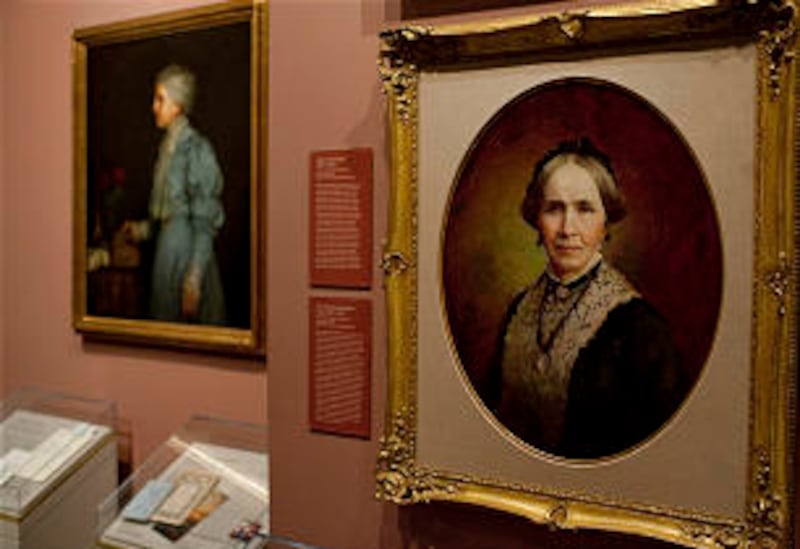
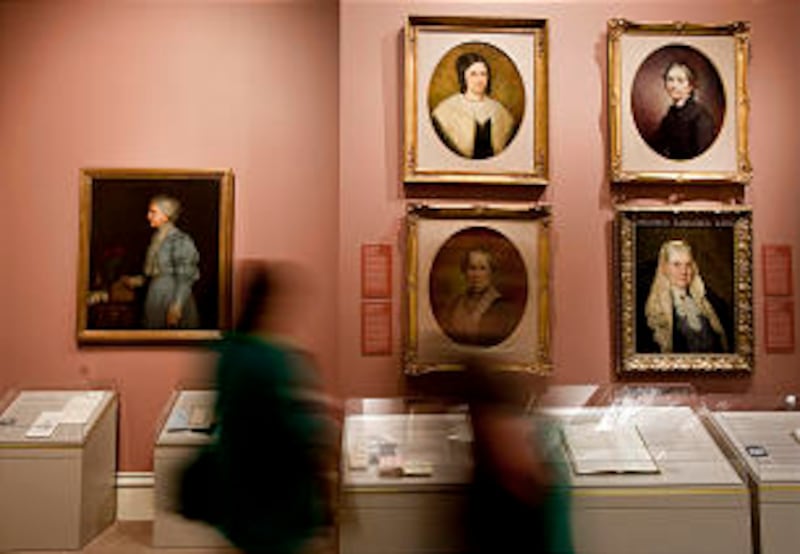
A prominent feature in the exhibit is portraits of the first five Relief Society presidents — Emma Hale Smith, Eliza R. Snow, Zina D. H. Young, Bathsheba W. Smith and Emmeline B. Wells — together with a summary of the life of each woman and her contribution in the history of the organization. The administrations of those presidents comprise about the first 80 years of Relief Society.
"We have taken from Joseph Smith's first addresses to the Relief Society four themes," Sister Derr said. They are "Knowledge and Intelligence," "Faith and Holiness," "The Mantle of Charity" and "An Influence in the World."
Among items in exhibit cases is a picture of workers outside the Salt Lake Temple in 1917 and a handkerchief said to have been used during the Hosannah Shout at the temple's dedication.
Sister Derr said the Prophet instructed the women of the society that its purpose was not only to relieve the poor but to save souls. "I think that shows the connection to the work of salvation, that the Relief Society has a responsibility to minister to the temporal and spiritual welfare of men and women," she said.
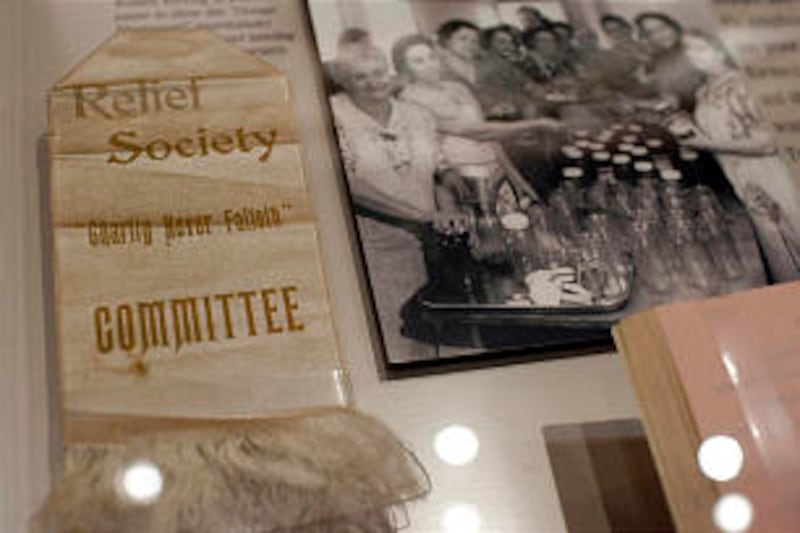
To illustrate charity, the exhibit features a photo from the 1940s of women in the South Los Angeles Stake engaged in a welfare project bottling and labeling "Orange Mormonaid" (marmalade). "I think their faces are beautiful and loving," Sister Derr commented regarding the women in the photograph.
"And we have a late 19th century Relief Society committee ribbon with this motto: 'Charity never faileth.' It became the Relief Society motto."
A portion of the exhibit reflects the expanding influence of Relief Society under priesthood direction, as the women engaged themselves in the suffrage movement and the Red Cross, and general officers of the Relief Society and Young Women's Mutual Improvement Association the World's Congress of Women in 1893, part of the Columbian Exposition, the Chicago World's Fair.
Two paintings by prominent Mormon artist Minerva Teichert complement the exhibit, as they depict noble women in Church history settings: as handcart and covered-wagon pioneers.
