



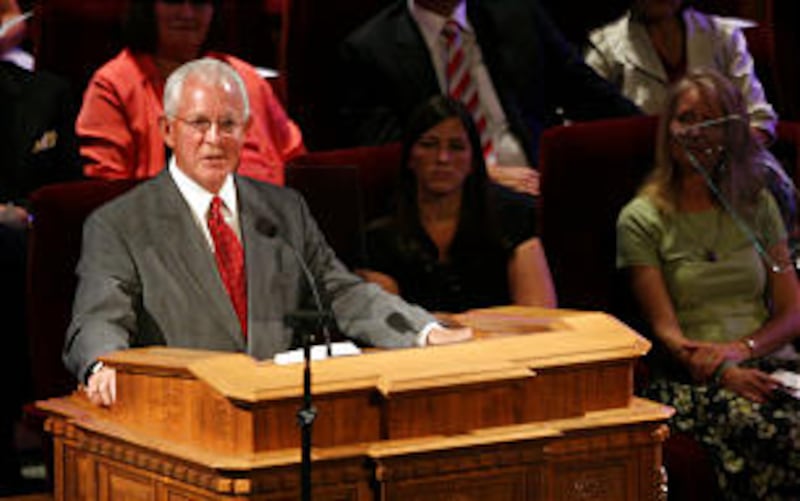
While much is to be gained from remembering Mormon pioneer history, there is an often forgotten "rest of the story" that should be a part of the Pioneer Day observance, that being the perspective of the American Indian tribes who were living in the Great Basin at the time Brigham Young and his followers entered it, Elder Marlin K. Jensen said at the traditional Days of '47 Sunrise Service in the Salt Lake Tabernacle July 24.

"It is seldom given adequate prominence," said Elder Jensen, Church Historian and Recorder and a member of the Seventy. "It begins with the recognition that the Great Salt Lake Valley, at the time of the arrival of the Pioneers, was already home to several itinerant bands of American Indians." Numbering about 20,000, they included the Shoshone tribe to the north, the Goshute to the West, the Ute in the central and eastern regions and the Navajo in the southwest, he said.
"The Pioneers no more 'discovered' the Great Basin than Columbus 'discovered' America," Elder Jensen remarked.
With villages and camps clustered primarily in the valleys but also in arid locations usually near water sources, the Indians regarded the land as sacred and were strongly attached to it, he said. "The land and its bounty were critical to their existence."
Unfortunately, useful land was scarce, he noted. "From the day the 1847 pioneers first put their plows in the ground, "settlement" for them would mean displacement for Indians."
That consequence was not due to lack of concern on the part of the Mormons, who themselves were a displaced people, Elder Jensen said. Moreover, Church doctrine stemming from the Book of Mormon gave the Indian people a distinctive place in LDS theology, which designated them as a branch of the House of Israel, he explained.
"There was another positive factor," he said. "Brigham Young, over time, grew to be an important Indian ally." In the Church History Department archives is a collection of more than 80 letters he wrote to Indian leaders that give insight into his positive feelings for the native people of the area, Elder Jensen said.


Coming from different worlds, the Mormon Pioneers and the Great Basin Indians saw their futures intertwined after 1847, Elder Jensen noted. Early on, he added, relations were peaceful and promising, but by the spring of 1849, tension developed over the use of the best pastures and fisheries, leading to a skirmish in which Mormon settlers killed more than 100 Indians.
"Despite such tensions, most Indians and pioneers worked to find peaceful solutions to their conflicts," Elder Jensen said. "On the individual level, stories of conflict resolution and of admiration for each other are often heartwarming."
Elder Jensen quoted a written recollection of Lewis Barney regarding a dispute that arose after Indian women were allowed to glean grain from Mormon fields after harvest. A few of them took grain standing in the shocks, and the farmers then withdrew permission. After one farmer drove some Indian women off his land, an indignant chief approached Brother Barney and said, "This is our land and this is our water, our grass, our valleys, and this is our wheat. I will have this field and this wheat."

The chief then said he would kill Brother Barney and raised his rifle. Brother Barney caught hold of the barrel. After several minutes of scuffling, the chief gave up, eyed his adversary and began to laugh. They agreed to be friends. Brother Barney told him to send the women into the fields and glean all they wanted and they would not be molested.
"This account clearly reveals the differing points of view of settlers and Indians," Elder Jensen remarked. "In the settlers' view, the land was not theirs and the Indians needed permission to go on it and enjoy its fruit. The Indian view was that the land had been and still was theirs and having given the settlers permission to plant crops, Indians should now rightfully share in the harvest.
"I think telling the rest of the story requires one to acknowledge that Indians made sincere and often heroic efforts to absorb the tide of Mormon emigrants and to peacefully and even symbiotically co-exist with them," he said. Yet eventually, relations deteriorated and were similar to those in other parts of the West, he said.
"Regardless of how one views the equities of Indian-Mormon relations in those times, the end result was that the land and cultural birthright Indians once possessed in the Great Basin were taken from them," he said. "As tragic as that is, history cannot be unlived. What we can do, the least we can do from a distance of 160 years, is to acknowledge and appreciate the monumental loss this represents on the part of Utah's Indians. That loss and its 160-year aftermath are the rest of the story.
"We can also work until the rest of the story becomes an integral part of the story; until Wakara, Wanship, Washakie and Black Hawk have their appropriate place in Utah's history books as well as Brigham, Heber and Parley; until Utah's history includes Indian history and July 24th commemorates everyone's contribution to our state's unique past."
