




Editor's note: The Church News recently visited Peru to report on humanitarian projects sponsored or assisted by the Church. Several reports from Peru have appeared in recent issues of the Church News. The report below tells of the ongoing partnership between the Church and a private humanitarian organization in Lima helping to feed thousands of poor children in the nation's capital. Additional reports will be published in future issues.
LIMA, PERU
Dionisia Garcia has known poverty's debilitating sting.
Several years ago she was living in a desperately poor section of Lima. Times were tough. Her husband could find only temporary jobs and simply feeding their 3-year-old daughter posed a daily struggle. Their dire circumstances left them with little hope. Mrs. Garcia felt worthless.
Then one morning Mrs. Garcia noticed a group of small children in a wide clearing all lining up in an orderly line. Each little boy and girl was receiving a glass of milk and something to eat. She asked a few of the adults who were distributing the food if the breakfast was part of a government program. If so, how much did it cost? The young mother was told the breakfasts were free and provided by the Johannes Gutenberg Cultural Association — a non-government organization that provides humanitarian service and educational opportunities in Lima.
Soon Mrs. Garcia was participating in the program — not merely as a food recipient but also as a volunteer. She served children in need even as her child was being served.
"I have changed a lot," she said. "I feel very useful now. My self-esteem has increased."
A partner for the Church
It's that spirit of "doing-one's-part" — the notion that one can serve even as he or she is being served — that makes the ongoing partnership between the Gutenberg organization and the Church a good fit. For several years, the Church's welfare department has donated foodstuffs, hygiene kits, school kits and building supplies to the Gutenberg association. Church welfare service missionaries have also provided organizational and planning expertise to help the association operate smoothly.
"It's important to not simply give things away — but to teach families to be self-sufficient," said Raul Sotomayor, the director of the organization's cultural section. "[We serve] people without education and employment, but, over time, they must learn to overcome these things. The Church helps us to teach them to be self-sufficient."
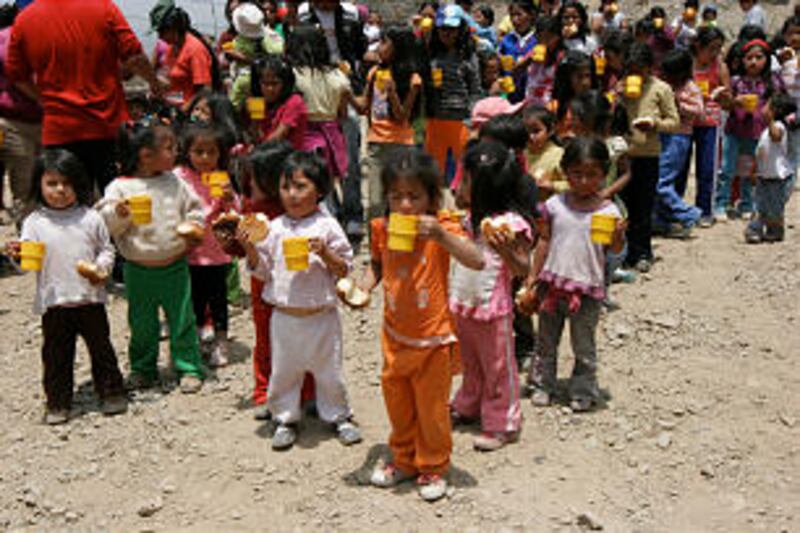
Each weekday, the Gutenberg association feeds breakfast to more than 11,000 impoverished children throughout the Lima area. The typical day's breakfast of oatmeal and a piece of bread likely represents the most nutritious meal of the day for many of young recipients.
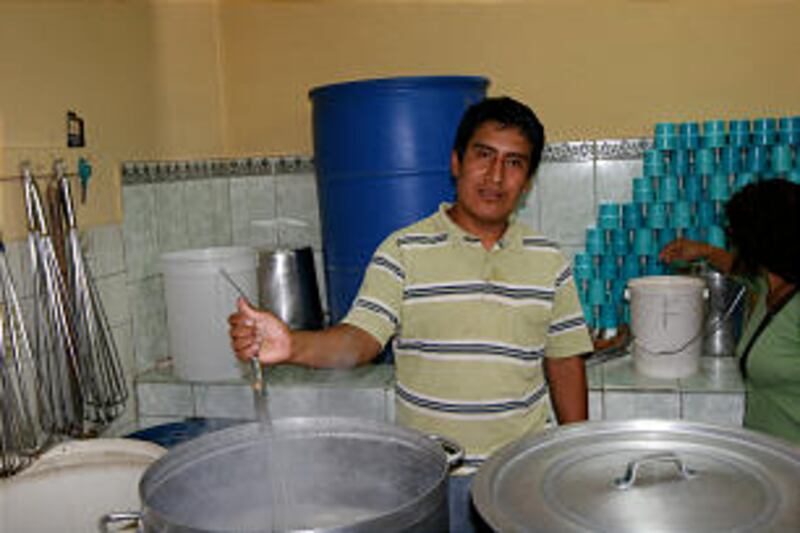
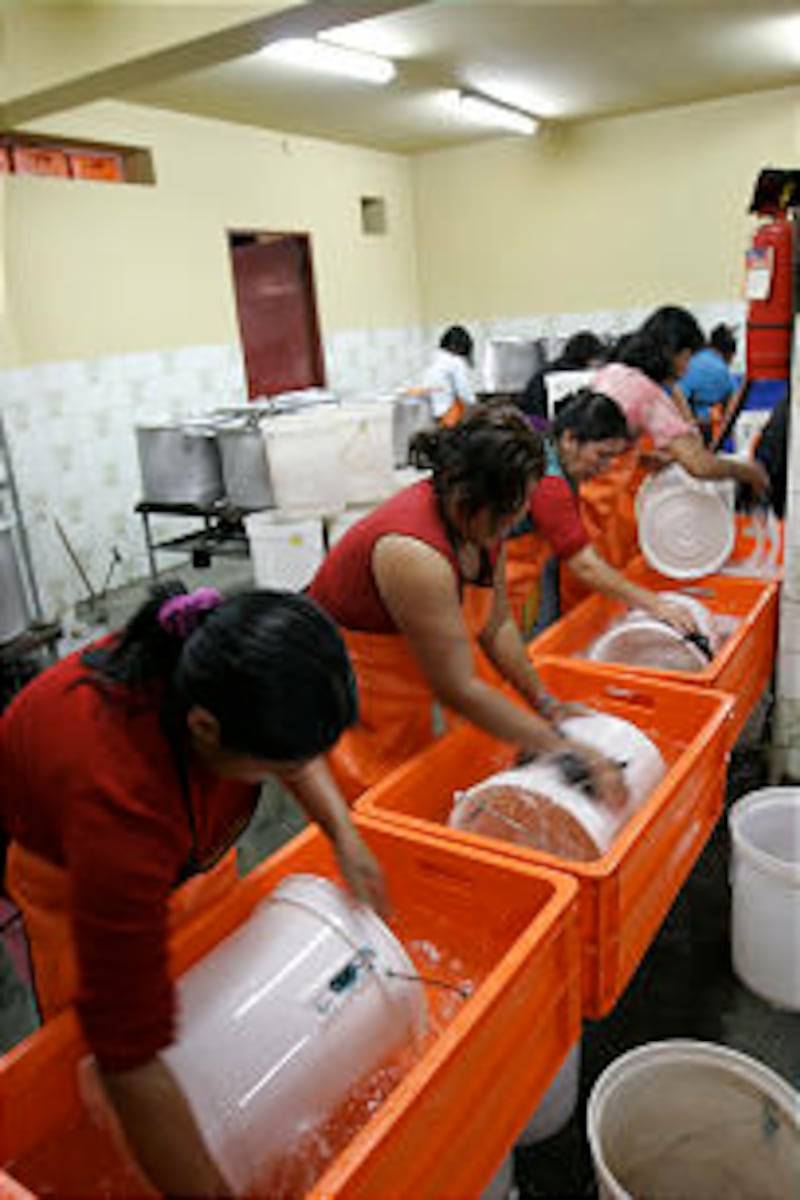
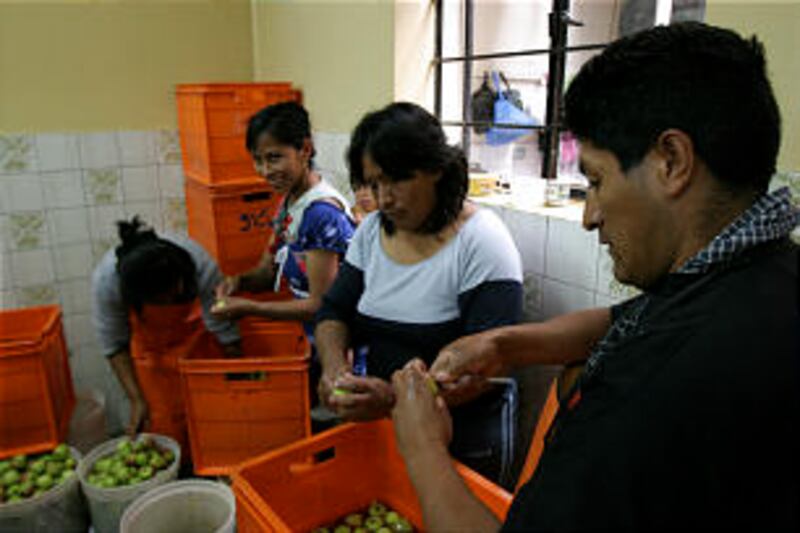
The daily task of making and delivering thousands of hot breakfasts throughout the city would be impossible without the support of many of the parents, especially the mothers. Hours before the food is served, parent volunteers arrive at the Gutenberg kitchen to help prepare and cook the food, chop fruit, wash and sort cups and serving pots, scrub the kitchen and do whatever else is needed to keep the operation running.
"Many children we serve are malnourished," said mother/volunteer Gregoria Pumavicel. "This food will help my children and others remain healthy and stay strong."
The daily participation of parents such as Mrs. Pumavicel is essential to the success of the ambitious breakfast program. Between 200 to 300 volunteers are needed each day to feed all the children in need.
"The parent volunteers are the engine that runs the program ... their participation is essential," said Mr. Sotomayor. "The parents would feel bad if they did not get to contribute."
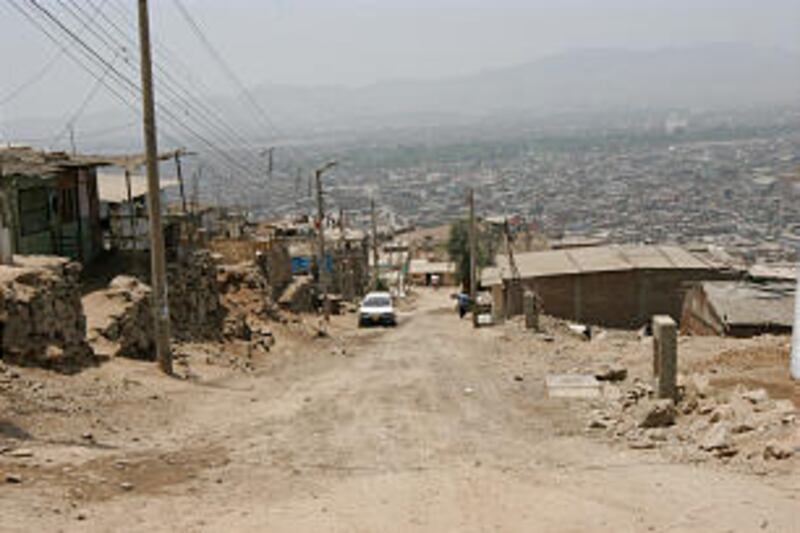
Once the food is cooked, Gutenberg administrators and volunteers (and sometimes Church welfare service missionaries) squeeze into large vans and travel to dozens of locales to distribute the food to hungry children. One recent breakfast distribution took missionaries Elder Jaime Joo and his wife, Sister Georgina Joo, to a dusty slum in the hills above Lima. It's a dangerous area, rife with gang activity. And, on this day, a pair of police officers escort the Joos and the others to their destination.
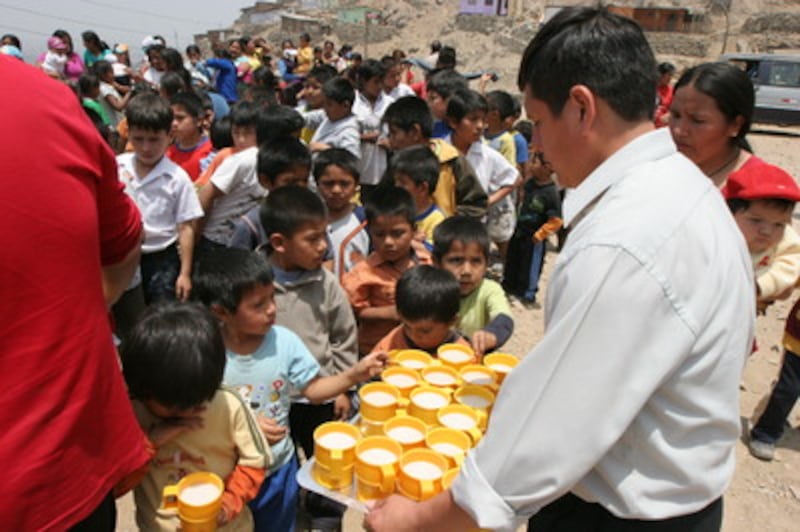
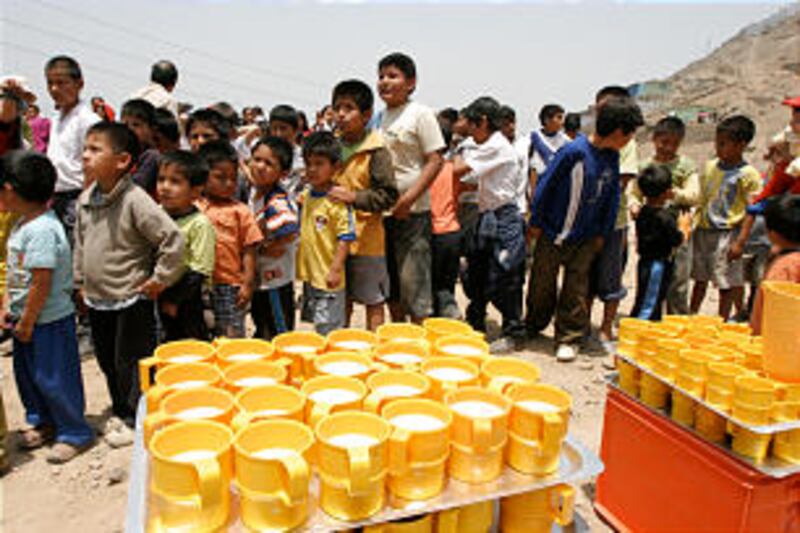
When they arrive at the distribution spot they are greeted by dozens of youngsters waiting patiently in long lines. Several of their mothers help the children stay in line. They offer to help however they can. It's an efficient operation. Volunteers pull dozens of tall plastic mugs from the vans while others unload deep buckets of oatmeal. Soon the hot cereal is poured from the buckets and volunteers walk up and down the rows of hungry children handing out the steaming mugs. A moment later each child received a fist-sized roll.
Most of the children accept the breakfast with a smile and an enthusiastic "Gracias, senor — Gracias, senora" (Thank you, sir — Thank you, ma'am.)
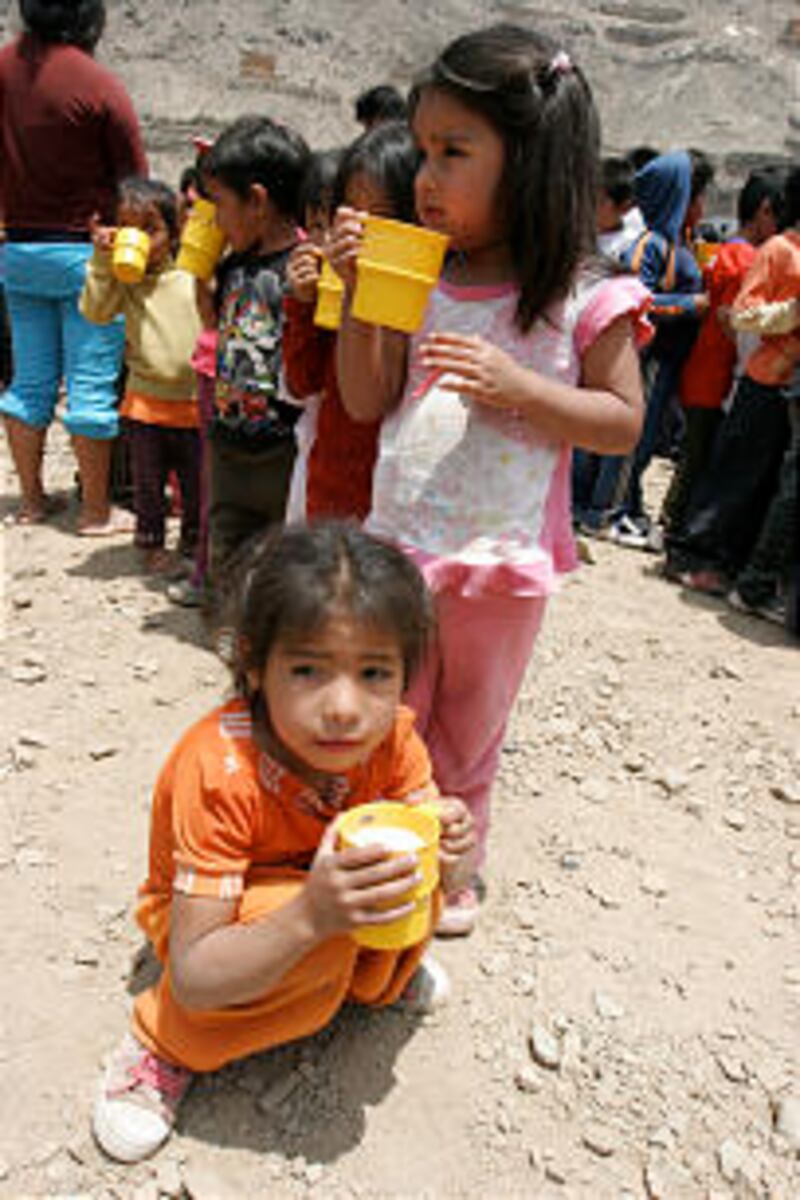
Elder and Sister Joo, along with several of their Gutenberg friends, speak warmly with the mothers as the small children enjoy their meal. A few of the older children also receive Church-donated school kits to help them with their studies.
Additional assistance
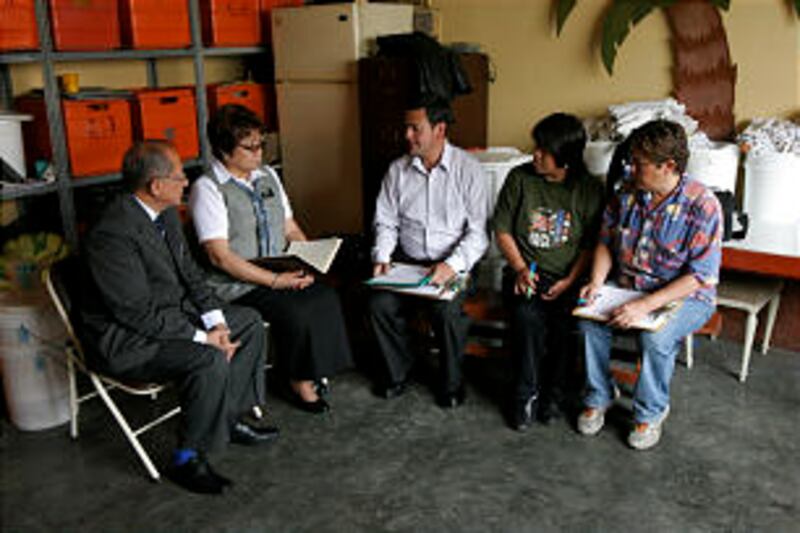
The Church's assistance with the Johannes Gutenberg Cultural Association extends beyond food donations and volunteer service. The Church has also provided sturdy doors and windows to help poor families in the region improve their homes. Service missionaries have also provided professional expertise, training Gutenberg personnel on humanitarian relief administrative matters such as working with customs officials and receiving international donations.
Mr. Sotomayor said he has been touched by the devotion and love demonstrated by the welfare service missionaries he has worked with. He speaks of witnessing a sister missionary taking off her own jacket to warm a shivering child during a winter breakfast distribution. He recognizes a spiritual sensitivity that goes beyond simply distributing provisions and offering administrative support.
"There are not many people who can transmit such a passion of sharing," he said. "Many of the children are struggling, but perhaps in the future they can overcome their struggles. Their history need not be repeated."
Members and their friends can support Church-sponsored humanitarian efforts such as the Gutenberg breakfast program in Lima, Peru, by donating to the Humanitarian Aid Fund. Contributions can be made to the fund:
— Through a local ward or branch and marking the category "Humanitarian Aid" on the donation slip.
— By mailing donations to Humanitarian Services, 50 East North Temple, Floor 7, Salt Lake City, UT 84150-6890.
— Online through LDS Philanthropies, www.ldsphilanthropies.org/.
