



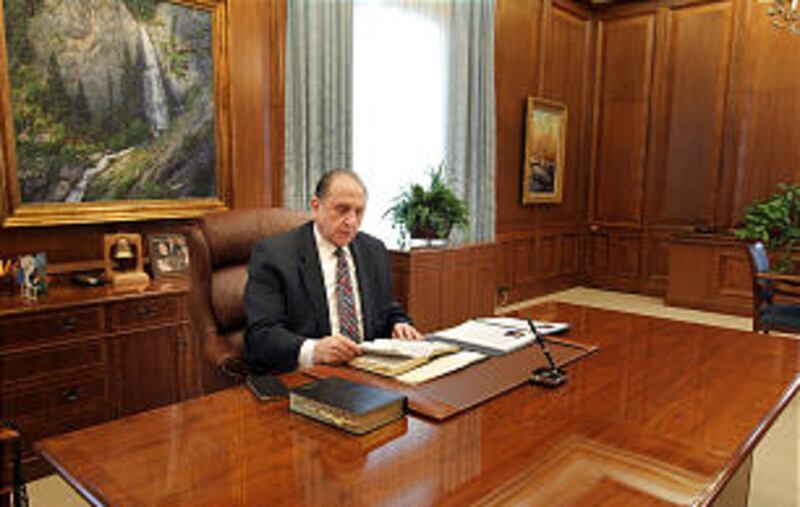

From topping sugar beets and maintaining chicken coops as a youngster to presiding over the Church as it brings relief to the needy in more than 175 countries, President Thomas S. Monson speaks with the voice of experience and authority when it comes to the Church Welfare Program.
He grew up serving others through Church welfare. He was 8 years old when the program was launched 75 years ago, on April 6, 1936. As he grew from his youth into roles as a bishop and stake president's counselor before becoming a mission president and then a General Authority, he worked alongside others on various stake and region welfare projects.
In the Sunday morning session of the 181st Annual General Conference, he said the Church's Welfare Program is "inspired of Almighty God."
Growing up in the fallout of the Great Depression, he saw firsthand the gnawing pangs of hunger and the desperation of want. Through the welfare program and the teachings of his parents, he stepped up to do his part to provide for those in need. He has been at it ever since.
Shortly before conference, President Monson met with the Church News to talk about the Church Welfare Program, sharing some of his memories and personal experiences.
"I think my first welfare assignment was to top sugar beets on a region welfare project," he said. He described the process of lifting the beets from the soil and then cutting off the tops with a beet knife, which was about 16 inches long and very sharp. "You had to be very careful or you would cut your fingers off," he said.
He was called in 1950, at age 22, as a bishop of a Salt Lake City ward of 1,080 members, many of whom were in need.
"I felt it was my responsibility as a bishop to find out who needed help, to make certain that it was handled in the way the Lord wanted us to handle it," he said. "How grateful I was for the welfare program of the Church and for the help of the Relief Society and priesthood quorums.
"I could see that if it weren't for the Church Welfare Program there would be many a night when children would go hungry." In those days, he said, many people "were too proud to beg — and they shouldn't have to beg."
He erred on the side of generosity, wanting people to have what they needed, and seeing to it that they got it. President Monson said Welfare Square not only stocked items that people needed but also gave recipients an opportunity to work there and, in doing so, preserved their dignity.
"The purpose of Church welfare assistance is to help people to help themselves," President Monson said. "Recipients of these resources are given the opportunity to work, to the extent of their ability, for the assistance they receive."
He explained why so much emphasis is placed on the welfare program, saying, "The members of the Church take most seriously the words of the Lord, as recorded in the 25th chapter of Matthew: 'For I was an hungered, and ye gave me meat: I was thirsty, and ye gave me drink: I was a stranger, and ye took me in: Naked, and ye clothed me: I was sick, and ye visited me: I was in prison, and ye came unto me. ... Verily I say unto you, Inasmuch as ye have done it unto one of the least of these my brethren, ye have done it unto me.' "
He said that the funding of the operation of the Church worldwide is based on tithing. The poor and needy, however, are assisted through fast offerings.
"The concept of fast offerings appears as early as the time of Isaiah, who described the true fast by asking, 'Is it not to deal thy bread to the hungry, and that thou bring the poor that are cast out to thy house? When thou seest the naked, that thou cover him; and that thou hide not thyself from thine own flesh? Then shall thy light break forth as the morning, and thine health shall spring forth speedily: and thy righteousness shall go before thee; the glory of the Lord shall be thy [reward]' (Isaiah 58:7).
"Guided by this principle, in a plan outlined and taught by inspired prophets of God, Latter-day Saints fast one day each month and contribute generously to a fast offering fund at least the equivalent of the meals forfeited, and usually many times more. Such sacred offerings finance the operation of storehouses, supply cash needs of the poor, and provide medical care for the sick who are without funds."
Further, President Monson said, "In addition to helping members of the Church through our welfare program, we also sponsor humanitarian relief and developmental projects around the world to help those in need, regardless of their faith. From 1985 through the end of 2010, the Church has provided, through its Humanitarian Aid fund, essential help to the needy in 178 countries and territories. With these funds, which have been generously donated by its members and which number in the millions of dollars, the Church provides essential help to people in times of natural disasters, famine, sickness and events that can strike anyone, anywhere. Clothing and shoes are provided to those who are without. Quilts and blankets bring warmth to those who are cold. Kits are filled to meet the needs of newborn babies and their mothers. Bags are filled with supplies for school children. Hygiene kits help to maintain cleanliness and health in emergency situations.
"Additionally, our humanitarian efforts also furnish wheelchairs to those who cannot afford them. Skilled missionary couples serve humanitarian missions to impoverished areas in the world, providing whatever help might be needed. Vision care is furnished by physicians who generously donate their time and talents not only to provide medical assistance, but also to train medical personnel in areas where such is needed. Neonatal resuscitation is also taught, as well as classes in proper nutrition and other subjects which can improve health."
President Monson said that whenever and wherever a disaster occurs, the Church is among the first to respond with emergency relief. "By way of illustration, within an hour after the earthquake hit Haiti in 2010, the Church was in motion, immediately sending relief supplies on their way," he said. "We provided water, food, medical supplies, hygiene kits and other items. We sent teams of doctors and nurses to provide much-needed medical care. Our relief efforts in Haiti continue."
In 2010 alone, 777,381 days of labor were donated to Church welfare facilities in 143 storehouses, 102 home storage centers, 54 production projects, 23 processing facilities, 326 resource facilities and 326 employment centers.
In the past quarter of a century, from 1985-2010, the humanitarian assistance the Church gave included 63,377 tons of food, 14,345 tons of medical supplies, 93,196 tons of clothing, and 11.1 million hygiene, newborn and school kits.
Millions of people have benefited from the Church's financial support to the World Health Organization for campaigns to eliminate diseases such as measles.
"We share a common interest with people of many faiths in helping those who are in need," President Monson said. "We work cooperatively with them in efforts to feed the hungry and relieve suffering.
"We may not be able to do everything, but we must do something. I believe all can be of service. Helping others does not always involve responding to a major disaster. It might be something simple, such as taking a meal to a sick neighbor or providing some other simple but needed assistance.
"The Prophet Joseph Smith declared this truth: 'A man filled with the love of God is not content with blessing his family alone, but ranges through the whole world, anxious to bless the whole human race.' I pray that we may ever be filled with such love."
By the numbers:
Storehouses: 143
Home storage centers: 102
Production projects: 54
Processing facilities: 23
Storage and distribution facilities: 36
Employment resource centers: 326
Deseret Industries thrift stores: 43
LDS Family Services offices: 79
Humanitarian assistance rendered (1985–2010): $1.3 billion
Countries and territories served: 178
Food: 63,377 tons
Medical supplies: 14,345 tons
Clothing: 93,196 tons
Hygiene, newborn, and school kits: 11.1 million
