



Related stories from the 2011 Seminar for New Mission Presidents:
President Henry B. Eyring: Holy Spirit will help missionaries succeed
President Dieter F. Uchtdorf: Presidents help missionaries reach their potential
President Boyd K. Packer: A voice felt, rather than heard
Elder Russell M. Nelson: Learn, live and teach the doctrine of Christ
Elder Jeffrey R. Holland: Mission president, trainer important to new missionaries
Elder David A. Bednar: Becoming a 'Preach My Gospel' missionary
Elder D. Todd Christofferson: Faith in Christ is an 'upward cycle'
Elder Richard G. Hinckley: Recent changes intended to encourage senior couples to serve missions
PROVO, UTAH
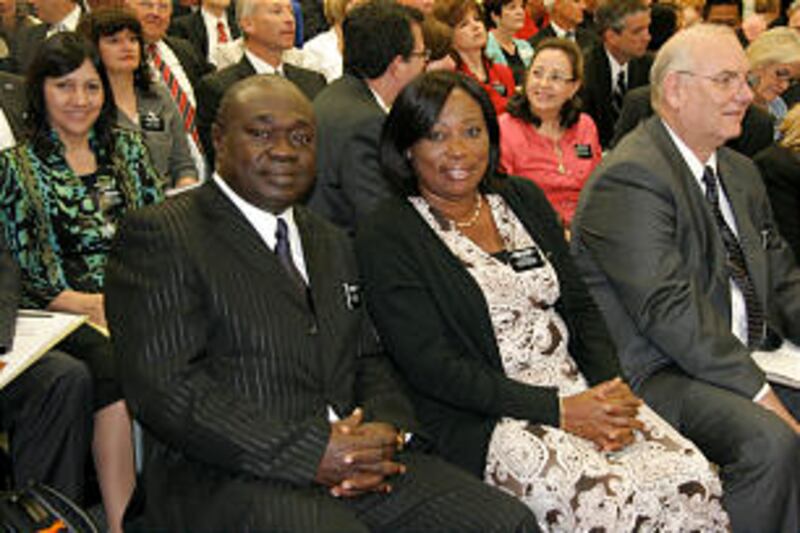
Referring to missionaries as "that precious commodity entrusted to your care," President Thomas S. Monson greeted 127 new mission presidents and their wives June 23 at the 2011 Seminar for New Mission Presidents June 23. The focus of his talk, the opening address at the four-day seminar, was motivating missionaries.
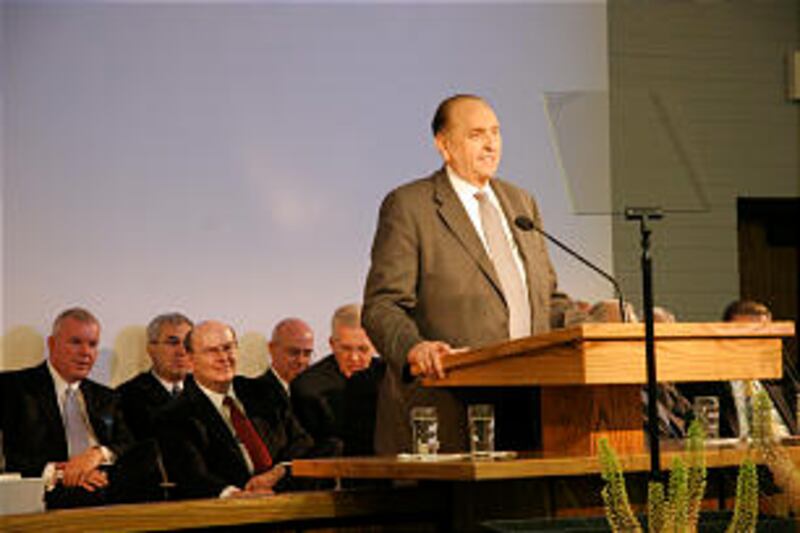
Citing Isaiah 52:7 and applying it to missionaries, President Monson remarked: "The missionaries represent the flower of youth. They represent the hopes, the prayers, the dreams of their parents; they represent the element of sacrifice. If you as mission presidents can realize the importance of their missions in the lives of these young men and young women, and in the lives of your senior couples, then you will be in a better position to motivate them properly."
He noted that parents of missionaries pray for them daily. "And in that prayer, they ask a blessing upon you, for you in effect become a mother and a father to their child. You become, as it were , the determiner or the destiny of that young man or that young women.
The Church president touched on a several points of emphasis pertaining to the motivation of missionaries: personal interviews, transfers, homesickness, temptations, companionships, weekly reports, preparation day, letters home, missionary meetings, and member involvement in missionary work.
He said he likes it if a mission president is at the airport or train depot to greet the arriving missionary. He said the first interview, at the mission home, should be a time when "you take them from where they stand to make them what they can be."
"I suggest that you take notes during that interview and that you make a file folder for each missionary containing information abut his background, his family statistics, his objectives, and so forth, so that with all the missionaries you have under your direction, you have an opportunity occasionally to refresh your memory."
President Monson suggested that mission presidents "love, not scold."
"'Show how' is more important than 'tell how' in that kind of a situation," he said.
Regarding transfers, he spoke against putting missionaries "out in the boondocks to pioneer." Rather, he said, "We subscribe to a philosophy of putting our missionaries in areas where we have established branches and where we can move from the center of influence outward."
Outstanding missionaries should be chosen to introduce new elders and sisters to the field, President Monson said. He spoke of one such missionary in the mission where he presided in Canada.
"His influence could be seen in almost every missionary whom he had trained and those who had been trained by those he had trained. You will occasionally find that type of talent. Utilize it when it comes."
President Monson said that, as part of the weekly report, every missionary should have the privilege of writing a letter to the mission president and knowing the president is reading the letter. "Always have a note pad right next to you so that you can pen a note to the missionary."
Missionary meetings should "build and lift and inspire," President Monson said, with missionaries demonstrating door approaches, referral techniques and lesson presentation. "But in every case use the principle of 'show how' rather than 'tell how' in that kind of a meeting. Also, it is an opportunity to share success experiences. Nothing succeeds quite like success."
President Monson told the departing leaders the greatest single thing they can do to increase the effectiveness of missionaries is to ensure they maintain a proper relationship with local Church leaders.
"As a mission president, whenever I would assign a missionary to a new area, say as a district leader, I would write a letter to the bishop and tell him who the missionary was, what his background was, and why I looked forward to the cooperation that I knew the bishop would provide," he said.
"In addition, I would instruct every new district leader, every new zone leader, that the first thing he did when he moved into his district or into his zone was to call on the bishop and stake president, that they might jointly have a successful proselyting program."
President Monson concluded by emphasizing the importance of building mission spirit.
He told of being in Rome some years ago at a Church district conference, where many were wearing a white carnation. The presiding officer, Leopoldo Larcher, explained to him that a carnation was provided to each member baptized since the last district conference. "Then all the members and the missionaries know that these people are especially to be fellowshipped."
President Monson said he watched those new members "being greeted, being embraced, being spoken to. They were no more strangers nor foreigners; they were fellow citizens with the Saints, and of the household of God.
"You may sometimes be tempted to say, 'Will my influence make any difference? I am just one. Will my service affect the work that dramatically?' I testify to you that it will. You will never be able to measure your influence for good."
