



ICHODA, INDIA
When Shivudu walked into a shop in Ichoda, India, to buy a pair of dark glasses, he had no idea that his future was about to change. A young technician named Venkataramana insisted that Shivudu receive a free eye examination before purchasing any eyeglasses, prescription or otherwise. Shivudu quickly agreed — he was just a confectionary salesman with little money.
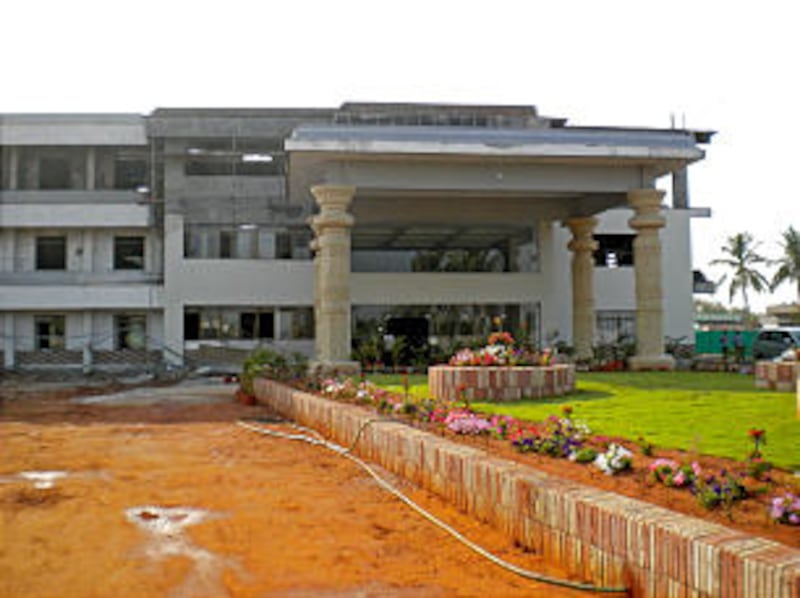
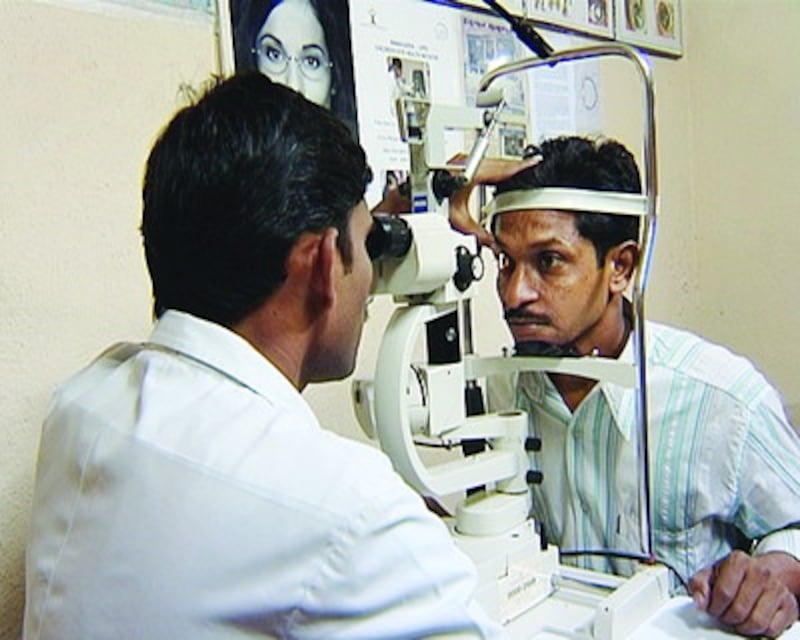
During a routine slit lamp examination, Venkataramana detected high pressure in Shivudu's eyes — a symptom of glaucoma. He then referred Shivudu to a secondary care center where he was advised to get laser treatment at the L.V. Prasad Eye Institute.
Shivudu's diagnosis was not the only miracle unfolding in Ichoda, India, that day. Another was the newly acquired abilities of the technician. Venkataramana was not an optometrist or ophthalmologist — in fact, he had only received one year of vision training the prior year.
Many scoffed when it was suggested that vision techs with little training could make a vast improvement in poor eyesight in the overcrowded areas of rural India. Yet that's exactly what happened with a community clinic program assisted by Latter-day Saint Charities.
Today, Shivudu still sells his confectionaries in Ichoda, but he does so with an added mission in mind. He encourages his clientele to get complete eye examinations. As a result, many families are being touched through word-of-mouth publicity for life-changing eye care.
The vision unfolds
The rural vision project was the brainchild of Dr. Gullapalli N. Rao, a U.S.-trained ophthalmologist and native of Andhra Pradesh, India. He and his wife, Pratibha, established the L.V. Prasad Eye Institute in 1987 with financial help from L.V. Prasad, a successful movie mogul in India. Dr. Rao has long envisioned a multi-tiered system of vision treatment facilities, and for the past 20 years, has helped create dozens of locally staffed, rural community vision centers.
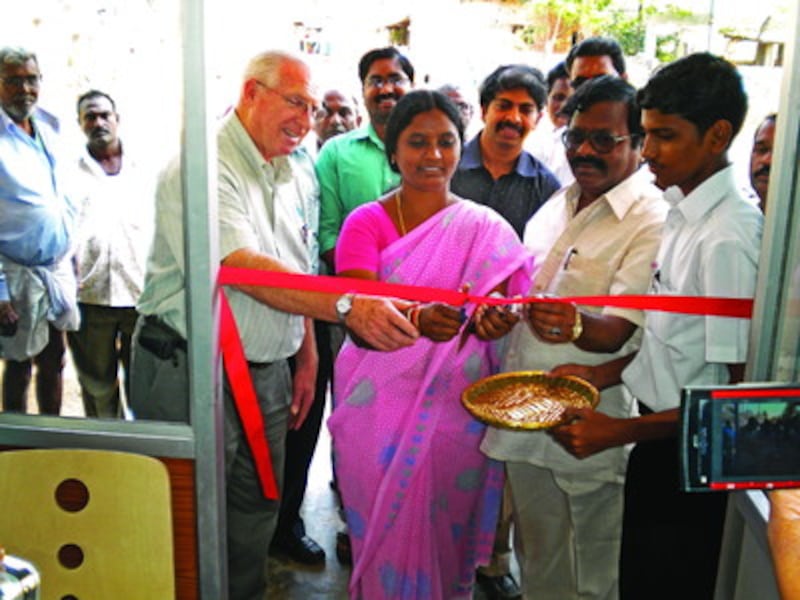
The rural centers are small — just 500 square feet — in communities where no eye-care services exist but are within an hour's drive of a secondary eye-care center. Community involvement in most locations helps reduce operational costs.
"We train people like Venkataramana to diagnose eye problems and provide primary care, like prescribing spectacles," said Dr. Rao. "If surgery is required, the technician can refer the patient to a secondary center."
LDS Charities aids growth
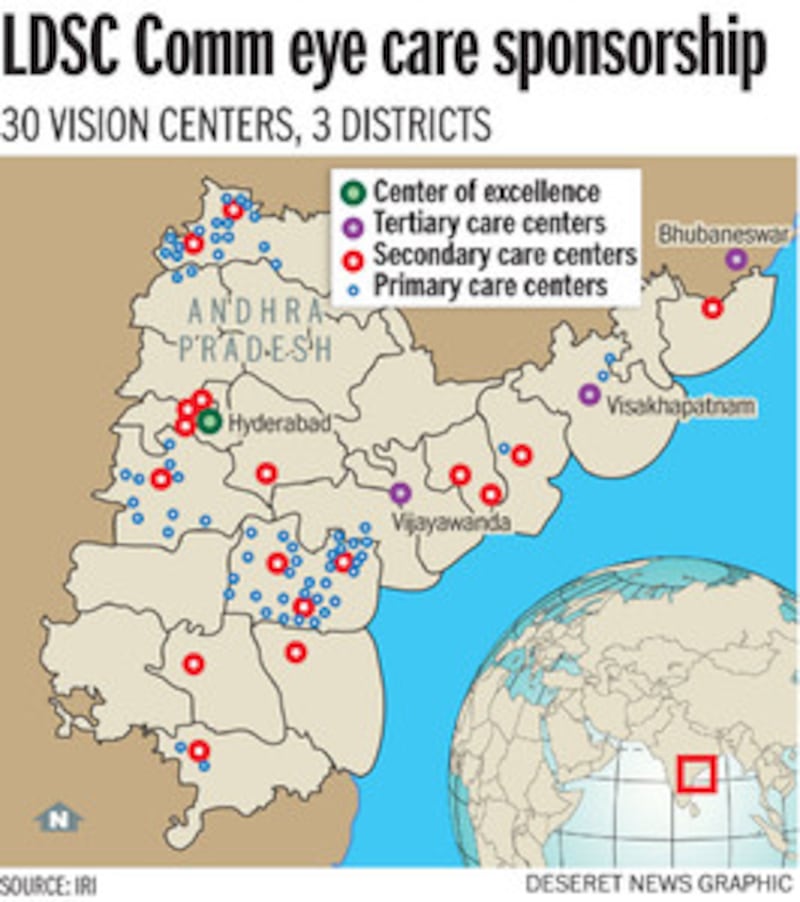
The first project with the L.V. Prasad Eye Institute involving LDS Charities began in 2006. Twenty rural eyecare facilities were planned in northern Andrah Pradesh. By the end of 2012, 100 such centers will be in operation. LDS Charities provides state-of-the-art equipment and pays for the one-year technician training for about 40 of these clinics.
"LDS Charities got involved in the project because of Dr. Rao's commitment to help the rural poor," said Dean Walker, manager of the vision initiative for LDS Charities. "We partner with organizations that have ideals similar to ours, and Dr. Rao's model is something we wanted to help with."
"The L.V. Prasad Eye Institute is providing a model of primary eye care to underserved geographical areas of India," said Ike Ferguson, a "short-term specialist" missionary with LDS Charities. "The model addresses the triple challenges of quality, accessibility and affordability."
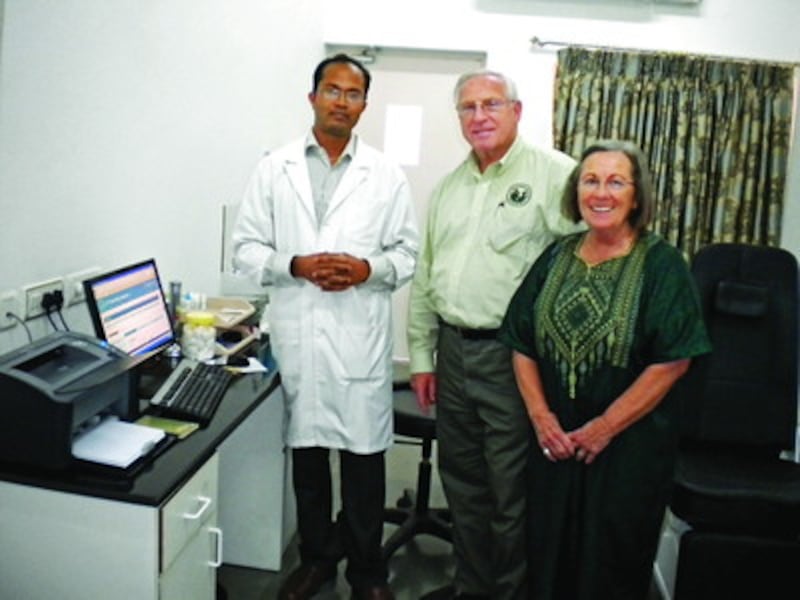
Brother Ferguson is no stranger to humanitarian work, having started his career in the Welfare Services Department of the Church in 1974. He is a past director of LDS Humanitarian Services and has worked tirelessly throughout Asia, Africa and Eastern Europe to bring relief to suffering people. Though officially retired, Brother Ferguson and his wife, Gloria, have made 18 international trips in the past three years to help plan or evaluate humanitarian projects for LDS Charities. Short-term specialists like Brother Ferguson have a particular technical or management skill that enables them to quickly evaluate the potential of a humanitarian project, become a catalyst to get it started, and then work with project partners to ensure its successful completion. Short-term specialists typically visit two or three project sites a year and follow up with frequent telephone calls and e-mail.
Vision techs are a key to success
The vision technicians are the key to the eye institute's success. High-school graduates are recruited in rural communities and receive a rigorous one-year technical course at LVPEI in Hyderabad. After training, technicians spend four days a week seeing patients, giving eye exams, prescribing eyeglasses and making referrals for more advanced care. For two more days each week, the technician conducts eye screenings with schoolchildren or visits others with identified eye problems.
The vision technician program is directed by senior optometrist Srinivas Marmamula. Dr. Marmamula was asked to develop the course now used by vision technicians which graduates about 100 students per year.
Keernai Charthanya is the vision technician at the recently opened Yellandu Community Vision Center. "My uncle was examined at an LVPEI center," she said, "and they identified a serious cataract. After it was removed, his vision improved 100 percent. I was very impressed and decided I would like to help people in this way."
Asadi Rama Deve is a student in the vision training program with first-hand experience of the program's value. "A few years ago, I had a sight problem in my left eye," she said. "As my sight grew progressively worse, I heard of an LVPEI vision center in a nearby town. The vision technician there referred me for cataract surgery, and it corrected my sight almost perfectly." Upon completion of the training program, Asadi plans to return to a rural area near her home to help others.
Centers become self-sustaining
One of the keys to success of the vision program is that the model is designed to become self-sustaining. Following an initial, donor-led investment to cover startup costs and technician training, a community center can generally sustain itself through the sale of eyeglasses. Shortfalls in patient-generated income are met by donors that are typically Indian corporations or private philanthropies.
Each community plays a large role as well. In Yellandu, a local physician and a local philanthropic group provided financial support for a new vision center. In Manuguru, the Lion's Club helped provide the physical facilities and is actively involved in community outreach to encourage eye screenings. In Paloncha, a secondary service center was made possible by Nava Bharat Ltd., a local manufacturing company that donated property, construction costs and medical equipment. In Vijayawada, the new tertiary care center was donated by a wealthy entrepreneur who provided land, facility construction and equipment.
A sight to behold
Seeing is believing — Dr. Rao's vision of a multi-tiered system to provide eye care to rural areas has become a reality. During the past three years, LDS Charities-sponsored vision centers conducted 91,500 free eye examinations, distributed 41,430 pairs of eyeglasses and referred more than 9,500 patients to the secondary eye centers. Funding for LDS Charities comes from Church members and friends via donations directly to humanitarian aid or through LDS Philanthropies at LDSP.org.
"The LVPEI project is likely the most comprehensive public health program I have seen in the years I have been associated with the Church," said Brother Ferguson. "The productivity of these centers has been impressive."
