




Perhaps it was John Forres O'Donnal's upbringing in the rural Latter-day Saint colonies in northern Mexico that blessed him with a farmer's eye. He could look at a fallow, empty field and immediately divine a rich bumper crop.
It was 1942 and Brother O'Donnal wasserving as an agricultural adviser in Guatemala. Outside of some Mormon expatriates working near the Panama Canal far to the south, he was perhaps the lone member living in Central America. A congregation of one.
But he had a missionary's soul and he sensed the gospel would bury deep roots in Guatemala and its neighboring nations of Central America. He traveled to Salt Lake City and secured an audience with President George Albert Smith.
"[President Smith] asked me many questions about Guatemala and Central America, and about the people," wrote Brother O'Donnal in his book Pioneer in Guatemala. "He listened with great interest to what I had to say, and to my plea that missionary work be initiated in these lands, which I was certain were ready."
President Smith agreed with Brother O'Donnal's assessment and, a short time later, missionaries arrived in Guatemala. A district was organized and soon welcomed its first convert — Brother O'Donnal's Guatemalan-born wife, Carmen.
"This was a joyous day for me and the beginning of a great opening of the Lord's work, not only in Guatemala, but throughout all of Latin America," he wrote.
Since Sister O'Donnal's baptism, the "fields" of Central America have indeed proven ready to harvest. Today there more than 630,000 Latter-day Saints living in the nations of Belize, Costa Rica, El Salvador, Guatemala, Honduras, Nicaragua and Panama. While the rapid growth of the Church in Central America over the past seven decades is remarkable, it's the region's recent temple boom that truly purports the maturation and potential of the region's members and homegrown leadership.
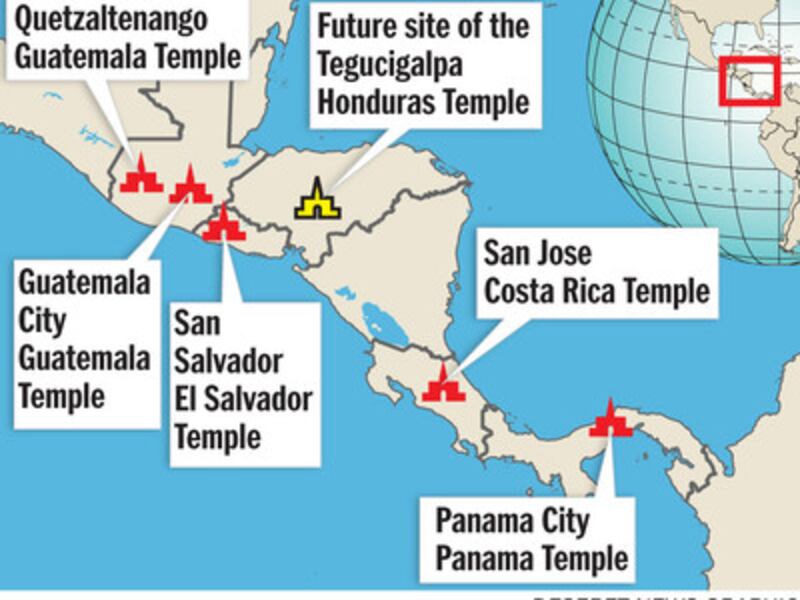
The dedication of the Guatemala City Guatemala Temple in 1984 signaled a new day for the Church in Central America. The region had a temple of its own. For almost two decades, that beloved temple would serve as a sacred destination for faithful members from Guatemala to Panama. But it was not enough. More temples were needed.
Now, thanks to the diligence of the members and the guiding leadership of modern-day prophets such as President Gordon B. Hinckley and President Thomas S. Monson, Central America has truly become a "land of temples" in recent years. Members living in southern Central America rejoiced in 2000 as the dedication of the San Jose Costa Rica Temple brought the blessings of eternity closer to the homes. Eight years later came the opening of the Panama City Panama Temple. In recent months two additional Central American temples — the San Salvador El Salvador Temple and the Quetzaltenango Guatemala Temple — opened their stately doors for worship and work.
And the building continues. Construction on the Tegucigalpa Honduras Temple began in 2010 and is expected to be completed later this year. For most LDS Central Americans, a temple is within a relatively short drive, making frequent temple worship a reality for hundreds of thousands.
The Church is still young enough in Central America that many of the region's "pioneers" are still alive and relishing the building and dedications of their new temples. Some have participated in the recent dedicatory activities with great appreciation for the sacrifice that was once exacted of Central America's faithful temple-going members.
Many here in the midsection of the Americas were temple-going people long before the first temple was built in Guatemala City. Julio Alvarado, a Guatemalan convert who has served as a mission president and an Area Seventy, remembers joining temple trips for local members to the Mesa Arizona Temple aboard decrepit buses. Such trips typically lasted eight days — three days traveling to Arizona, two at the temple and three to return. On one occasion, U.S. border officials near El Paso, Texas, refused the members' request to enter the country. The members worried their temple trip would have to be scrapped until a determined priesthood leader contacted a counterpart in El Paso. Soon a convoy of Latter-day Saints arrived and drove the Guatemalan members to Arizona.
Brother Alvarado's friend and countryman, Elder Enrique R. Falabella, comfortably wears the dual hat of "pioneer" and "Church leader." A member of the Seventy, he presides over the Central America Area and has attended several of the dedications of the area's temples. Each new temple represents a local miracle for this son of Central America. Perhaps, with each dedication, his thoughts turn to his own family.
Elder Falabella's late father, Udine Falabella, was widowed when young Enrique and his three siblings were small children. An unexpected visit from a companionship of LDS missionaries offered the Falabellas a spiritual lifeline. Through the missionaries the family learned about temples and forever families. Comforted and eager to claim the eternal blessings of the temple for his grieving family, Brother Falabella joined the Church and would go on to become Guatemala's first stake president and an example of the Church in the area.
Today Elder Falabella presides over the Church in Central America. He undoubtedly seizes any and all opportunities to counsel the members he serves to prepare to take their own families to the temple and celebrate this pivotal chapter of the Church here.
With each new temple dedication, the faithful Latter-day Saints of Central America have marked the moments with equal measures of joy and humility. Yes, new temples in Costa Rica, Panama, El Salvador or western Guatemala stand as singular blessings. But each new temple also represents an earnest responsibility. The Lord, they say, is allowing them to build His house in their nations. Now He expects them to fill each temple and invite their families and neighbors to claim their respective blessings.
Central American members have also enjoyed the visits of several Church leaders who have traveled to their respective countries to preside over the temple dedications. Many say it was a blessing to be with President James E. Faust, who dedicated the San Jose Costa Rica Temple. President Monson dedicated Panama's first temple in 2008, while his counselors in the First Presidency, President Henry B. Eyring and President Dieter F. Uchtdorf, dedicated the San Salvador El Salvador Temple and Quetzaltenango Guatemala Temple, respectively.
Counted among the most anxious visitors to last month's dedication of the Quetzaltenango Guatemala Temple was Elder Ricardo Valladares, an Area Seventy. The Honduran Church leader made the short flight from his native country to Guatemala to participate in the dedicatory events such as the traditional cultural celebration. But Elder Valladares was no tourist. He was assigned by the area presidency to travel to Quetzaltenango to observe the events so he would be better prepared for the fast-approaching open house and dedication of the future temple in the Honduran capital of Tegucigalpa.
The harvest Brother John O'Donnal once envisioned in Central America continues to flourish.
