



Note: The Mormon History Association Conference was held in Calgary, Alberta, on June 28-July 1. On this page is a report from one of the sessions. Other proceedings of the conference were reported in the July 7 Church News and on the website www.ldschurchnews.com.
CALGARY, ALBERTA
The Calgary Stampede, perhaps this western Canadian city's most prominent claim to fame, is an example of what Lynn A. Rosenvall calls "the transfer of Mormon culture to southern Alberta."
Brother Rosenvall, professor emeritus of geography at the University of Calgary, is a former stake president, regional representative, Area Seventy and president of the temple in Cardston, where he makes his home today.
He was the opening plenary session speaker for the 47th Annual Mormon History Association Conference, which convened this year on the campus of the University of Calgary June 28-July 1.
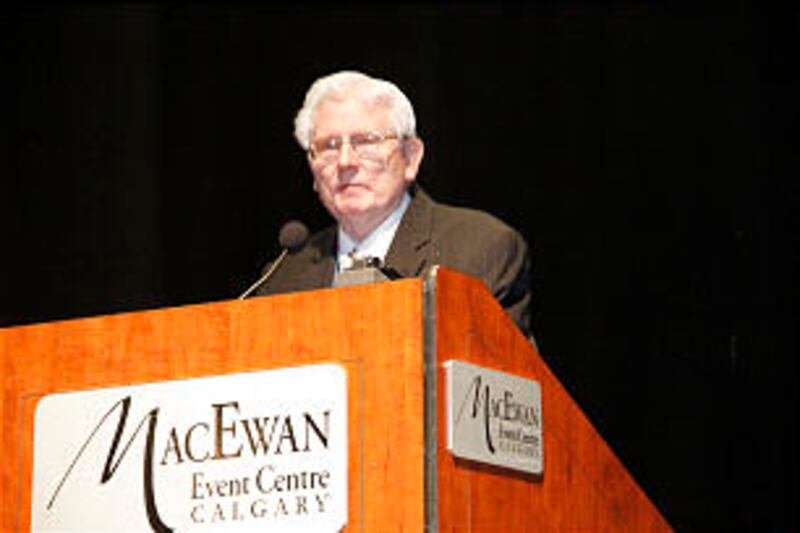
"In a week, we'll have a million people descend on this fair town for what's called the Stampede," Brother Rosenvall observed. "There are not one of a thousand of those who understand that the word 'stampede' is a Mormon term. That rodeo — and that's the biggest rodeo in the world, the Calgary Stampede — is a transfer of culture from Utah."
He explained that Raymond Knight, the eldest son of Utah industrialist Jesse Knight and the man for whom the Alberta town of Raymond was named, started the Raymond stampede and introduced the art of calf roping to western Canada.
Surrounding towns had stampedes, including Calgary, whose event this year observed its 100th anniversary.
Brother Rosenvall spoke of other examples of the transfer of Utah Mormon culture to southern Alberta — including basketball.
"There are two religions here, the Mormon religion and basketball," he quipped. "And that came from Utah.
"[In the] little town of Cardston, where I am living now, they are the provincial champions of basketball in high school. They compete with high schools here in Calgary and in Edmonton, cities of over a million, and they do very well."
Yet, he said, it is not true that culture can be transferred anywhere one wants, because there are certain things that prevent it. "We have to understand that as historians in order to get a true picture of what's going on."
He told a story of a farmer in the 1880s who moved to Alberta just a short distance over the United States border — or so he thought. When the survey teams came through, they discovered his farm was actually in Montana, not Alberta. His response was, "Good. I don't know if I could have stood another Canadian winter!"
It's just a story, but there are kernels of truth in it, Brother Rosenvall said, including borders and the severity of the winter.
Borders are very important as part of political and historical geography, he said.
He spoke of his background as a young man who found himself in New Zealand, where his father was called to be the first LDS temple president there. He got the opportunity to observe LDS culture in that country.
Later, as a young local Church leader while working at the University of Calgary, he learned even more. He has been involved in Church leadership for 40 years; that amounts to one-third of the Church's history in Alberta.
He became the trustee-in-trust for the Church in Canada, because national laws precluded donated funds from Church members in that country being sent to Church headquarters in Salt Lake City.
"We have to run a different organization here in Canada because of what? The border," he said. "And so we do things quite differently."
As an example, he recalled that in the mid-1980s, there was a famine in Ethiopia, and general Church leaders decided that in North America, a special fast would be held with the fast offering funds going toward famine relief. In Canada, some $250,000 was raised on that fast day, money that could not be mingled with funds in Salt Lake City because of Canadian law. A solution was devised whereby the money was donated to the Canadian Red Cross, which would in turn apply the money to relief efforts in Ethiopia.
The province of Alberta matched the donation, doubling it to $500,000. The national government doubled that amount again, making it $1 million. The president of the Canadian Red Cross said it was the largest donation ever made to that organization.
Harsh winters in Canada, Brother Rosenvall said, were encountered early on by the pioneers who came under the leadership of Charles Ora Card from Utah. Camping in the area in June, they woke up one morning to find snow on the ground.
Brother Rosenvall, who is a climatologist as well as a geographer, said he once commented to a Church congregation that the average year-round temperature in Calgary "is less than your refrigerator."
That's what early Church members faced in bringing their Mormon culture over the border, he said. "Many don't understand that when you come from a different climate, the seeds you bring with you don't work."
That's why the Mormon settlers in Alberta failed in their effort to establish a sugar beet industry, though it had been a thriving enterprise in Utah, he said.
Brother Rosenvall spoke of the influence of the temple presence in Alberta.
"If the decision had not been made to build a temple very early in Cardston, I can assure you there would not be very many members of the Church here," he said.
"Cardston is not the end of the world, but you can see it from there," he said, speaking of the town's relative isolation. The temple is the reason the people stay there, he said.
