



A retired United States Air Force general with a 37-year military career, Elder Bruce A. Carlson had been a member of the Second Quorum of the Seventy only a short time in 2009 when his government beckoned again.
He was on his first assignment as a General Authority, accompanying Elder L. Whitney Clayton of the Seventy at a mission presidents training seminar and area council meeting in Portland, Ore.
"During a break, I got a call from a friend who was connected with [President Barack Obama's] administration," he recalled. "He told me what they wanted. I explained to him I couldn't do that, and he said he was fine with that."
But the matter didn't end there. He received a subsequent call from Admiral (Ret.) Dennis C. Blair, director of National Intelligence for the United States. Elder Carlson had been recommended by a committee to head the National Reconnaissance Office, which designs, builds, launches and operates the nation's spy satellite system.
He again demurred, explaining his commitment and duties as an LDS General Authority. Mr. Blair, who was somewhat acquainted with Elder Carlson's faith, having heard him deliver a sermon at the funeral of a colleague, seemed to understand.
"I've been around long enough to know that when something happens like that, you report it to your file leader, so I did," Elder Carlson said. To his surprise, he received a call from Elder Ronald A. Rasband of the Presidency of the Seventy, who said the matter had been discussed by the First Presidency, who felt that Elder Carlson should answer the call to government service.
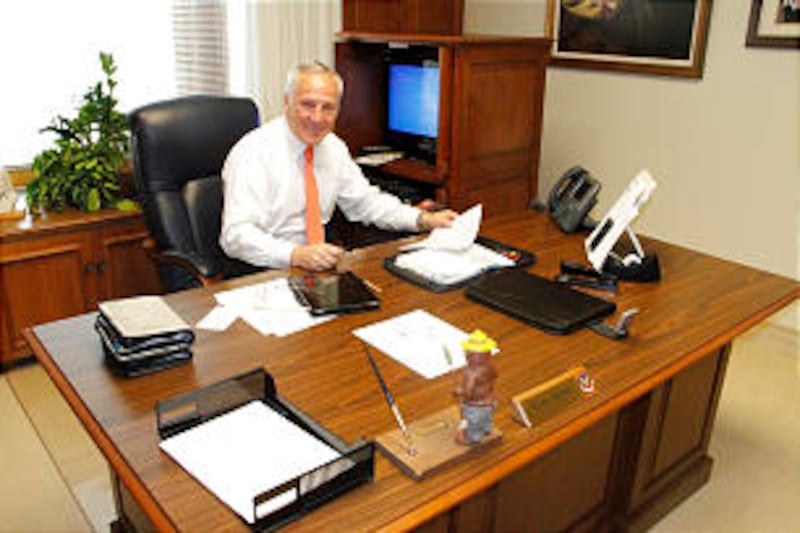
"I pleaded with them, to no avail," he said, "and I ended up going out to Washington D.C. to take over the National Reconnaissance Office for three years."
He knew what he was up against. "It would be a difficult assignment, just a difficult pace of life
"But it was a remarkably uplifting experience. For one thing, there's an appreciation in the Church for the importance of service to our country. I think that's universal; I don't think it applies just here in the United States. I think the Brethren believe that if you're in service to your country, you're in service to your God. So there's a crying need for honorable men to go do that kind of work."
Moreover, he found an understanding attitude among those with whom he worked. "They seemed to have a sense that the Church had sacrificed and said, 'OK, we're going to give him back to you as needs arose,'" he said.
Elder Carlson's task — and ultimate success — was to set in order an organization that had fallen into some degree of disarray.
"They didn't have a clear path on the way ahead and what things they were going to focus on," he said. "If they were going to build a satellite, what was it going to look like? What would it cost? What were its capabilities going to be? And they didn't have a corporate process to make decisions."
Those matters were well within the capability of Elder Carlson, who was used to running large organizations such as the Air Force Materiel Command, which had a workforce of 73,000, a $50 billion budget and nine Air Force bases.
"Even though this wasn't that size of an organization, it was still very large and diverse," he said. "We had five operating locations throughout the world: Australia; England; Denver, Colo.; Las Cruces, N.M.; and Washington, D.C."
He said, "When I first got asked to do it, in addition to my full-time Church service, I told them that I don't know anything about this business." He had never been involved with space or rockets or satellites.
"But what they really needed was somebody who knew how to come into an organization, sort of pick up on what needs to be done, and then watch while other people do it."
Experience in Church service helped prepare him. "I wasn't raised in the Church, but I've run elders quorums before," he said. "I had worked with people, and that's one of the greatest skills you need in any organization. I think that, and the communicative skills I've developed while serving in the Church, set me up very well to go out and do this. And it worked out well."
