



PROVO, UTAH
Marjorie Volkel was eager to participate in anything organizers had planned during her tour of BYU — as long as it wasn’t climbing Y Mountain. She had been raised in Utah but never had she set foot on campus. Now she was being invited to visit the organ department of the School of Music where she’d donated her estate.
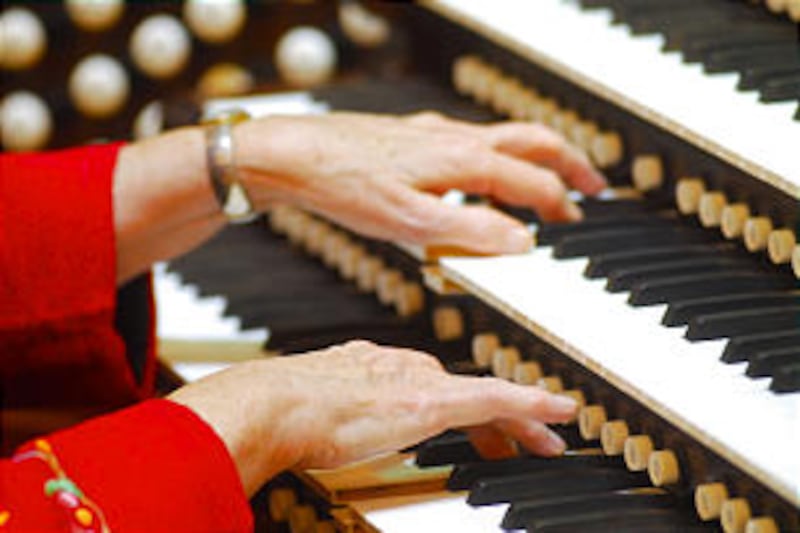
Organizers were secretive about plans, but she quickly connected the dots as soon as she stepped into the Madsen Recital Hall and beheld the grand concert organ with its impressive rank of 52 overhead pipes. An empty organ bench was all the invitation she needed. She rummaged through her shoulder bag to pull out two white, pointed-toe organ shoes. She drew out four sheets of music — music that she felt captured the moment.
Now 82 years old, Sister Volkel has had a lifelong love affair with the organ. To her, the organ is just as Mozart said, “The king of instruments.”
For many, the piano and organ appear similar since each makes sound by striking black and white keys.
But that’s where the similarity ends, she contends.

“Pianists are not necessarily organists,” she said. “Because someone can play the piano doesn’t mean they can sit down at the organ and bring out its beauty.”
She fears that if musicians continue to play organs the way they play pianos, much of the sacred richness of sacrament meeting worship will fade away.
Sister Volkel, who resides in the Mount Vernon Ward, Mount Vernon Virginia Stake, began violin lessons in the third grade. Years later in high school, after her mother challenged her to become more proficient, the young Marjorie practiced to the point that her mother recanted her challenge.

At age 16 she led a high school choir of seminary students from four stakes in a performance at Jordan High School in Salt Lake City. She’s had a finger in ward and stake music ever since.
Over the years she grew concerned that knowledgeable organists were diminishing, and that newly called organists in wards and stakes were often overwhelmed with the immensity of the instrument, leaving the music of the sacrament worship service to fall short.
Seeking a solution, she enrolled in her first private organ lessons at age 50. She soon learned that there was little instruction available to help the piano player convert to the complexities of the organ.

Organists simply need better training, she felt.
Ruminating with a friend and professor in the BYU School of Music, they concluded that the way to improve organ playing was to send out some of the finest organists in the Church to visit stakes locally to conduct one- or two-day workshops.
To begin, the first workshop was organized in her Mount Vernon stake in August 2013 where more than 170 people attended from an eight-stake area, including two sisters who drove four hours each way, she said.
She was encouraged by the enthusiasm of so many participants and withdrew from the resources she and her late husband, Victor, had acquired to make a donation to BYU to fund other training ventures with stakes around the country that are interested and to also provide scholarship funds for BYU organ students. Her donation is part of a planned gift.
Sister Volkel was invited to tour the campus in November to see firsthand what BYU was doing to train organists. On a warm, sunny day, she was directed from room to room in the Harris Fine Arts Center to watch as students practiced on the 12 organs in the practice lab, and on the seven teaching organs, and on the two studio organs.
“I noticed the eagerness of the students,” she said. “I envy them as they pursue their heart’s desire to play the organ. They are serious students who have a love and joy for what they are doing. You don’t see many students with that same attitude.”
Sister Volkel found particular affinity with a married mother of grown children who had returned to school to fulfill her long-held dream of playing the organ.
The crowning moment of the tour came during her half-hour of fame while playing the Tabernacle organ on Temple Square in company of several Tabernacle organists.
“Playing that iconic organ is a transforming experience,” she said. “Once you’ve felt of its grand power to shake the earth, or its ethereal tones that pierce the soul, you are never the same.”
“Marj’s generosity to the School of Music is simply overwhelming,” said Kory Katseanes, chairman of the School of Music. “It will mean so much to our organ students, and will provide opportunities in organ outreach and distance learning that we could only dream of before.
“It’s not just the gift that makes me grateful, however,” he said. “It’s the opportunity to become acquainted with Marj herself. She’s a powerhouse of a person, an example of dedication and sacrifice. She makes me want to do more with what I have. We will use the gift — in a ‘Marj’ way — to bless the world.”
Stakes can request information regarding organ training by contacting Don Cook, professor of music at BYU, by emailing: doncook@byu.edu.
