




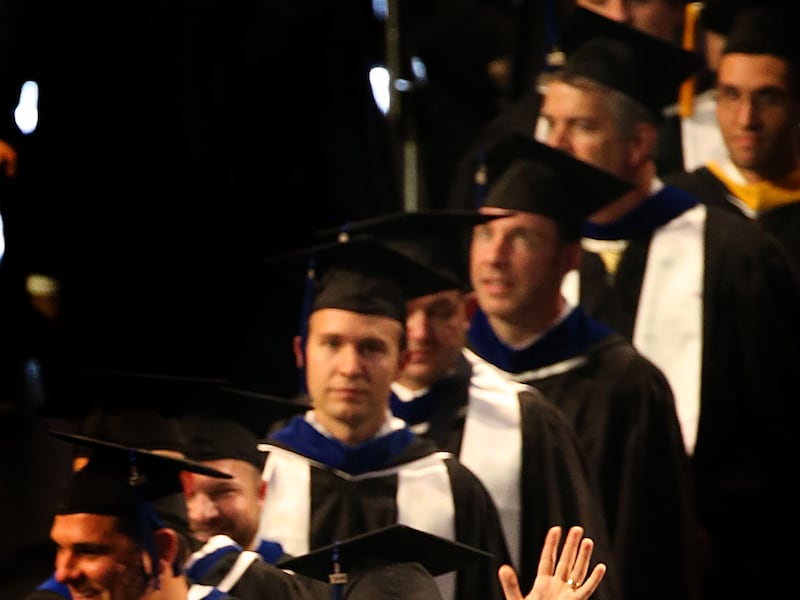



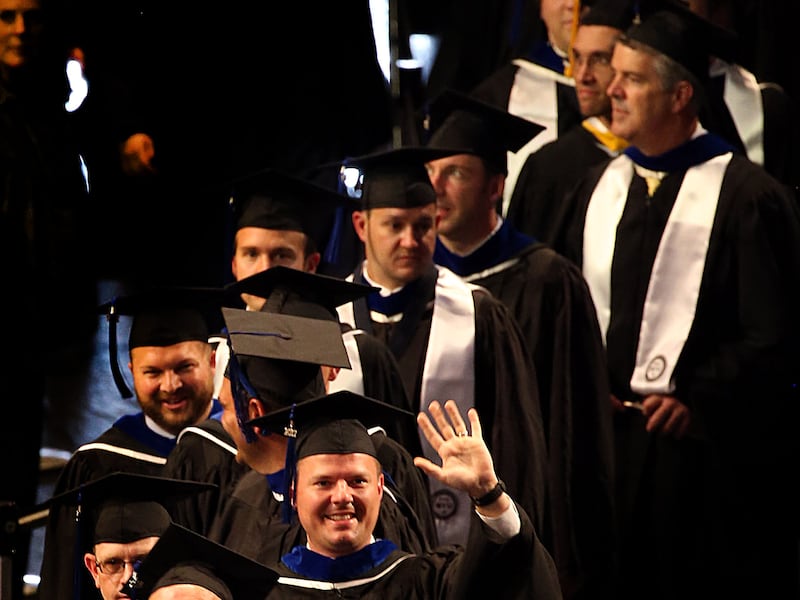
PROVO, Utah
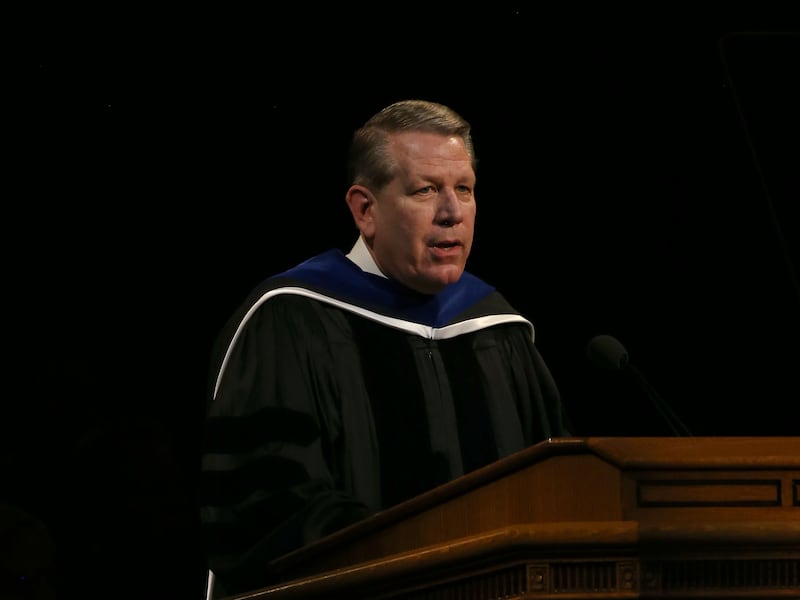
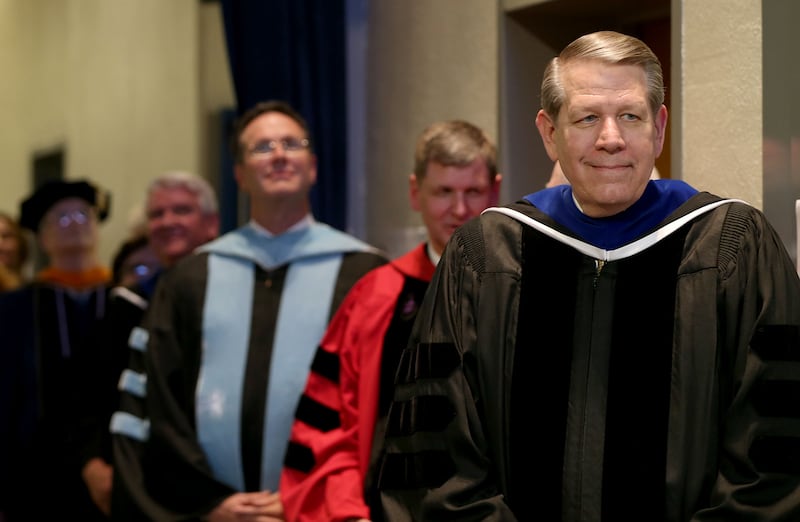
“Seeking balance — giving adequate time and effort to each of those things that really matter — is vital to our success in mortal probation,” Elder Donald L. Hallstrom, a General Authority Seventy, told Brigham Young University graduates during commencement exercises on Aug. 17.
“Leading a balanced life is difficult for many,” Elder Hallstrom said. “There is not an exact pattern for everyone and even our own blueprint may change during different phases of our life. … There are certain fundamental responsibilities we cannot neglect without serious consequence.”
Speaking to this summer’s graduating class consisting of 1,888 students earning 1,502 bachelor’s degrees, 339 master’s degrees and 47 doctoral degrees, Elder Hallstrom invited graduates to consider their future and priorities, and counseled them to seek balance in their lives.
Elder Hallstrom spoke of when he was called to lead an 850-member ward in Honolulu, Hawaii, at the same time he had started a business and was raising a young family.
“The daunting responsibilities to properly care for my young family, the saints entrusted to my stewardship, and create a viable business, seemed impossible,” he said. “Would I know how to allocate my time when any one of these three important and complex aspects of life could become all-consuming?”
Elder Hallstrom shared four points to living a balanced life.
1. Love for Heavenly Father and Jesus Christ
“Our love of the Father and the Son is foundational to all else,” he said. “The Savior, representing the Father, is the source of peace. Love for Him is the supreme motivation to keep ‘in the right way.’ Every other aspect of our life is enhanced when we truly love our Heavenly Father and Jesus Christ, as we will love ourselves and others more completely. Answers to our most challenging problems are found only when we love and have faith in Them.”
2. Care for family
“For many, properly caring for our family is the first area of compromise when other demands arise, as the results of neglect are not always immediately apparent,” he said. “Nurturing the husband/wife relationship and building a spiritual home requires men and women of vision and commitment.”
3. Service to the Lord
“Our time spent in church and community service may vary during different periods of our life depending on specific callings we receive and our family circumstances,” he said. “However, our desire and our availability to serve should never waver.”
4. Temporal work
“Although temporal work is temporary, it is still important as a support to the other, more long-lasting aspects of life and provides valuable service to others,” he said. “This monumental effort will allow choices in your life’s work, and dedication to an honorable profession, properly balanced, will enhance your spiritual life.”
Each one of the points is important, needs constant care and must not be neglected to fulfill its proper role in making a person “whole,” the LDS leader taught. Constant evaluation is needed to prevent too much focus in one area causing neglect in another area.
“How do we know if our life is out of balance?” he asked. “Well, most of us just know. We simply need to admit it and exercise the discipline to change, substituting higher values and better habits for those we have been living.”
For others, recognition of imbalance may not be clear. “We organize, prioritize and live worthy of spiritual guidance required when making the difficult decisions,” he said. “Often, we seek counsel from those closest to us. From time to time, we may be ‘out of balance’ for a brief period as the immediate needs of one portion of our life takes temporary precedence.”
When an imbalance occurs, it is important to knowingly work through the issue and seek to stabilize as soon as possible, before the short-term need becomes a long-term trait.
“If we are out of balance, we can change,” he said. “We can delay and be compelled by the tragedy of a failing family, or the sorrow of lowering our own spirituality; or, we can be attentive and continually nudged by the whisperings of the Holy Spirit. Seeking balance among the essential responsibilities of life is preparatory to salvation.”
Describing himself as a “word nerd,” BYU President Kevin J Worthen spoke of his fascination and love of words and language.
“My love of language is one reason why I enjoy graduation ceremonies so much,” President Worthen said. “At graduation, we hear words we don’t ordinarily use in everyday life.”
Sharing two phrases associated with graduation — alma mater and alumni — President Worthen described their meanings and encouraged graduates to look at their education as a special nurturing role in their personal development.
“Interestingly and instructively, neither of these terms originated in connection with graduation or even higher education,” he said. “Alma mater is a two-word Latin term that literally translated means ‘bounteous [or] nurturing mother.’ ”
Although alma mater has been used in a variety of ways at universities, President Worthen explained that a university plays a special “nurturing” role in the development of its students, “somewhat like, though not identical to, that of a parent.” The term “alumni” also refers to an almost parent-like relationship.
In addition to family members and friends, there are many other “alma maters” who have helped each student while they are obtaining an education.
“When you hear the term alma mater, I urge you to think not of buildings or bricks and mortar, but of people and relationships,” he said. “When you proudly proclaim that BYU is your alma mater, please have in mind all the alma maters who have contributed to you in so many ways.”
As an alumni of BYU, graduates have the responsibility to nurture others and follow the hymn, “because [we] have been given much, [we] too must give,” President Worthen taught.
“Enter to learn, go forth to serve is not just a motto; it is a university and gospel imperative. … I hope that when you hear the terms alma mater and alumni and remember their familial origins and connotations, you reflect on the glorious truth that, as important as the relationship is between you, as alumni, and the many people who have made BYU your alma mater, it pales in comparison to one central and eternal family relationship.”
