



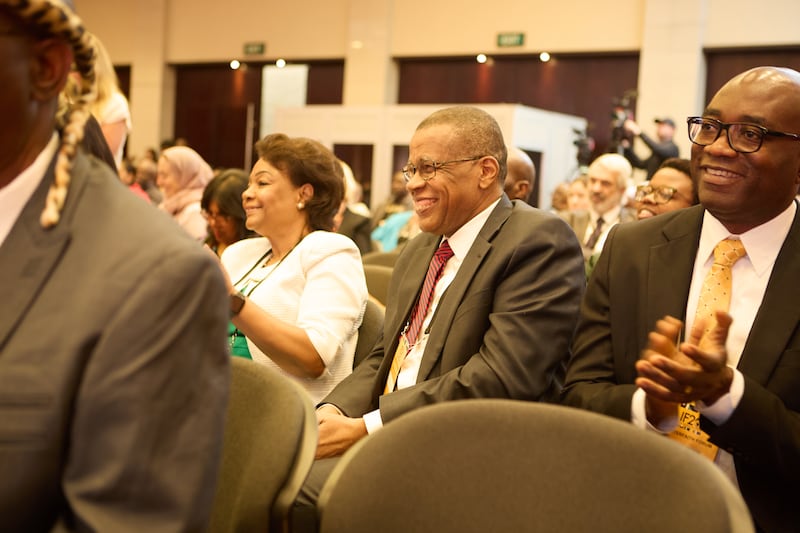

The words “Ubuntu in Action” set the tone for this year’s G20 Interfaith Forum, held Aug. 10-14 in Cape Town, South Africa, where over 500 global leaders gathered to seek solutions to some of the world’s most urgent challenges.
Ubuntu, an African philosophy meaning “I am because we are,” demonstrates the interconnection of all people. It was a common thread running through the remarks of six leaders of The Church of Jesus Christ of Latter-day Saints from each of Africa’s area presidencies who participated in the gathering.
The call of ubuntu
Elder Thierry K. Mutombo, General Authority Seventy and president of the Church’s Africa Central Area, shared what ubuntu can accomplish.

“Ubuntu is a call to love, to lift and build each other. A call for humanity, dignity and equality,” he said. “A call to practical compassion in serving vulnerable communities. By living ubuntu, we build stronger and more just societies.”
He concluded his remarks by sharing that the forum is a God-given opportunity to determine how to make a difference for good.
‘The world God wants us to have’

Elder Adeyinka A. Ojediran, General Authority Seventy and first counselor in the Africa West Area, told a panel that change begins individually.
“It is said that doctrine well understood will change behavior more than behavioral science will,” said Elder Ojediran. “What do we do in our interaction and engagement that can change people from within [so] their actions have positive impact externally that will give us the world God wants us to have?”

Later, he asked, “Can we appeal to the conscience of policymakers [so] they can see people as God’s children and ask themselves how accountable they are to our Creator in the policies and things they do that will impact the vulnerable?”
‘We are not alone’

Elder Denelson Silva, General Authority Seventy and first counselor of the Africa South Area, began his remarks with testimony.
“We are not orphans. We can pray every night, every morning and talk to our Father. We are not alone. We are not forsaken. And because He is our Father, this means that we are all brothers and sisters and we need to care for each other.”

Discussing the Church’s women and children humanitarian initiative, he shared the importance of teaching self-reliance. “Because I know my needs and I trust in God, I can make all the difference in my own life.”
‘Lead with respect and love’

Elder Adilson de Paula Parrella, General Authority Seventy and first counselor in the Middle East/Africa North Area, spoke on religious freedom.
He said: “Regardless of where we are, we should be engaged in [our] host country. We should be involved in humanitarian and emergency aid and projects that will help people become self-reliant. We need to be involved in the community and promote the well-being of the community.”

That work begins at home, he added. “Everything that we are discussing institutionally starts at home with parents, teaching and setting the example to our children. … We set the example of how we treat others, and we lead with respect and love for others.”
‘Go bless the world’

Elder Vaiangina Sikahema, General Authority Seventy and second counselor of the Africa South Area, shared that his parents received temporal support from the Church that provided them a teaching opportunity he has not forgotten.

“The Church impressed upon my parents that we were to contribute to our own self-reliance,” Elder Sikahema recalled with emotion. “Because we received food orders from the bishops’ storehouse, my parents insisted that we kids go every Saturday to the bishops’ storehouse and work and clean and stock shelves and sweep and mop. You know what that did for us? It gave us dignity. It taught us as children that we were to work for whatever it was we were given.”
He concluded with a call to those in attendance to “go bless the world.”
‘This world ... will never be the same’

Speaking about community resilience, Elder Isaac K. Morrison, General Authority Seventy and second counselor of the Africa West Area presidency, emphasized communities should carry one another through hardship.

After he and his wife lost a child years ago, Elder Morrison recounted, “do you know what helped us? Many members from our community and many members from our faith writing to us or coming to visit us and telling us about their own story. … That brought so much comfort and solace and healing to us.”
Concluding, Elder Mutombo shared the impact that this year’s summit could have.
“This world, particularly the African continent, will never be the same,” he said.
Listen to Church leaders remarks available online
Elder Thierry K. Mutombo — Religious leaders’ actions on G20 leading issues and priority challenges
Elder Adeyinka A. Ojediran — Action imperatives and realities of finance and debt panel
Elder Denelson Silva — Fighting Hunger as a Critical Element in Addressing Poverty panel
Elder Vaiangina Sikahema — Leave no one behind: Vulnerable communities at the center
Elder Isaac K. Morrison — Sustainability: Religious responsibilities and Action


