





Throughout his apostolic ministry, President Dallin H. Oaks has been a strong advocate and defender of religious freedom, a topic he considers to be of great importance to The Church of Jesus Christ of Latter-day Saints and the world.
“Religious freedom is a lifelong interest of mine,” then-Elder Oaks said while speaking at St. John’s College, University of Oxford, in 2016, noting that his first publication on the subject was more than 50 years earlier when he was a young law professor at the University of Chicago.
In the United States, Jan. 16 is recognized as National Religious Freedom Day, commemorating the 1786 passage of the Virginia Statute for Religious Freedom. Since 1993, the U.S. president has annually declared the date as Religious Freedom Day.

In honor of National Religious Freedom Day, here are some of President Oaks’ thoughts and insights from speeches he has delivered over the years on the significance of religious freedom.
2009
In October 2009, then-Elder Oaks of the Quorum of the Twelve Apostles spoke at a BYU–Idaho devotional with an address titled “Religious Freedom," warning students that religious freedom is at risk.
“There is a battle over the meaning of that freedom,” Elder Oaks said. “The contest is of eternal importance, and it is your generation that must understand the issues and make the efforts to prevail.”
He continued: “The importance of [the guarantee of religious freedom in the U.S. Constitution] should make us ever diligent to defend it. And it is in need of being defended.”
2011
In 2011, Elder Oaks spoke at Chapman University’s law school in Orange, California. He encouraged religious groups to unite to protect religious freedom as one of the Constitution’s supremely important founding principles.

“We must never see the day when the public square is not open to religious ideas and religious persons,” he said. “The religious community must be united to be sure we are not coerced or deterred into silence by the kinds of intimidation or threatening rhetoric that are being experienced. ... There should be room for all good-faith views in the public square, be they secular, religious or a mixture of the two.”
2013
At a 2013 black-tie dinner in New York attended by religious dignitaries from many faiths, the Becket Fund for Religious Liberty presented Elder Oaks with its highest honor, the Canterbury Medal, for his lifetime of defending religious liberty.

In his address, Elder Oaks noted that religious teachings and religious organizations are vital to a free society and deserve its special legal protection.
“Our society is not held together primarily by law and its enforcement but most importantly by those who voluntarily obey the unenforceable because of their internalized norms of righteous or correct behavior,” he said. “Religious belief in right and wrong is a vital influence to produce such voluntary compliance by a large number of our citizens.”
2014
Returning to speak at a BYU–Idaho devotional in February 2014, Elder Oaks taught, “We should press officials in the executive, legislative and judicial branches of governments to honor the constitutionally guaranteed free exercise of religion.”
Elder Oaks highlighted public prayer, noting it has faced challenges for decades.
“Whatever the designated prayer’s concept of God and whatever his or her religious persuasion or language of prayer, I hope the citizens of this nation can continue to witness their belief in God by the symbol of prayer, wisely and tolerantly administered. That is worth contending for.”
In his October 2014 general conference talk, “Loving Others and Living With Differences,” Elder Oaks spoke on themes of religious freedom.

“On the subject of public discourse, we should all follow the gospel teachings to love our neighbor and avoid contention,” he said. “Followers of Christ should be examples of civility. We should love all people, be good listeners and show concern for their sincere beliefs. Though we may disagree, we should not be disagreeable.”
He encouraged Latter-day Saints to practice the Savior’s Golden Rule: “Whatsoever ye would that men should do to you, do ye even so to them” (Matthew 7:12).
2015
On Jan. 27, 2015, Elder Oaks gave a statement on religious freedom and nondiscrimination, offering principles based on the teachings of Jesus Christ and “fairness for all, including people of faith,” during a press conference in the Conference Center.
Read the four principles here.
2016
In March 2016, Elder Oaks gave the keynote address at the 2016 Mormon Studies Religious Freedom Conference at California’s Claremont Graduate University.
Elder Oaks concluded with a continued call for civility.
“We all lose when an atmosphere of anger or hostility or contention prevails. We all lose when we cannot debate public policies without resorting to epithets, boycotts, firings and other intimidation of our adversaries. We need to promote the virtue of civility.”
Read Elder Oaks’ entire address here.
On June 9 of the same year, Elder Oaks spoke at England’s University of Oxford on complementary functions of religion and government.

Elder Oaks said the responsibilities of religion are to observe the laws and respect the culture of the country that secures its freedoms. “When religious freedoms are secured, such a response is a debt of gratitude gladly paid,” he said.
Read a transcript of Elder Oaks’ University of Oxford remarks here.
Speaking at a BYU devotional in September 2016, Elder Oaks said, “I believe religious freedom is declining because faith in God and the pursuit of God-centered religion is declining — worldwide. If one does not value religion, one usually does not put a high value on religious freedom."

He continued: “We must strive for mutual understanding and treat all with goodwill. We must exercise patience. We should all speak out for religion and the importance of religious freedom. We must, above all, trust in God and His promises.”
Read a transcript of Elder Oaks’ BYU devotional address here.
2021
In November 2021, President Oaks, as first counselor in the First Presidency, spoke on “Going Forward With Religious Freedom and Nondiscrimination” at the University of Virginia.
President Oaks’ lecture in the Dome Room of the Rotunda proved to be “a landmark address given in a landmark location,″ said Richard E. Turley Jr., former assistant Church historian and recorder and President Oaks’ biographer. “It was a talk that addressed constitutional issues in a building that was designed by Thomas Jefferson.”

Said President Oaks: “We need to live together in peace and mutual respect, within our defined constitutional rights. ... Let us unite with those who advocate nondiscrimination to seek a culture and laws that respect the rights of all to the equal protection of the law and the right to the free exercise of religion.”
Read President Oaks’ entire address here.
Weeks later, President Oaks continued to advocate for religious freedom in Rome’s La Sapienza University in Italy.
“For us, religious freedom is a fundamental feature of our religious doctrine,” said President Oaks. “The restoration of the fullness of Christian doctrine teaches us that God created and put His children on earth to grow spiritually by making right choices between good and evil consistent with His commandments.
“Freedom of choice is, therefore, fundamental to God’s plan.”
2022
Speaking at an Ensign College devotional in May 2022, President Oaks said: “Our voices need to be heard on the importance of religion and religious freedom for all citizens — believers and nonbelievers alike. We can do this if we avoid contentious settings and speak in the context of respect for those with whom we disagree."

In July 2022, President Oaks gave a keynote address at the 2022 Notre Dame Religious Liberty Summit, held in Rome, Italy.
“We need to treat religious freedom in the context of the laws of the country, because God established the governments of men as well as the governments of God,” he said. “It is shortsighted of religions and religious believers to believe that their particular values, as important and God given as they are, should be dominant over every other concern of other children of God.”
A Church News video titled “Understanding Religious Freedom” features President Oaks’ plea to find the middle ground on this important issue.
“If you have not thought seriously about religious freedom, or if you wonder why it is important, let me encourage you to think about where would the absence of religious freedom lead society?” President Oaks said.
2023
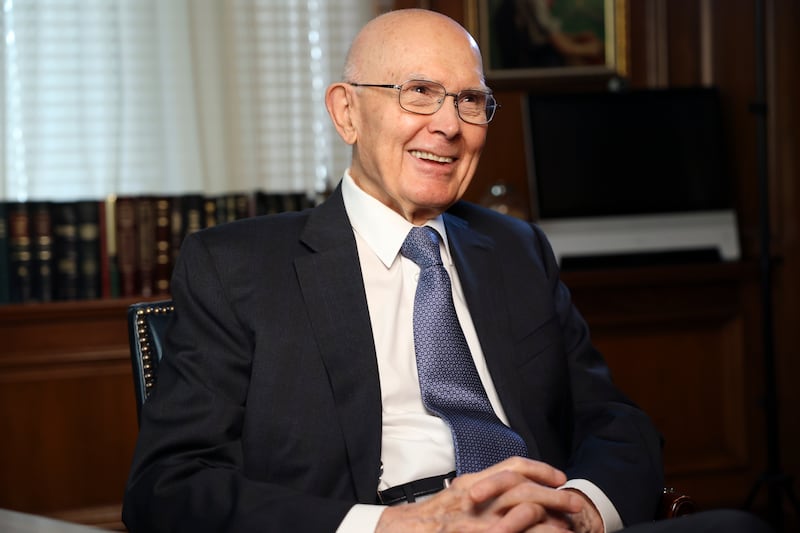
As a guest on the Church News podcast in July 2023, President Oaks spoke about the most effective representation of religious liberty.
“The most effective representation of religious liberty is a representation that stands up for people of faith or no faith, because even people of no faith have a great interest in what can be done by religions and believing people who speak up for freedom generally, which we try to encourage,” he said.
“The members of our Church are members of the restored Church of Jesus Christ of Latter-day Saints. And fundamental to that doctrine is the right and the obligation of individuals to choose to do what keeps the commandments of God and what furthers the purpose of the gospel of Jesus Christ as He taught it. Without religious freedom, we are not free to do that.”

