



Over the past decade, the abilities of and access to artificial intelligence have increased rapidly. Elder Gerrit W. Gong of the Quorum of the Twelve Apostles of The Church of Jesus Christ of Latter-days Saints has spoken at several key events dealing with the morality of AI.
The Church released a video on Sunday, June 7, about AI. In the video, Elder Gong teaches about best practices for maintaining sensitivity to hear the Holy Ghost while AI use increases. The video, titled “Faith, Dignity and Human Flourishing: Hearing God’s Voice in an Age of Artificial Intelligence,” is available on the Church’s YouTube channel, with individual episodes or clips also published on Elder Gong’s YouTube channel.
The clips are divided into specific topics designed to help individuals answer specific questions. The episode titles are:
- Episode I: “An Issue Defining Our Day”
- Episode II: “AI and Our Relationship With God (Thou)”
- Episode III: “AI and Our Relationship With Self (I)”
- Episode IV: “AI and Our Relationship With Others (They)”
- Episode V: “AI and Our Relationship With the Environment and Natural World (It)”
- Episode VI: “Concluding Thoughts on Hearing God’s Voice in an Age of Artificial Intelligence”
- Additional Insights: “Hearing God’s Voice in an Age of Artificial Intelligence”
In the video, Elder Gong says he finds people with “a deep love of humanity” everywhere he goes. He said he also finds individuals with concerns about AI.
“You are not a data point. You’re a beloved child of God with moral agency and divine potential,” Elder Gong says.
While the challenges and concerns may be valid, Elder Gong says that he hopes the message of this video will also help people look at the emerging technologies around AI as something that can change the world for the better. He says he believes AI can narrow digital divides, expand human flourishing and enhance faith, moral clarity and human meaning and possibility.
Elder Gong teaches that the current iterations of AI are based largely on algorithmic exercises that help it understand languages, recognize patterns, make decisions and generate ideas.
He also says AI can be both autonomous and unpredictable. “We’re grappling with AI’s increasing capacity and fundamental issues these new capacities raise.”
Among the questions Elder Gong says need to be resolved, he asks how individuals will promote and protect divine principles like work, moral agency, accountability and personal growth. And, he adds, “how can we preserve peace, unity and community?”
Before attempting to answer or contextualize those questions, Elder Gong says he sees AI as a “massively consequential technological development” and a “profoundly significant moral opportunity.”
He shares three gospel-centered guideposts to help guide personal use of AI.
- Rely on the Spirit: Let technology support, not supplant, revelation, personal study and covenant living.
- Practice wisdom: Apply wise judgment informed by doctrine and one’s lived experience.
- Choose trusted sources: Anchor understanding in scripture, prophetic counsel and reliable information.
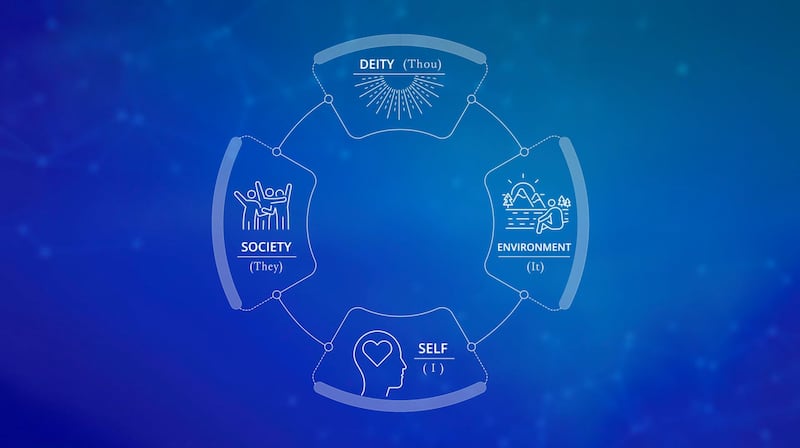
Elder Gong invites individuals watching Episode 2 to understand four core relationships each person has with Deity, himself or herself, society and his or her environment. He says AI affects all of these relationships.
Looking back in history, Elder Gong shows that agriculture was the primary means of production in the 19th century. In the 20th century, it was industry.
“Now, in the 21st century, information, innovation and intellectual property shape daily life,” he says. These three are unique because they are scalable in ways that agriculture and industry were not, he continues.
Some potential pitfalls to that scalability include the increased competition by companies to concentrate information, capital, technology and power in what Elder Gong calls “unprecedented ways.”
That consolidation “gives us all a vital interest to encourage, support and incentivize safe and ethical AI. It’s critical we all help set the boundaries and define AI’s moral compass,” he continues.
Elder Gong teaches that unnecessary reliance on social media and AI is damaging to self-esteem and one’s understanding of who one really is. It can also contribute to the worsening of one’s mental health, he says. Because of these consequences, Elder Gong invites listeners to step away from technology to engage with personal relationships and time in nature.
“If you find you’re more comfortable on your phone than with people or that it’s keeping you from the light, serendipity and spontaneity inherent in God’s nature, now is a good time to change,” he says.
“Find again the serenity, calm and assurance that comes when we reimmerse ourselves in the order and beauty of creation.”
Elder Gong invited individuals who engage in nature as individuals or as groups of family or friends to put devices away in order to get the greatest benefit.
“When we step outside, we step into God’s classroom,” he said.
Stepping into that classroom can help individuals better understand all of God’s creations and develop an appreciation for them, Elder Gong says. Each generation has created tools that could alleviate existing needs. Similarly, AI should be seen as a tool, not the end.
“Discipleship is a covenant journey. AI is a tool. When we rely on the Spirit, practice wisdom and choose trusted sources, technology can help us deepen our relationships with God, ‘Thou’; self, ‘I’; others, ‘they’; and the natural world and environment, ‘it,’” he says.
Elder Gong makes four invitations to the video’s viewers.
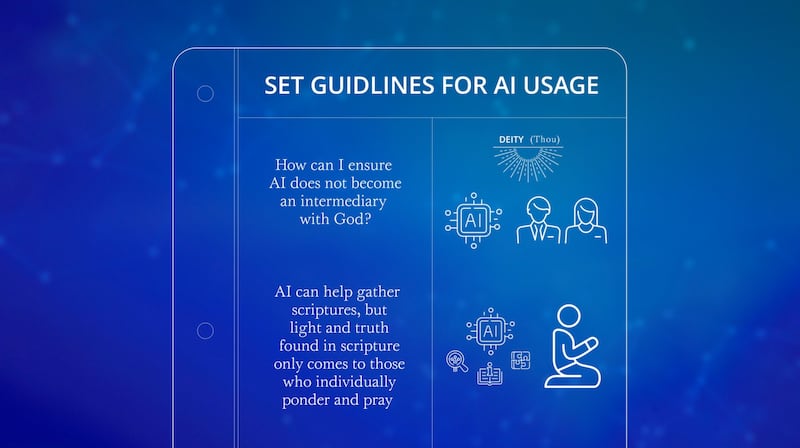
First, set guidelines for AI usage. These guidelines should help an individual avoid placing AI between himself or herself and God.
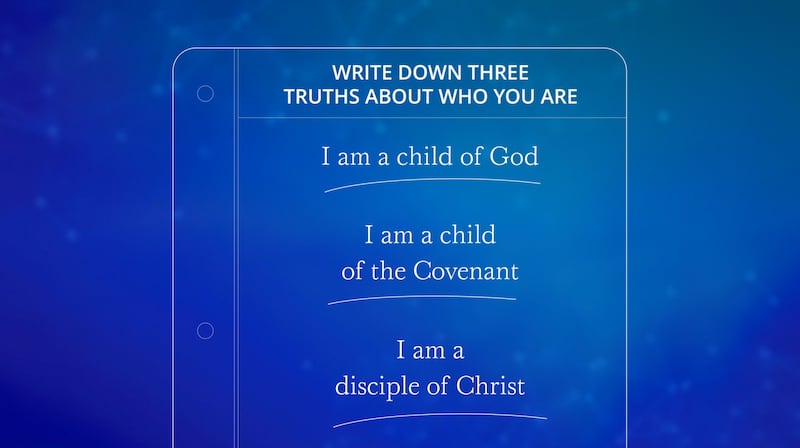
Second, write three truths.
“Write down three truths about who you are — a child of God, a child of the covenant, a disciple of Jesus Christ,” he says. Elder Gong invites viewers to put those written truths somewhere where viewers would see them regularly with time to “pause and remember.”
Third, connect with others. He suggests connection through sending a handwritten message to a friend, family member or loved one. Another option could be visiting a family member, friend, roommate or neighbor.
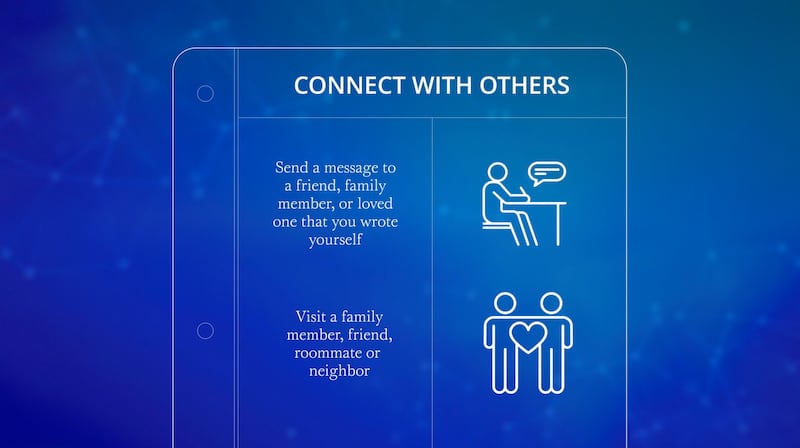
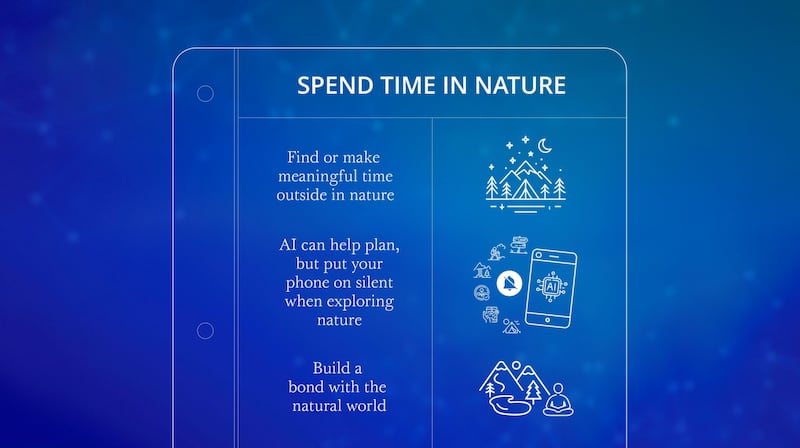
Fourth, spend meaningful time in nature with notifications silenced on electronic devices.
“Offer a prayer of gratitude for the beauty and testimony of all the things that denote the natural order and the loving purposes of God, the Great Creator,” he says.
Following those invitations, Elder Gong expresses his hope for unceasing effort to connect with God.
“In a world of accelerating technology and artificial intelligence, may we never lose the divine intelligence that matters most — the voice of God. May we listen for His whisper amid the noise, love one another beyond algorithms and steward creation and the environment with reverence.”
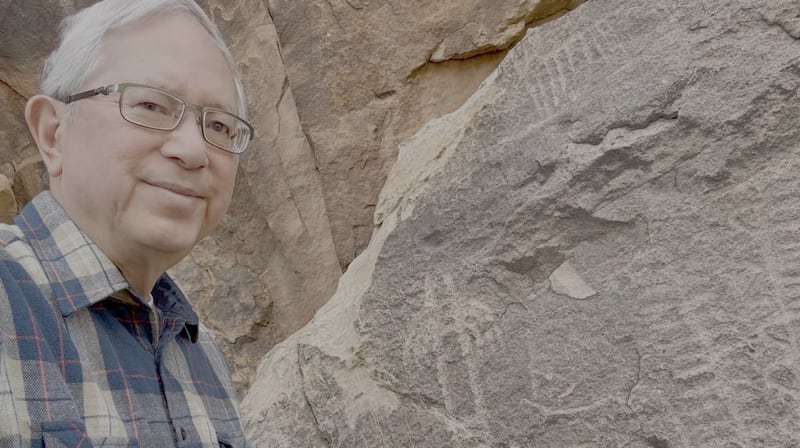
Elder Gong describes what he calls the potential gift that AI could be to God’s children who use it for righteous purposes.
“An authentic gift of AI possibility can expand human agency and dignity, prioritize learning and enlarge human character and empower individuals to find dignity, place and purpose, as each contributes to the greater good,” he says.
All of this requires AI to be morally grounded, he continues. Ultimately, he says, AI has potential to help humankind, but God’s children must continue to seek His guidance over that of AI.
“May you discern with the gift of the Holy Ghost what is real and unreal, true and untrue, uplifting and not uplifting. With faith and righteous intent, please choose wisely to follow Jesus Christ. Work with faith, obedience and diligence to become all you can become as a child of God.”

Elder Gong’s video will be available soon in Spanish, Portuguese and French. Each episode is available separately on Elder Gong’s YouTube channel.
The Church and AI
Two years ago, Elder Gong said, Church leaders were already regularly evaluating how to best use AI as a tool in support of the ongoing Restoration. On March 13, 2024, Elder Gong introduced to Church members some guiding principles for their use of AI.

“Throughout the ongoing Restoration of the gospel of Jesus Christ, emergent technologies — including in construction, communication and transportation — have allowed this great work to reach out and touch every nation, kindred, tongue and people,” Elder Gong said in that presentation.
Elder Gong also said wisdom helps individuals to use a combination of knowledge, experience and judgment in making decisions. He quoted from 2 Nephi 28:30, where the Lord says through Nephi, “Blessed are those who hearken unto my precepts, and lend an ear unto my counsel, for they shall learn wisdom.”
When he spoke about AI a year later at BYU Education Week, Elder Gong said, “Our most important personal wisdom and understanding is to know the blessings and Atonement of the Lord Jesus Christ are meant for each of us.”

He told listeners in his keynote address that the power of technology like AI raises concerns for multiple reasons.
Some individuals may succumb to the temptation to allow AI to create talks or lessons in place of doing their own work to fulfill the same needs.
“As Church members, we will not grow spiritually if we let AI write our sacrament meeting talks or do our seminary homework,” Elder Gong said.
Outside of supplanting personal effort, Elder Gong said Church leaders are also concerned about the potential use of AI to teach incorrect doctrine or misrepresent their teachings.
“We are establishing protocols to guard against deepfakes, call out intentional misuse of AI and mitigate the tendency for people to disbelieve everything when they can’t trust some things,” Elder Gong said.
Research released in May 2026 by a team that included individuals from Brigham Young University, the University of Notre Dame, Baylor University and Yeshiva University suggests that current AI models have gaps when it comes to understanding religions and faith. The same report suggests AI models also have biases about religion.
Among the research findings, one survey identified shortcomings in AI responses anticipated by those who ask questions that users expected to have religious answers to. More than 1,000 Americans in that survey showed that almost all the AI models failed at giving religious context in their answers.
AI on a global stage
Many of the concerns expressed by Elder Gong are shared by leaders of other religions and communities around the globe.
In July 2025, Elder Gong spoke to the Religions for Peace World Council in Istanbul, Republic of Türkiye. He invited those representing other religions to join in promoting safe, ethical and trustworthy AI in a conference titled Faith, Ethics and Human Dignity in an Age of Artificial Intelligence.

“As we enter uncharted technological and ethical territory, we need especially now to align AI’s pervasive exponential reach with enduring faith-based ethical principles and moral values,” he said. Elder Gong’s full address from that council can be found on ChurchofJesusChrist.org.
The fact that AI continues to grow and change each day can make it challenging to set boundaries of its use, Elder Gong said in that message. However, Elder Gong encouraged high-level collaboration with AI’s use and not a concentration of its use or power.
“Amidst AI competition between and among companies, countries, governments at all levels, all societies and all peoples share a vital interest to encourage, support and incentivize safe and responsible AI,” he said.
A few months later, Elder Gong furthered that message when speaking in Rome, Italy, by saying that AI needs “moral grounding and moral compass.”

In the October 2025 Rome Summit on Ethics and Artificial Intelligence, Elder Gong asserted that AI can’t be and can’t become a replacement for God.
“God is God. AI is not and cannot be God,” he said.
He also said that AI is being used to magnify some existing challenges within society.
“We deplore addictions and evils that AI is being used to enhance,” Elder Gong said, “including AI ‘adult companions,’ AI-generated pornography and AI-driven gambling.”
In Rome, other religious leaders shared similar concerns to those of Elder Gong. Some expressed dismay at the lack of accurate information given by AI models when those models attempt to return answers to queries about religions.
Elder Gong said, “We are warning against anthropomorphizing AI; AI undermining divine principles of work, faith and reasoning; and AI becoming a counterfeit for something it is not, such as a divine source of inspiration.”
This past month, Elder Gong spoke at the AI Summit on Ethics and Artificial Intelligence in Athens, Greece. He said there are ways AI can help humankind.
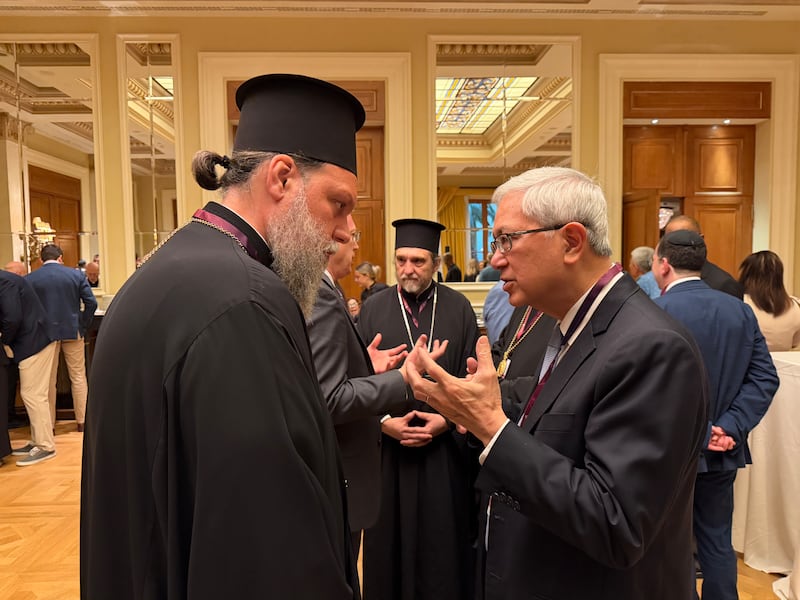
He said he believes “AI that can find a needle of pattern in a massive data haystack can help identify and nurture each person to flourish in their choices with capacity, dignity and worth.”
That ability from AI can come only if AI is “as morally good as we make it powerful,” Elder Gong said.
