


RootsTech conference attendees gathered to hear updates at the FamilySearch Global Tech Forum 2026 and the Global Innovation and Tech Forum on Thursday, March 5, and Friday, March 6, including how artificial intelligence is being integrated in family history tools.
FamilySearch Global Tech Forum
At the Global Tech Forum, leaders from FamilySearch emphasized new artificial intelligence-integrated features now available to users as well as the importance of remembering the dignity of people from records on the website.
Speaking of the use of artificial intelligence in genealogical work, product design engineer Ryan Parker said that it was “reasoning applied to human connection.”

AI has dramatically increased record documentation. It “removes barriers” and “enables human discovery,” he said.
The product design engineers, including Bret Weekes, also spoke of FamilySearch’s dedication to human dignity by maintaining privacy, trust and careful stewardship of people’s records.
Annette Carlson, a session attendee visiting from Pittsburgh, Pennsylvania, spoke of the ease of FamilySearch software. “Boom, you’re connected to the tree,” she said.
Another attendee, Jeannie Halversen, said, “I love all the AI,” adding that new tools had helped her to find “so many things.”

Leaders at FamilySearch then introduced new AI features designed to simplify and speed up family research.
Robby Parker, a product manager, noted a “new change history” feature. He also discussed an AI-guided merge feature that allows for “wiser merge decisions.”
Michelle Barber introduced “full text search,” a feature that uses AI to help users search the massive database of AI-transcripted records. AI transcription has allowed for the number of images to advance from 100 million in 2024 to 2.3 billion in 2026, making 20 billion more names available.
Barber also introduced “simple search,” a search function that uses natural language for a more flexible search that does not require input into specific query boxes. For example, one can put an entire search query into one place rather than putting specific items into the “date” and “name” boxes.
Ian James, a product manager, noted that users say the most special thing is to add a name to the tree. AI-powered tree-extending hints have made this more readily available by creating a virtual tree in the background that prioritizes hints for the user.
To close the session, James noted how much information was “hiding in the shadows” and that new methods not previously available would uncover that information.
“We’re just seeing the front of the wave,” he said, speaking of the sea of information available.
Global Innovation and Tech Forum
Similar developments across genealogy-oriented companies were presented at the Global Innovation and Tech Forum on Friday, March 6.
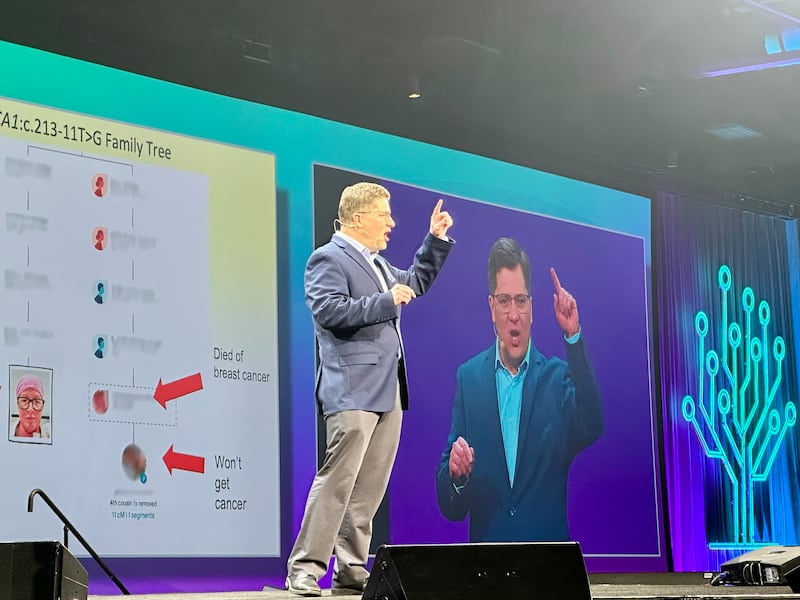
Brian Shirts, representing ConnectMyVariant, spoke of the company’s mission to prevent disease by finding genetic risks. “Getting people to talk to their relatives” was key to the company’s mission, he said.
Goldie May founder Richard Miller compared new AI technology in the software to a “super-energetic intern” that magnifies output of family history researchers. Users are able to use the AI assistant to drastically increase the amount of research done in a time period.
Laryn Brown, chief operating officer of Storied, presented Newspaper Archives, powered by Storied, that has transcribed and made searchable 3 billion articles and enabled 500 million people to be identified.

John Crockett, director of marketing at Ancestry, noted how the company is using AI, including through handwriting recognition tools. Crockett also spoke of Ancestry’s AI resource tools, which are able to “fill in the gaps” by creating summaries and descriptions of written and photo history.
Dave Vance, general manager at FamilyTreeDNA, shared how ancestral lines could be traced through their Y-DNA haplotree, the largest commercial phylogenetic tree. The tree represents the direct paternal line of a family.
Marisa Humphrey, CEO of LifeWeaver, talked about how the site enables a user to combine digital information to create a story while protecting the privacy of user records. Humphrey highlighted the difficulty of capturing handwritten information and the ease of uploading digital information to the website.

Alon Ehrenfeld, from MyHeritage, highlighted the company’s Scribe AI technology, an AI feature that provides record suggestions, photo descriptions and transcriptions.
RootsTech patron Nate Lloyd noted that technological advances in genealogical software were encouraging him to get past dead ends in research and “look for clues again.”
Another attendee, visiting from Idaho, Monica Elva Rogers, commented that she sees how “the Lord is hastening His work” through means such as AI.
