





Last week, I sat in the Washington National Cathedral and listened with care to the first Prophet to speak in that location.
The evening of Sept. 16, President Dallin H. Oaks spoke about religious freedom and invited individuals to engage in the protection of religious rights for all. Earlier in the day, the eve of Constitution Day in the United States, I heard legal scholars discuss the origins of the right of conscience in the country.

Speakers in the Washington, D.C., venue quoted U.S. Presidents George Washington, Thomas Jefferson and James Madison. They revisited the differing levels of religious participation of these and other U.S. Founding Fathers.
Quotes from speeches and letters from such leaders illustrated the shared beliefs of freedom of thought. They also showed that none of those individuals claimed to know exactly how to preserve these freedoms. The messages of those early American leaders also showed how differently everyone felt about the right path forward.
The United States celebrated its 250th anniversary as a country this year. The U.S. Constitution, however, wasn’t ratified until a dozen years after the country declared its independence. And that ratifying vote wasn’t unanimous.
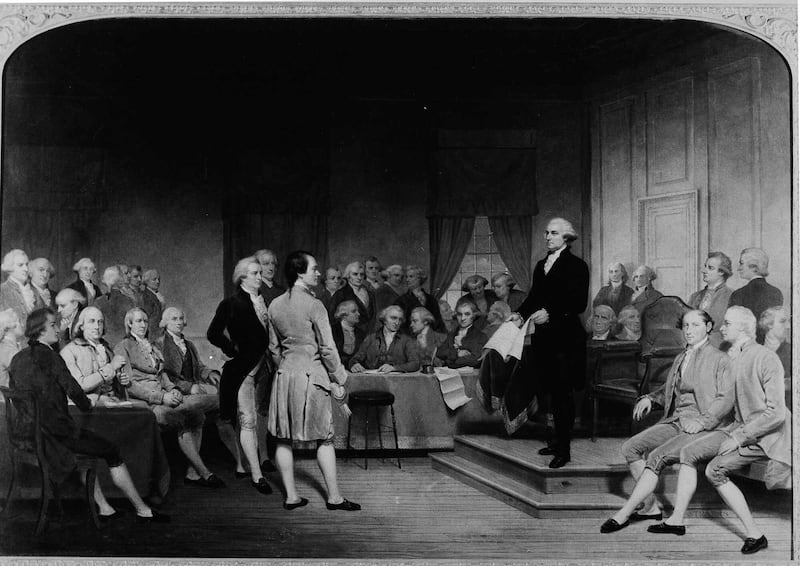
In June 1789, shortly after his election and inauguration as president of the United States, Washington wrote a letter to the Hebrew Congregations of Savannah, Georgia.
“May the same wonder-working Deity, who long since delivered the Hebrews from their Egyptian oppressors, planted them in a promised land — whose providential agency has lately been conspicuous in establishing these United States as an independent nation — still continue to water them with the dews of heaven and make the inhabitants of every denomination participate in the temporal and spiritual blessings of that people whose God is Jehovah,” Washington wrote.
President Oaks, in his remarks in the Washington National Cathedral, took this principle a step further. He used the word “all” 21 times — fairness for all, freedom for all, unity among all, balance for all, respect among all, peace among all.
Washington was right to say Heavenly Father has blessed the United States of America. And President Oaks has set a course that shows how God will likewise bless all of His children — wherever they are found — as they strive to work together for a common good.
The United States, President Oaks said, has its roots in individuals who came here from different countries, who represent different ethnicities and who held dearly different beliefs. In the forming of the country, the objective was not to homogenize those characteristics and beliefs.
“Our founding generation, whom we honor in this 250th anniversary, sought to be unified by a new Constitution and laws,” he said.
Compromise can sometimes be a challenge to accept when individuals feel their stances are absolutely right. I admit to having felt that at times as a husband, father, son and neighbor. Compromise is not always easy. It is also not inherently wrong.
“Far from being a weakness, reconciling adverse positions through respectful negotiation and coalitions is a virtue,” President Oaks taught.

He said this type of reconciliation comes by demonstrating mutual respect, sharing in understanding and in making good-faith negotiations.
I felt some guilt as I heard the President of the Church describe this process. I haven’t been good enough at doing this. I haven’t been patient enough in doing this.
And here I sit, one week later, rereading President Oaks’ remarks. Sometimes we have to sit with that unsettled feeling. Sometimes we have to let a hard teaching stew or a refining fire burn. I felt that heat this week. I’m grateful for a Prophet who was willing to push me and all of us to be better. I’m grateful for the examples he gave and the path he showed to help me find reconciliation.
“It is all about trying to understand the deep needs, the deep commitments, on both sides and then to forge solutions that yield peace and fairness for all,” President Oaks said, as part of his conclusion.
I hope to be a good enough listener moving forward that I will hear those deep needs and understand the deep commitments of those who see things differently than I do.
Because all of God’s children deserve that same treatment.
— Jon Ryan Jensen is editor of the Church News.
