



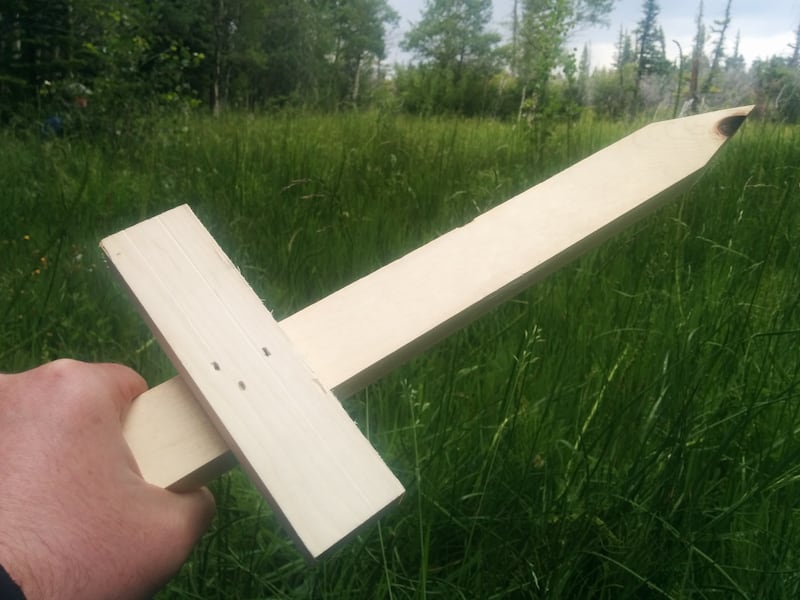

Several years ago in the mountains of Wyoming, east of Salt Lake City, a group of more than a hundred teenage young men — most Aaronic Priesthood holders — was handed wooden swords. To some, this might have seemed like a recipe for either impending disaster or comedy. But the result was stillness and reverence.
My own Young Men leaders took me camping dozens of times when I was a teenager decades before this sword-wielding experience. Summer camps, winter camps, overnight camps, weeklong camps — we camped in all sorts of conditions and learned all sorts of different skills.
I don’t recall a time when a leader willingly handed me or my quorum members a sword. They were worried enough about what we did with pocketknives.
But here we were, far from any hospital, swords in hand. Stake leaders spoke with the young men about having made these swords for them during their meetings. The leaders expressed their love and concern for the challenges faced by these young men and some of the choices they were making.
The leaders then shifted to talk about the Savior and His power and strength that is mightier than any sword. They taught about the Lamanites who would become Anti-Nephi-Lehies. They taught about conversion and repentance and forsaking of sins and spiritually damaging behavior. And they talked about the hope that builds when leaving those things behind.
When the stake leaders concluded, they handed something else to those young men. They distributed permanent markers to them and sent them out across the meadow where they were camping. The young men were instructed to go and pray about the things in their life they didn’t want to do anymore. When they identified those things, they were to write them down on the wooden sword and return to the leaders.

When everyone finished, the young men were led to another part of the meadow where a large hole had been dug. And loving leaders encouraged the young men to throw their swords — their metaphorical weapons of rebellion — into the pit to be buried. One by one and in near-complete silence, the swords dropped into the hole.
A bulldozer pushed earth over the swords to bury them forever.

In general conference earlier this month, Elder D. Todd Christofferson of the Quorum of the Twelve Apostles spoke about “Burying Our Weapons of Rebellion” in the Saturday morning session. He quoted Alma 23:7.
“For they became a righteous people; they did lay down the weapons of their rebellion, that they did not fight against God any more, neither against any of their brethren.”
Elder Christofferson explained — as did the Young Men leaders in Wyoming — that this burying of weapons of rebellion was both literal and figurative.
“It meant their swords and other weapons of war but also their disobedience to God and His commandments,” Elder Christofferson said.
I was immediately taken back to that day in the mountains when I watched a different, but still valiant, group of individuals bury their swords and begin to unearth their heavenly potential.

Since that stake camp eight years ago, many of those young men have continued on the covenant path. Many have served or are serving missions. Many have been sealed in the temple and made other temple covenants with Heavenly Father.
A handful were called to serve missions in which they would have to learn and speak the Mandarin Chinese language. This is regarded as one of the most challenging languages for native English speakers to learn, and yet nearly 1 billion people around the world speak it.
Elder Christofferson spoke about speech as something that can be used for good or evil.
“There are things in our lives that may be neutral or even inherently good but that used in the wrong way become ‘weapons of rebellion.’ Our speech, for example, can edify or demean.”
For these missionaries, they are learning how to convey their testimonies of the Savior and the blessings of His Atonement using a form of speech that is not native to them.
“There is much in public and personal discourse today that is malicious and mean-spirited. There is much conversation that is vulgar and profane, even among youth,” Elder Christofferson continued.
The youth in Wyoming were not immune to the challenges Elder Christofferson described, but they have learned to replace any negative conversation with that which uplifts and invites the Spirit into the lives of those who “know not where to find it” (Doctrine and Covenants 123:12).
By doing this, these young missionaries are modeling exactly what they are inviting those they teach to do. They have followed the Holy Ghost’s promptings and been purified by Him. And they are inviting others to follow that same path.
“In the end, burying our weapons of rebellion against God simply means yielding to the enticing of the Holy Spirit, putting off the natural man and becoming ‘a saint through the atonement of Christ the Lord’ (Mosiah 3:19). It means putting the first commandment first in our lives. It means letting God prevail,” Elder Christofferson said.
May we all let God prevail as we bury whatever our weapons of rebellion may be and let those habits be replaced with love and joy from our Heavenly Father.
— Jon Ryan Jensen is editor of the Church News.
