



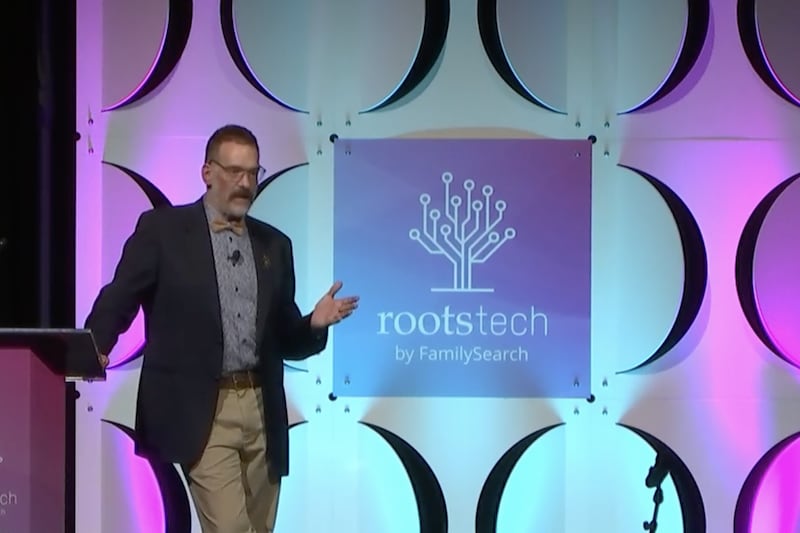

Hard-to-find ancestors are not invisible. This was the message delivered by Michael D. Lacopo, a professional genealogist and lecturer, at RootsTech 2025.
Pointing to the similarities between Jane Eyre and one’s obscure ancestors, Lacopo started with an Eyre quote from the 1847 Charlotte Brontë novel. “Do you think, because I am poor, obscure, plain and little, I am soulless and heartless? You think wrong,” he quoted.
During his two presentations — one in person on March 6 and one both in person and online on March 7 — Lacopo taught attendees about finding aids that can help discover elusive ancestors.
Invisible ancestors?
Shellie Robertson, a four-year RootsTech attendee from Salt Lake City, said she is her family storyteller, like her father before her. However, she cannot tell the stories for some ancestors who seem to have disappeared.
“I think everyone hits a wall somewhere in their family history,” said Robertson, who attended the class to learn more ways to “break through that wall.”

Lacopo acknowledged the frustration many people feel when ancestors’ vital records do not seem to exist, leading them to express that their ancestors are “invisible.”
“You are wrong,” said Lacopo during the in-person class. “They are hard to find, but they are not invisible.”
While vital records are a common go-to resource for genealogical research, they are not the only source of information, Lacopo explained. Even this documentation may have errors or not exist due to lack of record-keeping or loss. He encouraged attendees to think beyond birth, marriage and death records.
Lacopo separated the other sources of valuable information into three groups:
- Sources created by the presence of money.
- Sources created because of lack of money.
- Sources created without regard to money.
Sources created by presence of money
Not all ancestors owned land, and working families living as tenants often do not appear in census records from 1800-1840. Wills and estate files may not exist, and wood grave markers have long since deteriorated.
“The problem is that [first step] is where we oftentimes get frustrated,” Lacopo said.
Sources created because of lack of money
“Never assume your ancestors were not poor,” he cautioned, explaining that a common misconception is only people with money or land were recordable. “The poor often generated records for the sheer fact of being poor.”
Lacopo urged listeners to become familiar with an area’s social history. Often almshouses, poorhouses, asylums and county farms cared for the destitute. States had unique laws that produced many records regarding the poor, such as insolvent debtor records and old age/mothers’ pension records.

“In this world, nothing can be said to be certain except death and taxes,” said Lacopo, quoting Benjamin Franklin’s words in a 1789 letter.
“How many of you people diligently search for death records?” Lacopo asked, saying everyone is taxed — even on personal property — and if both death and taxes are sure, tax records should be searched. Whether or not someone has paid a tax, there is usually a record of it.
Sources created without regard to money
Lacopo said many records have nothing to do with how much money a person did or didn’t have. Church records that list communicants, confirmands and membership provide clues to age and relationships. Manuscripts, archives and private collections also offer relevant information.
“Do not assume your ancestor didn’t commit crimes,” warned Lacopo, saying he thinks “court records are grossly under-utilized.”
Searching civil records for IOUs gives a time, place and people associated with an ancestor. Lacopo said bail bonds in criminal records are great for relationships because it is usually a family member who pays the bond.
‘They left a footprint’
Lacopo reminded listeners that not all of these records are digitized, but they do exist. He encouraged those trying to find their ancestors that even without traditional genealogical records such as vital records, wills, deeds and grave markers, “invisible ancestors” can be found.
Robertson said she was amazed at Lacopo’s presentation. “I had no idea there were that many things you could check,” Robertson said, excited to use the tools Lacopo presented.
Reminded Lacopo: “Your ancestors may not have had money, but they left a footprint.”

